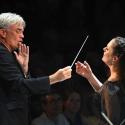
Valentine’s Day was only a week gone when the BBC Philharmonic gave us a programme on the theme of love. And the most haunting memory of it all was the gentle, song-inspired and highly original Viola Concerto by Cassandra Miller. It’s subtitled "I cannot love without trembling" and was played by this orchestra at the Proms under John Storgårds on 31 July 2024, by all accounts leaving everyone mesmerized. This time it was conducted by Ludovic Morlot, the orchestra’s Associate Artist, and again the soloist was Lawrence Power, who commissioned it (through his Viola Commissioning Circle, along with BBC Radio 3, Canada's National Arts Centre Orchestra, and the Scottish Chamber Orchestra).
The subtitle, and the headings Miller supplies to name the other four of its five sections, are quotations from Simone Weil. Its thought world is as much about sorrow as about love, about separation as about encounter, much of the music being the product of a compositional method Miller describes as “automatic singing” – in this case by herself singing along to the found material of the Greek violinist Alexis Zoumbas’ recording of a style of improvisatory funeral lament from his homeland. That’s the technical description of how it came about – and the “keening gestures and flickering flame-like ornamentation” of its origin, and indeed the very phenomenon of “trembling”, in a musical sense (tremolos, tremolandi, trills), are omnipresent in the music – but in many ways its greatest appeal is its underlying simplicity.
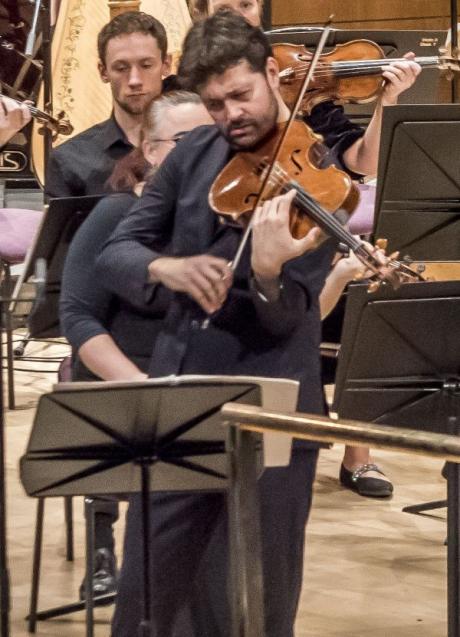
Everything (except for the brief Cadenza passage very near the end) is stillness and stasis; there are drone effects of many kinds; textures are slowly thickened and thinned; some parts of the orchestra (woodwind in particular) intone long, sustained notes; others ruminate chordally like tolling bells – and there are real chime bells tolling, too – while the solo is hesitant to make itself felt until it asserts a long, melodic song. There’s a dramatic emergence of the brass, fading to a distant rumble of bass drum, and the viola contributes its own tolling though repeated pizzicati amid its song. Only in that Cadenza do we hear something more like a virtuoso display as in most string instrument concertos, and it is rounded off quite quickly by a brass Amen. In short, this concerto is unlike anything else in its genre, and utterly bewitching. Lawrence Power (pictured above) was completely at home in its language, radiating the warmth of his instrument’s singing tone, rarely self-displaying yet in full possession of the technical skills involved.
The concert was introduced by another portrait of love entirely: the first of excerpts from Berg’s opera Lulu that he compiled as “Symphonic pieces from…”. Its title of Rondo might seem odd without the addition of the complete description (“Andante und Hymne”), so what you get is a slow-pulsed introduction in that signature texture of lush orchestral writing that seems, for all its atonal foundation, to be a hair’s breadth away from the extremes of chromatic Expressionism, followed, after a brief outburst of rhythmic energy, by a grandiose and deeply-breathed, swaying and anthemic sequence, subsiding into something very like tonality and relaxation. This is natural territory for the BBC Philharmonic, and under Morlot’s guiding hand they gave it all the richness he could ask for, with some distinguished solo playing from principal clarinet John Bradbury, leader Zoë Beyers, principal cello Peter Dixon and several others.
That was one kind of music from the mid-1930s: another altogether was Prokoviev’s ballet score for Romeo and Juliet. Rather than use any of the suites Prokoviev made himself, this programme gave us a potted version of the ballet scenario, briefly excerpting from the opening scenes (a pounding and jolly Morning Dance) before moving to young Juliet’s introduction (spikily busy and dreamily romantic), the Knights’ Dance from the Capulets’ ball (that’s the one now used for The Apprentice on TV – resonant and ponderous) and the Balcony Scene and the amorous encounter that follows.
The duel between Tybalt and Mercutio and the deaths of both Mercutio and Tybalt – the entire scene that closes Act Two – were truly exciting, with Romeo’s adrenalin rush fully realized as he avenges his friend, and an emphatic barrage of timpani and percussion at its close. We moved on to the searing chords that introduce Act Three, and finally the funeral scene for Juliet and her recovery and suicide. Such sweet sorrow is wrapped into that music – and indeed in the entire score.
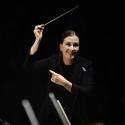
Ludovic Morlot is a conductor who seems able to draw out the goodwill of those who play for him, perhaps even more than most, and it shows in the results. We heard him conduct the BBC Philharmonic just a year ago in a programme that concluded with Ravel’s complete score of the ballet Ma Mere L’Oye, which was rewarding in its realization of a different world of fantasy and imagination.
But ballet music without the dancing is always a strange experience: what can be experienced is the sheer opulence of the writing when heard from a full orchestra itself centre-stage. It brought back the memory of meeting Galina Ulanova, the original Juliet, who as an elderly figurehead of the Bolshoi Ballet came over here with them in their post-Cold War tour. I wanted to ask her what Prokoviev was like as a dancer himself (as the story goes that she had to take to the floor with him at the after-show party on the first night of Romeo and Juliet, in keeping with Russian tradition), but she didn’t understand a word of English. Her answer to every translated question was that everything was “khorosho” – “Very nice”. As a child of the Stalin era, she knew better than to say what she really felt.
· To be broadcast on Radio 3 on 25 March