

It’s hard enough to sell tickets for any concert of classical music these days, let alone one that features mostly contemporary music; yet in this week’s offering from the Scottish Chamber Orchestra, featuring six recently written works, none of which could be described as familiar, there was hardly a seat to be had in Edinburgh’s Queen’s Hall. Why?
If there was any justice then it would at least in part be down to the quality of the orchestral playing, which is normally a given from this crew. And, indeed, the orchestra sounded terrific in Anna Clyne’s Sound and Fury, a piece written for them in 2019 while Clyne was their Associate Composer. With Shakespeare and Haydn as its twin inspirations, it takes two giants of western art and refracts them through Clyne’s very personal prism.
The result is a razor-sharp whirligig of energy, bookending big blocks of chords and solemn foundational melodies, against which a soliloquy from Macbeth is heard over what feels like a secular hymnody. It’s exciting, even if its material perhaps goes through one or two permutations too many, and conductor Ben Glassberg conducted it as though he knew it like a seasoned pro.
The SCO played it brilliantly – as well they should: it’s theirs! – and the string section alone sounded marvellous in George Walker’s gorgeously soft Lyric for Strings and Caroline Shaw’s throbbing, shuddering Entr’acte, its fragments disintegrating and re-forming like dust around a candle flame.
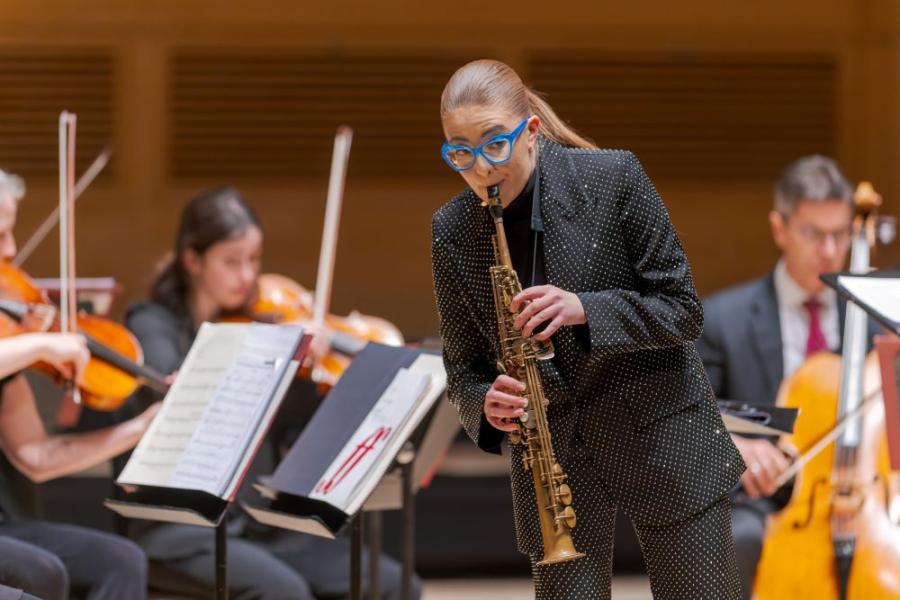
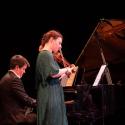
But the playing is this good every week, so maybe the sell-out was down to some star power from the guest soloist: saxophonist Jess Gillam. She’s a veritable geyser of musical energy on stage, and when she played two pieces written for her, she was unstoppable. One of those was written by her teacher, John Harle, whose Rant! seemed like an affectionate opportunity to show off all that his star pupil was capable of, with whirring fingerwork, bouncy melodies, and a delightful feeling that the sax was dancing with the orchestra. That also came out in Dave Heath’s The Celtic, a lovely sax concerto that celebrates his time in Scotland once he had moved on to London. It skirled, it swung, and it revelled in the unusual balance of sax and strings.
Finest of all, however, was the other piece written for Gillam: Dani Howard’s Saxophone Concerto which balanced the orchestra’s optimistic quasi-minimalist chuggings against the sax’s floated, long-breathed singing voice. The concerto is a portrait of Adolphe Sax, but it feels like a portrait of Gillam too, tapping into her infectious energy, particularly in the finale where the sax throws caution aside and joins in the whirlwind.
Maybe the third reason for the concert’s success was that all of the music was cleverly constructed but broadly tonal and warmly accessible, and it worked as a set, expertly curated as well as expertly played. Other concert planners could learn a lot from it.







Add comment