

Lise Davidsen: Live at the Met Lise Davidsen (soprano) James Baillieu (piano) (Decca)
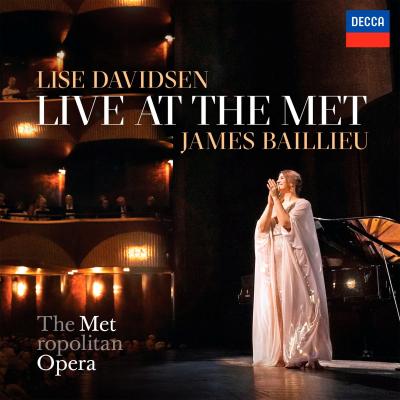
This really is Lise Davidsen’s moment. At the time of writing, the singer often described “greatest dramatic soprano in the world” has just performed the opening night of a run of performances at the Metropolitan Opera as Isolde. She made her house debut in 2019 (as Lisa in The Queen of Spades) and has been frequently welcomed back: this is her ninth different role in a house which she is starting to call it her second home. The current production of Tristan und Isolde is a major event, completely sold out...the run has been extended. In the days running up to the big first night, Decca cunningly released this album, a live recording of a song recital she did there in 2023 at the instigation of Peter Gelb, General Manager of the Met.
Davidsen certainly rises to the big occasion, and there are many moments to savour from this very great voice, whether giving us hushed and luxuriantly long phrasing in Richard Strauss’s “Morgen” or Schubert’s “Litanei auf das Fest Allerseelen”, or the ratcheting up of intensity in “Dich, teure Halle” from Wagner’s Tannhäuser, the aria which made jaws drop and her first prize inevitable at the Operalia competition in 2015. In the last of her Sibelius songs, “Svarta rosor” the full glory of her voice is unleashed. And at the end of the recital, Davidsen is totally in her element singing in her native language in Grieg’s song “Våren” (last spring). This song was also on Davidsen’s very fine 2022 album of songs by Grieg with Leif Ove Andsnes, although Davidsen curiously chose to take it down a semitone for the Met.
Live on this album definitely means live. There is a real sense of the big occasion, right from the opening “Vissi d’arte” from Tosca. Each group of songs is followed by ecstatic and loud bursts of applause - these clearly will have gone on for longer in the hall, but the engineers have snipped them to about 6-7 seconds each. The audience is quiet and attentive during the performance, apart from some mercifully brief and very erratic rhythmic clapping – the singer encouraged it – drowning the piano in “Heia, in den Bergen” from Kálmán’s Die Csárdásfürstin, near the end of the programme.
There are moments when the whole idea of performing a song recital in that vast spaces of the 3800-seater Met can start to feel counter-intuitive. Beverley Sills is supposed to have said that “you don’t sing at the Met, you project across an ocean”. With almost double the capacity of the Royal Opera, Palais Garnier or La Scala, it really is a space which makes its own demands. Davidsen’s Schubert “Gretchen am Spinnrade” has the kind of intensity builds which are necessary to make any impact on concertgoers far away in the Met’s “Family Circle”, but probably wouldn’t be attempted anywhere else. That thought serves as a reminder that Davidsen will be performing Schubert in concerts at the Wigmore Hall in late May this year, again with James Baillieu. His thoughtful way of pacing Schubert is ideal, and would whet the appetite – if the concerts hadn’t already briskly sold out before public booking opened. Seb Scotney
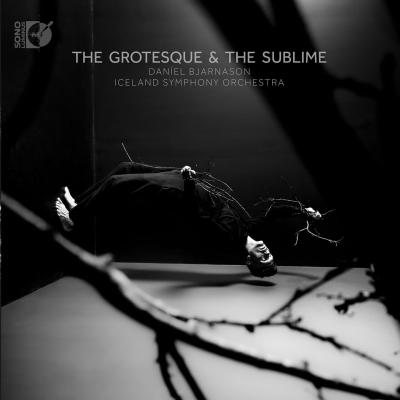
Daníel Bjarnason: The Grotesque & The Sublime Iceland Symphony Orchestra/Daniel Bjarnason (Sono Luminus)
Andrew Mellor’s sleeve note to this beautifully presented album cheekily alludes to “the slow, drone-lagged music of Icelandic archetype”. If you’ve ever encountered the work of Jón Leifs, or a contemporary masterpiece like Anna Thorvaldsdottir’s magnificent Metacosmos, you’ll know what he’s getting at, Mellor making the point that composer Daníel Bjarnason’s music is more eclectic in style. Try his Fragile Hope as a taster, this 15-minute orchestral work composed as a tribute to the late Jóhann Jóhannsson. It’s mesmerising stuff, the music’s slow progression from stygian gloom to bright light taking in a direct quote from Jóhannsson’s 2002 debut album Englabörn. This performance and recording is stunning, the dynamic extremes captured without strain. There’s a magical passage near the close, Bjarnason’s orchestra slowly winding down accompanied by barely audible chirping string harmonics. It's great: I need to hear this piece in concert.
Fragile Hope is placed between two of Bjarnason's large-scale concertante works. Feast is a seven-movement piano concerto taking inspiration from Edgar Allan Poe's The Masque of the Red Death; Poe's tale of a decadent prince's efforts to avoid a virulent plague tying in neatly to Bjarnason's desire to compose a piece reflecting the Covid-19 pandemic. This is a disturbing but exhilarating virtuoso work, beginning with a frenzied bacchanale (Poe's "voluptuous scene" and closing with the deaths of the prince and his guests. The closing processional is bleak, but this isn't a depressing work, Bjarnason's intention to give us "a reminder to savour life's banquet with fervour and abandon while we still can." Vikingur Olafsson gave the 2022 premiere under Esa-Pekka Salonen. The brilliant Frank Dupree is the soloist here; as first recordings go, this is about as definitive as it gets. Try him in the fifth movement's "one by one dropped the revellers", vainly pouring out his soul, Rachmaninov-style, while the world around him collapses.
There's also the Dante-inspired Inferno, a percussion concerto with "a focus on particular sound worlds, rather than a mad dash between many instruments". Those featured were in the collection of Martin Grubinger, the percussionist who commissioned the work. I had to search online to see what a txalaparta was, a pitchless idiophone ideal for suggesting Dante's underworld, its timbre in stark contrast to a marimba and orchestral tubular bells. It's another viscerally exciting work, valiant soloist Vivi Vassileva typically driving the orchestra along rather than fighting against it. I love the queasy timpani rolls at the start of "A Passage", and listen out for the luminous string theme which fails to take wing before a very dour conclusion. This album is already pencilled in on my 'Best of 2026' list. It's magnificently recorded in Reykjavik's Harpa Concert Hall and comes with a bonus Blu-ray audio disc. Buy it...
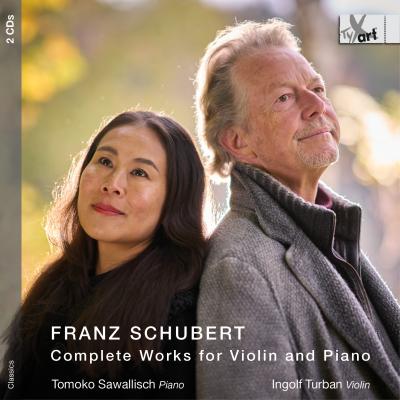
Schubert: Complete Works for Violin and Piano Ingolf Turban (violin), Tomoko Sawallisch (piano) (TYXArt)
To spend two hours in the company of the very greatest of melodists...what’s not to like? I have found myself going back to this two-disc set for pleasure, a lot. The first disc consists of the three sonatas (a.k.a. Sonatinas) from March and April 1816. The second, recorded a year later, is made up of the “Grand Duo” from 1817, the “Rondeau Brillant” from 1826 and the “Fantasie” from 1827.
There is a wonderful honesty and clarity about the playing of Munich-born and Munich-based violinist Ingolf Turban and Japanese-born pianist Tomoko Sawallisch. The violinist is alive to the implications of every mood-shift and modulation, always guiding the listener with subtle lightening or darkening of the tone. For a sample, try the beautifully paced opening movement of the A major Sonata D.574. The way the pair pace the movement, let the story unfold, let the listener marvel at Schubert’s constantly fresh melodic invention...it’s a complete delight, just beautiful playing throughout.
If Turban isn’t better known internationally, it’s because the cultural life of his native city is so strong. His story is that he was concertmaster of the Munich Philharmonic under Celibidache from the age of 21, then pursued a career as soloist, but has made his mark as a teacher, first for a decade in Stuttgart, and for he last two decades with a professorship and a class at the Hochschule in his native city. He has also recorded more than forty CDs. His duo partnership with Tomoko Sawallisch - who is also based in the Munich area, slightly further out - is well established. She is a very fine player. Her surname, incidentally, is from her marriage to a nephew of the conductor Wolfgang Sawallisch.
Andreas Ziegler of TYXArt has recorded the set beautifully, with a superbly natural balance. These days, Schubert playing which is more austere and less nourished might be fashionable, but Turban with his 1721 Strad and Sawallisch with her Steinway have given us a recording of these irresistible works which has real grace and nobility, and can be recommended. Seb Scotney
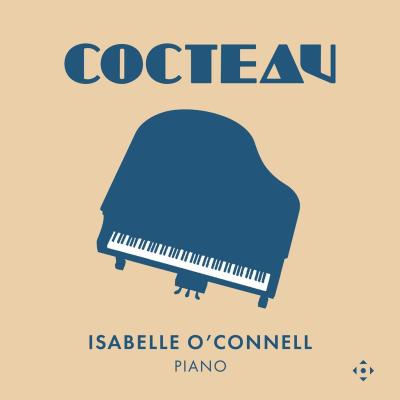
Cocteau Isabelle O’Connell (piano) (Divine Art)
This album was born from a Covid-time collaboration between pianist Isabelle O’Connell and composer Rhona Clarke, whose idea was to compose a set of pieces based on the drawings of French artist, filmmaker, novelist, and poet Jean Cocteau. For O’Connell, the obvious way to premiere this suite was alongside music by other composers inspired by Cocteau, which meant the music of Paris in the 1910s and 20s. The end result is an intriguing programme of some familiar and some unfamiliar pieces, alongside Clarke’s 26-minute piece, simply called Cocteau.
We kick off with the Erik Satie Rag-Time Parade from his 1917 ballet collaboration with Cocteau. I was, as they say, “today years old” when I discovered that it is an adaptation from Irving Berlin (Satie was never shy about borrowing) and O’Connell plays it straight, much in the same vein as Joshua Rifkin playing Joplin. Of the other Satie, the three Gnossiennes are very slow and statuesque, a very justifiable aesthetic interpretation, even if I prefer them to have some forward momentum. (The more famous Gymnopédies are included as a digital bonus, played in much the same way.) Rêverie de l’enfance de Pantagruel, originally an orchestral piece written for a Cocteau-organised concert, is not something I’ve heard before, O’Connell channelling Satie’s inscrutability well.
Of other composers in Cocteau’s orbit, we have Stravinsky’s Les Cinq Doigts, which is Igor at his most Satie-esque. These little pieces, supposedly for children learning the piano (has a child learning the piano ever played them?), have a faux-naïveté which O’Connell captures perfectly, not least in the penultimate “Vivo”. The Ragtime is a most peculiar thing if viewed as ragtime – the composer later called it “a concert portrait or snapshot of the genre” – and it benefits from O’Connell’s dancing whimsy.
Cocteau was the ringleader of the group of young Parisian composers dubbed “Les Six”. O’Connell next presents L’Album des Six, a book of short piano pieces, their only collaboration as a group. Perhaps the most striking pieces are Poulenc’s Cubist Valse and Germaine Tailleferre’s harmonically elusive Pastorale. Her the three miniatures earlier in the programme are also exquisite.
And then we get to Rhona Clarke’s suite. I had previously known her as a choral composer – her 2022 album Sempiternam is very good – but she started out as a pianist. The music of Cocteau is very unlike the music elsewhere on the album in its language, although it shares a mercurial and quirky quality. The pieces are more reflective and dense, not musically allusive, but deeply felt. “Antigone” has brooding chords amid fluttering decorations, the two movements called “Portrait” explore the vulnerable side of Cocteau, “Blood of a Poet” is an uneasy moto perpetuo and the cycle ends with “Oedipus”, an energetic and dramatic conclusion. Cocteau is a carefully put-together programme, with an excellent booklet and striking cover image, reflecting a successful composer-performer collaboration. Credit to Contemporary Music Centre in Dublin for bringing it about. Bernard Hughes
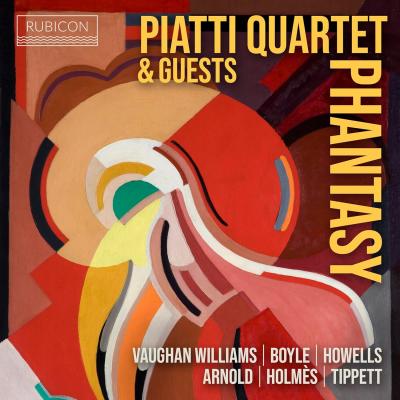
Phantasy Piatti Quartet & Guests (Rubicon)
The music patron Walter Cobbett singlehandedly made the “phantasy” a thing in early 20th century British music, by running a chamber music competition, with associated commissions, that briefly established this multi-sectional single-movement form of between 12 and 15 minutes in length. Lots of now-famous composers were recognised in the competition – both Herbert Howells and Malcolm Arnold were runners-up – and are heard on this Piatti Quartet disc alongside Vaughan Williams’s Phantasy Quintet, perhaps the best piece to come out of Cobbett’s project.
This dates from 1912, around the time of his immortal Fantasia on a Theme by Thomas Tallis and The Lark Ascending. The writing for string quintet – a standard quartet augmented with a second viola – has the same rapt quality, and if you like those pieces, you will like this. After the spacious “Prelude” there is a bustling scherzo in 7/8 that is reminiscent of Ravel’s String Quartet. The heart of the piece is the immensely touching “Alla Sarabanda”, with its distinctive modal harmony, very intimately played and close miked, so not a nuance is missed. And in the final bars of the “Burlesca” finale the Piattis find a rich viol-like sound, that nods back to the Tudor fantasias that inspired Cobbett.
I am less enamoured of Howells’ music than Vaughan Williams’s, and find his Fantasy String Quartet – the published score eschewed Cobbett’s preferred “ph” – less engaging, although played here as persuasively as it could be. Malcolm Arnold’s Vita Abundans, second placed in 1941 behind Ruth Gipps, is rather more the thing. The 19-year-old Arnold is already creatively fluent, the musical language is a world away from the warmth of the Vaughan Williams. Arnold’s piece is quizzical and quicksilver, with a bluesy harmony, the Piatti Quartet's playing edgy and spry.
The other pieces are a slightly odd mix. Irish composer Ina Boyle is only linked to Cobbett tangentially, and is represented here by two pieces for voice and quartet, James Gilchrist in Lament for Bion and Sharon Carty in Still Falls the Rain. The music is intense and the singing committed but I wasn’t sure why they were in the programme. This was even more the case with Augusta Holmès’s Noël d’Irlande, charming as it is. Likewise the squib that follows, Tippett’s In Memoriam Magistri, 30-seconds of music composed on the death of Stravinsky: it didn’t seem to belong. I would have rather heard Ruth Gipps prize-winning piece, or Imogen Holst’s, or Elizabeth Maconchy’s, rather than the Boyle, Holmès and Tippett, and maybe in preference to the Howells. Bernard Hughes
Kol Nidre Roman Mints (violin and viola) (Quartz)
Violinist Roman Mints recorded most of this release over a decade ago, the album first conceived as a gift for the soloist’s father and then put aside. Mints’ recent commissioning of a new arrangement of the Kol Nidre chant for saxophone and string quartet prompted him to finally finish the disc. That version, from composer Alexei Kurbatov, is the final item here. Listen blind and you’d think that the opening 30 seconds came from a rediscovered Bach passion setting, the soprano saxophone slotting in surprisingly well. Saxophonist-turned-composer John Zorn’s Kol Nidre contains neither saxophone nor Kol Nidre melody, his restrained seven-minute string quartet a succession of chorale fragments over a sustained low E on cello. Turn to the transcription made for violin and piano by Mikhail Erdenko to hear the melody in more conventional garb. Erdenko, a Russian from a Romany background, dedicated his setting to the memory of his friend Leo Tolstoy, recalling that the elderly author would ask him to “make an old man cry… play Kol Nidrei!”
There’s a pithy but appealing Suite for Violin and Piano by Alexander Veprik (1899-1958), his assimilation of Jewish themes modelled on Bartók’s use of folk material. The second movement “Barocco” is a real earworm, sparkily played by Mints and pianist Katya Apekisheva. Kesenia Bashmet accompanies Mints in the Erdenko and in two pieces by Bloch, Abodah especially involving. Elena Langer’s The Prayer, scored for male choir and solo violin, is the most striking thing here, Mints’ keening solo line responding to a sonorous choral backdrop. The performances, taped between 2006 and 2025 in a variety of venues, are consistently communicative and intense.




Add comment