

Why are the Irish such good storytellers? The historical perspective is that the oral tradition goes way, way back, allied to the gift of the gab. On the psychological level, is it partly an evasion, an escape from telling the truth about oneself? The transition from fantasy to honesty in Conor McPherson’s first play of 1997, so much better than his latest, suggests as much.
This new staging of a long-running hit, directed, like that well-acted disappointment The Brightening Air, by the playwright, sustains the atmosphere of curious meetings in a rural Irish pub saloon (perfectly designed by Rae Smith) all the way through to the quiet coda. McPherson’s inspiration was his grandfather Jack, who lived near the river Shannon in a tiny Leitrim hamlet with a weir and a fairy fort. So The Weir has an authenticity akin to Brian Friel's Dancing at Lughnasa. The essence, of an outsider changing an insular group, is similar to that of Enda Walsh's The Walworth Farce and The New Electric Ballroom, but without that genius's strangeness, despite the supernatural element. 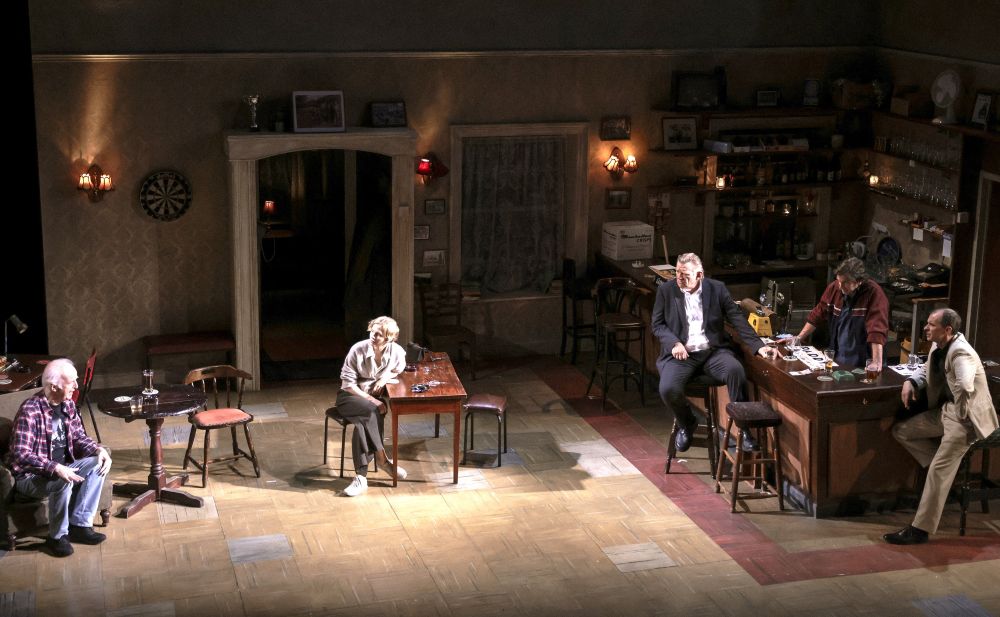 There are three outstanding performances, actually four if you also count Owen McDonnell as the barman Brendan, who regrettably is the only one of the five not to tell a tale (you hope he’ll reveal more, but that he doesn’t is part of his laconic nature). Brendan Gleeson as weathered loner Jack gets the most lines, but though inevitably the publicity is built around him, the other fleshcreep story spinners rivet the attention just as surely.
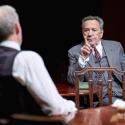
They’re well contrasted. Gleeson’s Jack is often the quiet man, but threatens to explode at times; Seán McGinley is the real oddball, Jim, whose quality of seemingly vacant stillness is remarkable, and who gets the funniest reaction in the play, to outsider Valerie’s narration (the audience laughed very loud at a lot, which at least suggested McPherson and his performers had them in the palms of their hands). The virtuoso showoffery belongs to Tom Vaughan-Lawlor’s Finbar, whom the others regard as having made it big outside their tiny confines, his jigs and comic turns masking a melancholy which pervades the play. (McGinley and Vaughan-Lawlor pictured below).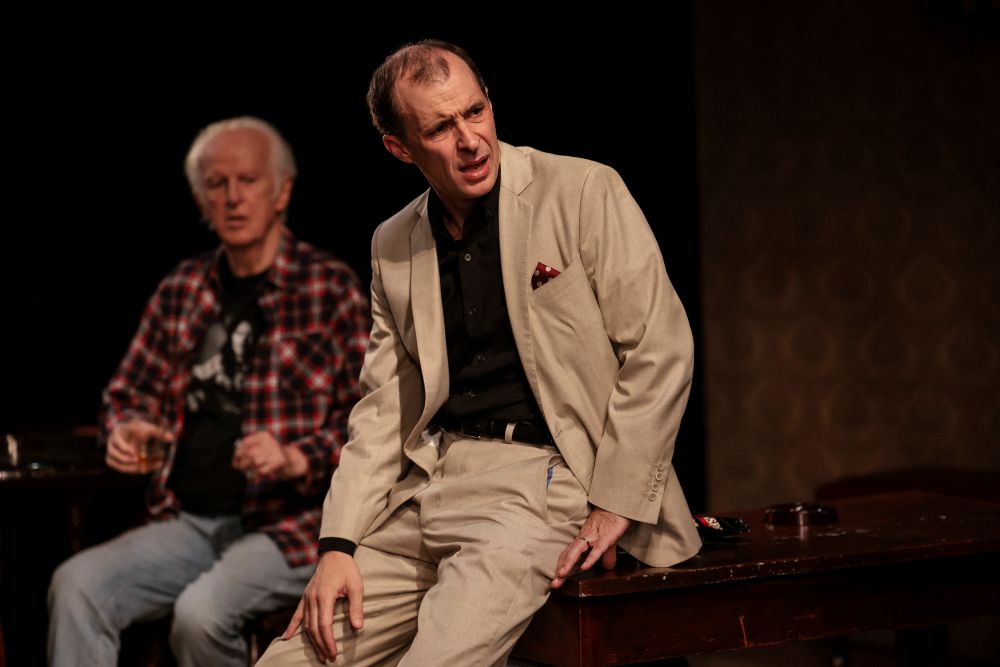 Finbar has brought to the pub newcomer and refugee from Dublin Valerie, whose presence will eventually shift the mood. Kate Phillips has a luminous presence and her reactions to the three ghost stories are very watchable. But her own speech, which brings the personal to the supernatural, isn’t as real as it could be; I felt the potential for tears, but Phillips’ delivery kept them at an arm’s length, which has nothing to do with the difficulties of sustaining a Dublin accent. So the catalyst for a change of sorts isn’t as strong as it could be.
Gleeson restores it as Jack opens up, and the slow diminuendo to a peace and a hope of sorts is beautifully gauged (congratulations to McPherson for not introducing any music, sentimental or otherwise, after the burst of Strauss’s Fourth Last Song on the radio at the beginning). Nothing obscures the fact that this is the Irish classic so many recent comers have wanted, and failed, to be.


Add comment