

Dublin theatregoers have been inundated with Irish family gatherings concealing secrets or half-buried sorrows, mixing “bog gothic” with very real horrors. Clearly they’re willing to try again with Jez Butterworth’s The Ferryman, because its run has just been extended. The vanishings familiar to Butterworth’s wife Laura Donnelly, whose uncle was among the disappeared, still resonate, as a programme article by Sandra Peake, CEO of WAVE Trauma Centre, reinforces.
In the London premiere (vividly reviewed on theartsdesk by Aleks Sierz), Donnelly played Caitlin Carney, who along with son Oisin has waited 10 years to know of the fate of her husband and Oisin's father Séamus (the play tells us at the start that he's been shot in the back of the head as an informer by the IRA and buried in a bog). The cast here is completely new, the direction by Andrew Flynn solid if a little overblown in the denouement (no music needed at this point, though whether it's unduly melodramatic would take another production to tell). Various lures have been made in the publicity: live goose, rabbit, baby – and special billing for Niall Buggy, a national treasure. He deserves it: Uncle Patrick Carney, alcoholic and self-taught classicist, holds us captive with his quieter tale-tellings, crucially so when it comes to Charon in Aeneas's visit to the underworld and the souls crying out to be carried across. 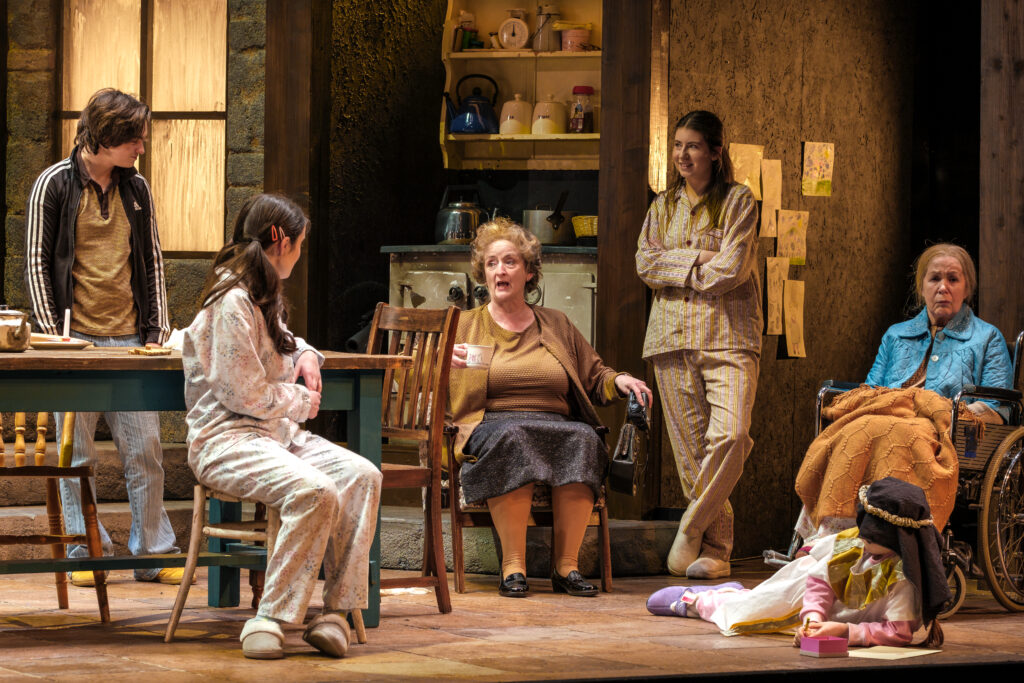 The equivalents to Rooster Byron's taller stories in Jerusalem are shared between the three elders: of the other two, Anna Healy is rivetingly good as Aunt Patricia, scarred by the 1916 uprising and its aftermath, venomously Republican and triggered at one point to a foul-mouthed tirade which is one of the evening's highlights (Healy pictured above centre), while Brid Ní Neachtain's Aunt Maggie Faraway (above on the right) snaps out of her immobile dementia at the beginning of Act Two to recount the past to the younger Carney girls (all excellent).
What sustains Butterworth's roving narrative is the balance between the vivacity of the gatherings, culminating in a brilliantly-staged romp to The Undertones’ “Teenage Kicks” – the more traditional numbers were recognised by many in the audience, who sang along – and the tense monologues or confrontations. Act Three extends the scope as we learn more about current associations with the IRA by one of the Corcoran brothers, who've come to the farm in County Armagh to help with the harvest: this is an ensemble scene of an unexpected nature, well shared between Dane Whyte-O'Hara (Shane), Ely Solan (Declan) and Diarmaid (James Murphy). Joe Hanley sustains the thin line between pathos and creepiness as English neighbour Tom Kettle welcomed – fatally, as it will turn out – into the family. Sarah Morris is note-perfect as brooding Quinn's hypochondriac wife, but there are just a few false notes from Charlene McKenna as Caitlin, and I don't know if it's a fault of Aaron McCusker that Quinn himself, a decent man driven close to madness by the vanishing of his brother, doesn't feel like a fully-rounded character. 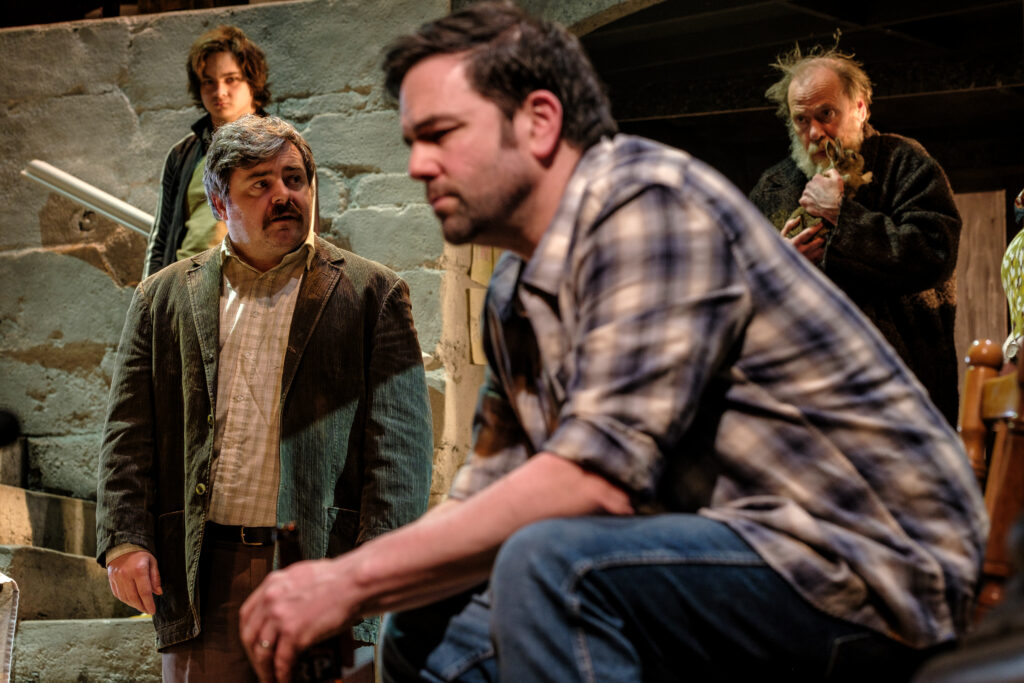 The dark undertow which will briefly be forgotten in the lively exchanges of the extended family is established right at the start by Colm O'Brien's troubled Father Horrigan, clear in every word as some members of the cast are not, and by the iron fist in velvet glove of Laurence Kinlan's IRA shot-caller Muldoon (pictured above second from left with Orén Kinlan as Oisin, Aaron McCusker as Quinn and Joe Hanley as Tom). It's still a remarkable group achievement, and a resonant, far-reaching play which should weather the passing years.

Add comment