

The best thrillers have not one, but two twists. Often, there’s a predictable twist, and an unpredictable one. So it is with The Guilty, Chloë Moss’s adaptation for the stage of the 2021 film of the same name by Antoine Fuqua, starring Jake Gyllenhaal, which is itself an English version of the 2018 Danish original, Den Skyldige, by Gustav Möller and Emil Nygaard Albertsen. Currently playing at the Donmar Warehouse, it’s a 60-minute monologue performed with compelling intensity by Russell Tovey. As with all the finest thrillers, it constantly keeps us guessing, asking what’s next?
The set up is simple: Joe is a police control room operator, an emergency call handler, suspended from his usual job as a police officer and facing a disciplinary hearing the following day. As he nears the end of his shift, answering 999 calls, his tension about what will happen at the hearing is as palpable as his boredom with being stuck in an office. Recently separated from his wife and six-year daughter Freya, his mind is under barely tolerable stress. So what’s next?
“Yes I can help you – that’s what I’m here for.” At first, Joe deals coolly with some straightforward emergencies, such as talking down a freaked-out teen who’s taken ketamine; then he advises a woman who’s witnessed a car accident to move away from the spilt petrol; then he finds out that a caller who’s been robbed was in a car with a sex worker; then he sneers at a middle-class woman who can’t sleep because of a noisy party next door… No, not very nice. But yes, maybe she should call the council. Not 999. Yet this can’t be all, so what’s next?
“So what’s your emergency?” Next, Joe doesn’t have to ask: he gets a call from a woman called Emily who’s been abducted by her estranged partner in a van, and, because he’s armed with a knife, she pretends she’s talking to their daughter. Abby’s six and she’s home alone. OMG. What next? Ah yes, there’s also another child, a baby. Oliver. So Emily’s in danger and her kids are all alone.
Joe now makes some good decisions and some bad ones. He directs his cop colleagues to chase the van, finds out about its owner, then requests some other officers to go and make sure Abby is okay, and then sends another fellow officer, a personal friend, to take a quiet look at the man’s flat. All the time, he and we assume we know exactly what’s going on. So what’s next?
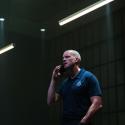
Well, time to admire the acting. As the tension rises, heart rate rising and clammy palms, crop-haired Tovey delivers an acting masterclass, eliciting our sympathy as he deals with time-wasters, then plugging right into our sense of justice as he throws himself into hero mode, determined to save Emily, and to help her kids. We can share his irritation with colleagues who work by the book, and are unwilling to break the rules. Clearly, we imagine, if we were in trouble we’d welcome him as a saviour. Or would we? So what’s next?
The rising anxiety and gut-tightening narrative is fast, but still gives us time to think about toxic masculinity, violence against women and the danger that family break-up poses for children. Other themes such as sclerotic police procedure, the camaraderie of male colleagues, who cover up each other’s blunders, are implicitly articulated. Likewise, the play’s title invites us to think about Joe’s guilt, to speculate on what he’s done on the job, and at home. And how guilty are the other offstage characters? What does guilt mean anyway? But nothing is examined in depth: it’s a thriller after all. So what’s next?
Time to admire the writing. Moss not only delivers a fast-paced narrative, with Joe jumping out of his chair and prowling a dark, dusty and drab office, but also uses language that sounds perfectly contemporary, leading us to believe entirely in what both Joe and his callers, whose voices alone enable us to make assumptions about them, are saying. Which make the two plot twists all the more surprising. So what’s next?
Time to admire the directing. It’s by Felix Barrett of Punchdrunk, the site-specific theatre company, and he – along with designer Alex Eales and sound maestro Gareth Fry – have created an approximately immersive experience. The darkly brooding stage atmosphere, lit up by red lights as the calls come in, and stuttering overhead lighting, forces us to feel the claustrophobia of this partially abandoned office. Yes, it’s intense. Spine-chilling. So what’s next?
Well, you can see that, like some Harlan Coben thriller, this is an exciting show, but it has to be said that it’s also a bit preposterous. If you’re a cop on a disciplinary charge you get sent home. You’d don’t get to work on calls. Especially not alone in an office. And neither would your colleagues put up with being bossed around. Like so many television and film cop shows, you really need to suspend your disbelief here.
And then there are a couple of meta-theatrical flourishes at the end of the show. The first is a kind onstage reveal that forces you to question everything in the plot. And even in the production. Nerve-fraying. The second happens on the way out – you get handed a card saying, “Shh… no spoilers, please.” After that, there’s nothing next. Except the tube home.





Add comment