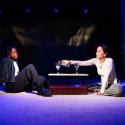
Queerness is subversive – it dissolves gender binaries. You know the kind of thing: male/female, straight/gay, married/single, fixed/fluid. Likewise, queer theatre typically calls into question all the genre norms: comedy/tragedy, naturalism/symbolism, everyday story/tale of horror. In Eleanor Tindall’s haunting play, Tender – which returns to the main stage of the Bush Theatre a couple of years after premiering there in the studio – the usual conventions of both gender and theatre are challenged in a passionate love story. Is it a queer romance? Body horror? Haunted house? Who cares? Not me, because it’s great.
Set in a recognizable London of high rents and temporary jobs, the play focuses on two women: Ash, a receptionist, has just moved into a cheap place on one side of the metropolis, and finds she can hear odd sounds coming from the walls. Since she’s actively avoiding a former boyfriend, who seems to be stalking her, this might just be a delusion. Or is It? When she meets Ivy, who works in a coffee shop and lives with her boyfriend Max, and is constantly providing emotional support for her brother Cas, the two women are drawn to each other. Ash has chosen now to date women, and there’s a quietly sad incident in which things doesn’t go to plan. But what about Ivy? How sexual is her attraction to Ash?
This beautifully written play is full of ambiguity. Its keynote is the question “Or is it?”. Ash is gay, and that’s a fact: or is it? Ivy is straight, and that’s clear: or is it? Ash lives in a room which has witnessed unspeakable events: or has it? Both Cas and Max are men who like to control women: or are they? At the centre of the play there’s a brilliant coincidence: or is it? Like some coincidences, it actually shows how two individuals can feel drawn together by forces that neither fully understands. In this case, it’s a pull which involves a slight suggest of incest, as if the genetic make-up of two very different people might be equally attractive to a lost soul.
Tindall’s writing is poetic from the start: Ivy remembers a time when she was a teenager who wanted to “cut parts of myself out and hide them in the walls of my bedroom”, and this visceral metaphoric tone recurs throughout the piece. By the time she meets Ash she spurts blood, a kind of body horror motif that suggests obvious connotations of menstruation, as well as other physical anxieties about revealing the intimate sensations of being a woman. Blood also implies violence, and both Ivy and Ash are, at various moments, threatened and fearful. Blood relatives play a big part in their story. Ivy’s a vegetarian, and so is disgusted by Max’s bringing home of meat: or is she attracted to its forbidden rawness?
The haunted room in which Ash lives is a symbol of her loneliness, and remains a disquieting presence whenever her search for female love runs into a problem. For if Tindall uses a lot of metaphors, and ambiguity, she also writes with really deep feeling, showing the awkwardness of physical attraction, of sex, and perceptively giving us situations that are full of emotional truth. Ivy experiences sex with Max, who she has been with for four years, as a heavy burden. Almost suffocating. Waking one morning which his large arm across her body, she struggles to free herself. And Ash is on the run from a man she’s clearly afraid of. So she sees him everywhere. Haunting.
The play’s title describes not only the gentleness of fresh physical love between two women, but also the painful bruising of violence. Repeated images of desire, as well as suggestions of cannibalism, even self-cannibalisation, create sensations of how the unconscious is peopled with strangeness, with surreality, with sadistic imaginings. Although the story ends on a lovely note of cautious optimism, the journey there is fraught with flashes of despair. And horror. Each of the women is in flux, looking for a way to be that feels right for them, despite the obstacles.
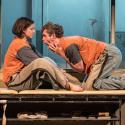
This thrilling production, directed again by Emily Aboud, is an 85-minute two-hander, with award-winner Francesca Amewudah-Rivers, who mainly plays Ash, also voicing both of the oppressive (or are they?) men. She has a confident stage presence that conceals her character’s vulnerabilities, but also shines with a glow of life’s happy places, as when she goes dancing or when we see her at work, helping other people. Nadi Kemp-Sayfi’s Ivy, by contrast, seems more restrained, yet soon also reveals the darkness in the heart, literally at one point, of her being. On a set designed by Alys Whitehead, who elegantly solves the problem of the spooky room, this is a compelling, brave and thoroughly enjoyable mash-up of preconceptions both theatrical and sexual. New writing at its best.