Water Colour ★★★★
Milly Sweeney’s powerful two-hander comes to one of the Fringe’s highest-profile venues bearing prestigious awards for new writing, and it’s not hard to see why it’s won them. Water Colour is a taut, focused, elegantly constructed creation that rather miraculously manages to be both poetic and bracingly vernacular, bristling with the distinctive rhythms of Glaswegian speech but unafraid to mull over matters of life and death, and the apparently arbitrary nature of both, with compassion and insight.
Haunted by school traumas, Esme is struggling to put paintbrush to canvas to complete her MA at the Glasgow School of Art. Harris, on the other hand, treated school as a joke, but has nonetheless landed himself a tidy job at one of the city’s poshest eating establishments. A chance encounter between both young people sets their lives criss-crossing on new and unexpected trajectories.
There’s no doubting the emotional power of Sweeney’s writing, nor the disarming blend of poetry and ruggedness in her often beautifully rendered writing. But it’s the very sculpted elegance of her dramatic construction – something that becomes increasingly evident as her 75-minute play progresses – that raises questions as to the intent and even the moral of her play. It’s hard to tell whether those are to suggest there’s some kind of Will Self-esque quantity theory of happiness, or simply that lives are governed by arbitrary forces. But – without giving away the play’s plotline – there’s a lingering feeling that structural inevitability may have trumped narrative authenticity.
That aside, however, Water Colour is a powerful and beautifully staged creation. Molly Geddes and Ryan J Mackay are thoroughly persuasive as the two young Glaswegians, in performances that are alive to Sweeney’s plentiful humour yet haunted by doubts and fragility. Director Sally Reid makes great play of Sweeney’s nifty dovetailing of scenes, and brings the writer’s dialogue thrillingly and often very amusingly alive. It’s rare, too, to see such evocative lighting as Adam Bowers’s, which almost forms part of the narrative at times in the shadows it throws across Natalie Fern’s graffiti-covered set. Associate director Steve Lauder-Russell’s movement genuinely adds depth to both characters, and Ross Brown’s atmospheric sound design fits the play’s gradually unfurling moods like a glove.
Water Colour is a captivating contemplation of young hopes and fears, and it packs a mighty emotional punch, as much through its narrative inevitability as through its moving storyline – even if there are lingering questions about the extent to which its form has dictated its content.
- Until 30 August
For Dolores ★★★★
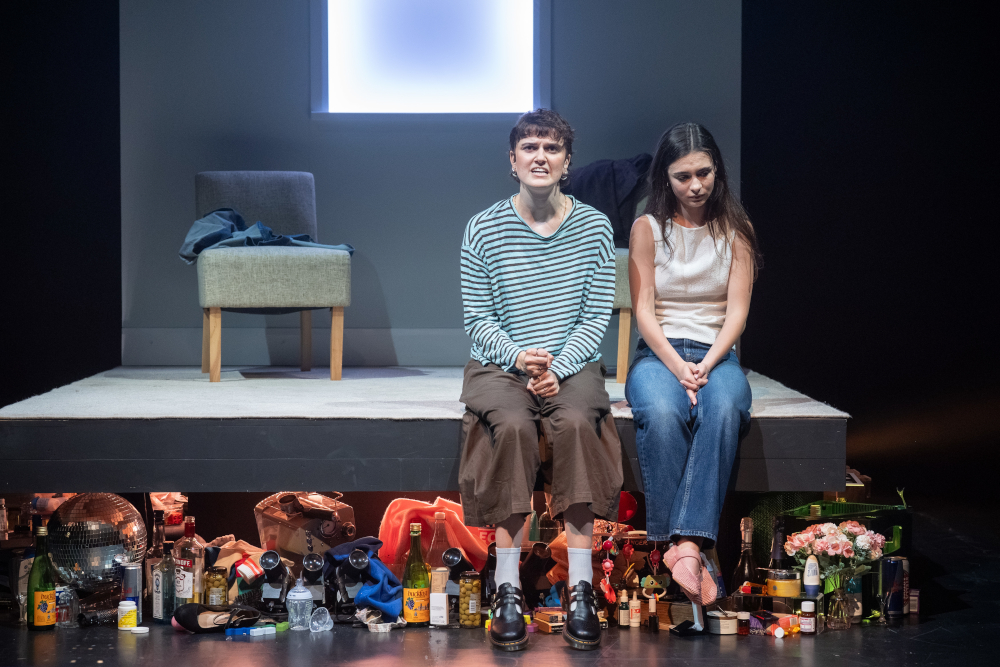
Another powerful and emotionally draining two-hander in the Traverse Theatre’s smaller space asks quite different questions to those of Water Colour. In the case of For Dolores from Dublin’s Fishamble theatre company, they’re issues of friendship, comradeship and obligation, of the point at which love curdles into hatred, and of the unshakeable bonds of connection maintained as much by shared suffering as by shared joy.
Irish Réaltín and Scottish Mo first meet in a broken-down lift during freshers’ week at Edinburgh University, but the bond that’s established between the two perhaps unlikely friends quickly feels unbreakable. That’s until Réaltín finds herself bewitched by the wealth and influence of a fellow student nicknamed Finland (you can probably guess why), and until Mo invites her Adonis-like younger brother to the young couple’s lavish engagement party.
To say more would spoil the shock developments in writer Eva O’Connor’s vibrant, gutsy script, though in truth the writer herself spills the beans on For Dolores’s twists surprisingly early on, casting something of a pall of inevitability over the fracturing or reconfiguring of Réaltín and Mo’s relationship. At times, knowing where we end up distracts from O’Connor’s careful, forensic dissection of Mo and Réaltín’s friendship by placing it within a what-happens-next thriller-like timeline. Nonetheless, her writing is sparky and brittle, and it’s brought vividly to life in Jim Culleton’s nimble direction. His two actors are just as vivid, Catriona Faint an imposing but fragile Mo, and Lara McDonnell all too aware of the horrible compromises Réaltín’s made for a potential life of luxury.
Whether O’Connor’s harrowing central story and her more sensitive and perceptive portrayal of the two young women’s ever-changing relationship pull in the same or opposite directions is up for discussion – certainly when the first provides surprises and thrills, while the second offers far quieter revelations. But For Dolores is a potent, compelling work that offers unflinching insights into the minutiae of relationships that we might otherwise prefer to leave unexamined.
Until 30 August
Badgers ★★★★
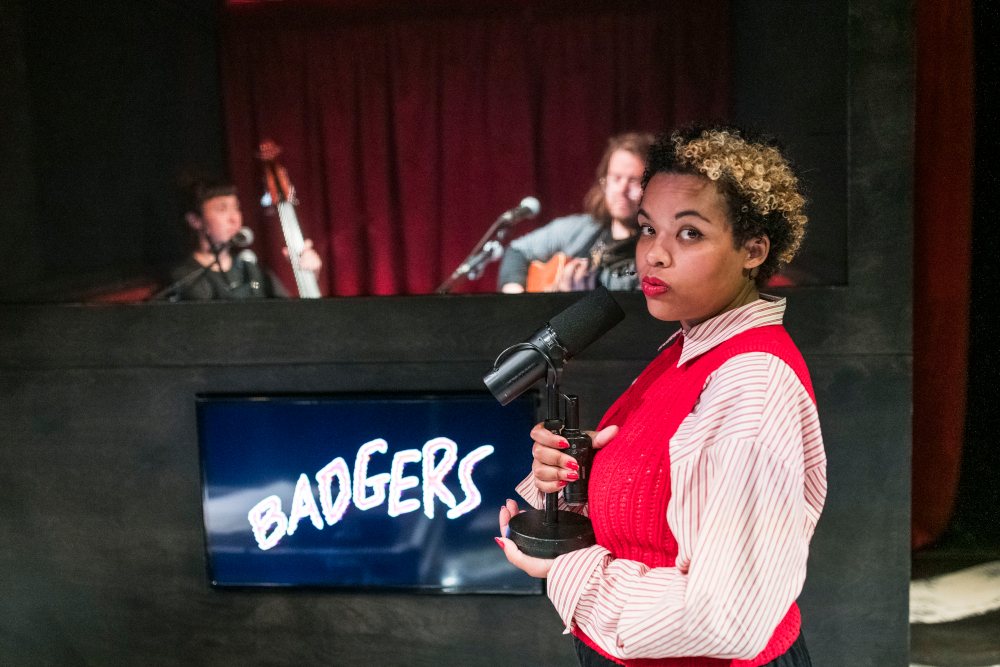
An elderly woman with a badger obsession, a musician’s mysterious disappearance, a song that has to power to – well, what that song can do is never entirely spelt out in Malaika Kegode’s eerie, bewitching folk horror-meets-gig theatre creation. It’s certainly one of the oddest offerings among the Traverse Theatre’s 2026 festival programme, but its strange magic and its woozy sense of suggestion nonetheless get thoroughly under the skin.
Kegode herself is all-powerful Storyteller in her weird and very English tale, turning off and on live musical accompaniment from Joe Williams and Beth Roberts in a centre-stage recording booth with a click of her ballpoint pen, and conversing with recorded testimonies from a whole cast of characters. Her story is about podcaster and wannabe influencer Meles, daughter of illustrious political journalist Dora, and the younger woman’s attempt to get to the bottom of what really happened when folk musician Ben vanished while recording an album in the rural property of the enigmatic Bridget Brock. Meles’s investigations grow ever more urgent as her mother’s health deteriorates, but can she really be sure of the truth of her discoveries?
While Kegode’s high-tech set up with mixing desk, recording booth and video displays brings a nicely modern-day sparkle to her tale of ancient forces, it also feels like new and old are pulling in opposite directions, and why this is a story that needs to be told in this way remains somewhat unresolved. There’s a similar question over combining a subplot of mental decline with one of arcane rural forces. Kegode is slightly softly spoken, too – a bit of a problem when multiple voices and music are competing for attention – but she’s a captivating presence nonetheless as she spins her ever stranger tale.
Badgers offers no pat answers to the questions it raises, suggesting instead that primal forces are ever with us, no matter how modern and squeaky-clean our lives. It’s a richly imagined, haunting creation, one whose delivery feels just as slippery and hard to fathom as the forces and events it describes.