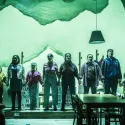
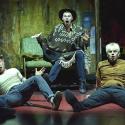
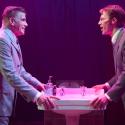
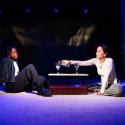
What would ol’ Shakey think of such liberties? Two plays that may or may not be a single narrative, which may or may not have a missing middle section, stitched together with a bit of text added here and a bit there. Then staged outside a toffs' school on Richmond Hill, far from the spit and sawdust of Southwark in every sense.
I'd conjecture - and maybe it’s wishful thinking, but The Bard certainly wasn’t precious with his work - that he’d have two questions above all others. Was the box office decent? Did the laughs land? Both would be answered to the actor-manager’s satisfaction.
No guarantees with conceits like this, but Tom Littler has plenty of form with this sort of caper at Orange Tree Theatre (co-producers with Guildford Shakespeare Company) so, taking one’s seat in the idyllic gardens of Thomas’s College on yet another worryingly glorious summer's day, we knew we were in safe hands.
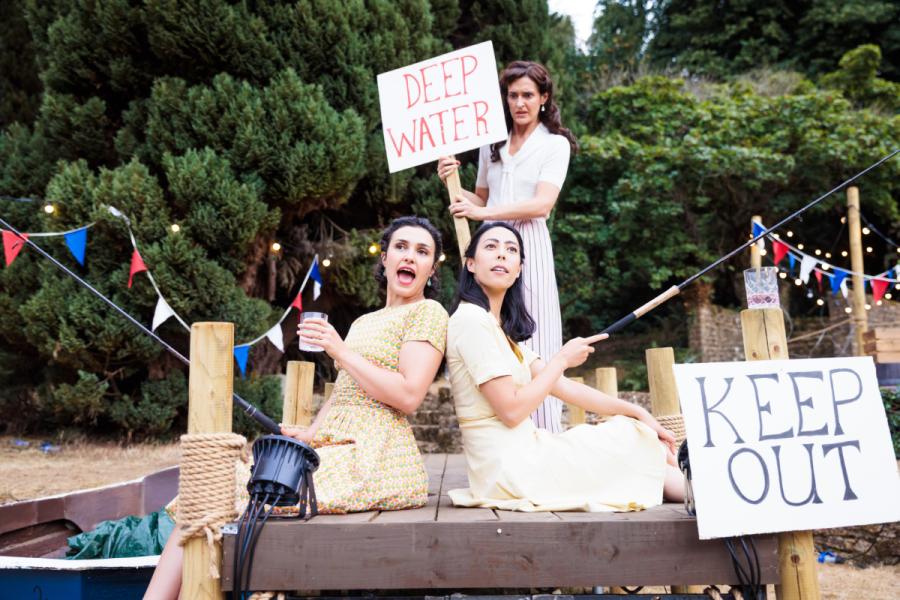
Taking the Saturday double header option, we kicked off with Love’s Labour’s Lost, immediately pitched into its Rupert the Bearish rhyming couplets. Without mics and with planes on final approach to Heathrow overhead, I feared for audibility, but it was a rare delight to simply receive the words without a moment’s strain - The Globe could learn a lot!
If the diction is superb, the line readings are even better, the verse rolling around the idyllic setting without any affectation at all. I sometimes wonder if it’s me who’s at fault so often in Shakespearean productions, failing to catch the iambic pentameter, a hostage to my lack of scholarship. And then you see a cast like this and you wonder what drama schools and directors are doing. Actors can indeed find the cadences and rhythms that tell so much of the stories in the canon, reveal, often in our subconscious, the true nature of characters and lend an unparalleled sheen to the English tongue. Nobody thinks it’s easy, but the sensitivity and hard work involved in mastering the speeches really pays off.
For all that, the company knows that the currency of comedy is laughter, and they milk the plays for all that they can. I do hope these productions will be captured on video because I can easily see them being the foundation for a thesis on the roots of 20th century popular British comedy. Too often, that phrase leads us back to pantomime and the commedia dell'arte or to French farce, but there’s an English tradition too.
Like those descriptions of wine that refer to all manner of sensations (citrus, ginger, caramel etc), I kept getting William S Gilbert, The Two Ronnies, Blackadder and, more than any other influence, the Carry-Ons. Of course, comedians have often excelled in Shakespeare, notably Ken Dodd, and I could not help but see Kenny and Sid, Babs and Joan and the rest of the gang playing these roles. That is a testament to the quality of the performances, of course!
The ensemble work across the two plays, set either side of World War II, the young bucks and giggling girlies of 1939 (LLL) back older, wiser, much more aware of time slipping through their fingers in 1946 (MAAN), actors staying with their characters. Inevitably, there’s a little shoehorning to make that happen, but the technical skills of the cast and creatives are such that the issue is never forced, nor does the balance tip too far from frivolity to melancholy.
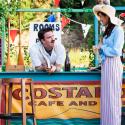
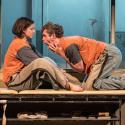
Naming standouts in a uniformly marvellous cast is to indulge in a non sequitur, but licence has been granted, I think. James Sheldon manages to be funny all afternoon and all evening as Benedick Berowne, his lightning wit put in the service of the cynical rejection of marriage in LLL, but leavened by combat into an understanding that it might be better to love and be loved come MAAN. Phoebe Pryce’s Beatrice (pictured above with Joëlle Brabban and Sally Cheng) goes on a similar journey, though from a less established base in the first play, fully coming into her own in the second. That neither actor is young lends both a poignancy to their reconciliation and the sense that the world itself was being renewed after much more violent disagreement than B and B’s verbal jousts.
If the relationship between those on-off lovers is the fulcrum on which the story turns, there are marvellously detailed performances circling them in both plays. Matt Pinches channels his inner Ronnie Barker as Dogberry the policeman, that stock comic character so often a chore to endure in Shakespeare, but a total delight here. Doubling, as many of the cast do, as the PTSD-afflicted John Longaville, he lends a more comprehensible motivation to his cruel betrayal of Hero (Joëlle Brabban) at the altar.
Speaking of television comedy, Robin Simpson goes full cod-Spanish Manuel as Don Adriano de Armado, an approach that could raise eyebrows in these censorious times, but it’s all done with such warmth and with the charm that suffuses the plays. One simply scoffs at the suggestion of such po-facedness. There are so many perfectly judged breaches of the fourth wall and well-judged raised eyebrows that we all know that we’re in on the joke and no harm is intended by the edge that must underpin comedy. And what was Shakespeare if not a bold celebrator of the power of transgression?
The set may be rudimentary, but all the context we need is provided by the costumes (by Neil Irish and Anett Black), absolutely beautiful to behold if, I suspect, something of a trial to wear if the heatwave continues. I am always delighted to be reminded of that wonderful musical Salad Days - and I was.
So a summer Saturday afternoon, spent laughing and, in the intervals, conversing with friends, the concerns of the world just a tap on the phone away - but never once was I tempted. Though today's horrors are not of the same order nor immediacy, I thought of those Elizabethans packing raucously into The Globe having dropped a penny in the box, while disease, squalor and threats of violence swirled around them in stinking London.
I suspect that they thought that laughter was the best medicine - I suspect they were not wrong.
- Love's Labour's Lost and Much Ado About Nothing at Orange Tree on the Hill until 22 August
- More theatre reviews on theartsdesk