

Violence against women – it’s horrible, and horribly familiar. Let’s make a list: everyday sexism, coercive control, physical attacks, mind games, casual cruelty, double standards, victim shaming, gaslighting, constant undermining, sexual manipulation, domestic abuse, gross neglect, femicide, grooming, harassment, unwanted touching, catcalling… It’s a long list, exhausting, but hardly exhaustive. So how can you dramatise this in a 90-minute play?
Award-winning playwright Sophie Swithinbank’s gruelling new drama, Sting, which is currently playing in the Young Vic’s studio space, takes its place in a long tradition of work fuelled by female rage. What’s new about it is that she chooses a very daring way of staging a familiar situation. Instead of writing a straight naturalistic drama, she deliberately creates a story full of bizarre details – turning the everyday into scenes where our sense of reality is put into question, stressed out. This is very unsettling because it forces the audience to shake off complacency, to question what is real, and yes, to challenge ourselves to pay attention. I call this way of storytelling the “Whaaat?” method.
So the plot goes a bit like this: 20-something Ash arrives for her new job at an historical archive after a sweaty night dancing, and she’s clearly still high. Whaaat? Her new boss, Lily is an academic researching misogyny and victim blaming from the 17th century to today, and helps Ash when she suffers a miscarriage on her first day. Whaaat? Dom, Ash’s boyfriend, happens to be a cop. Whaaat? When he beats her, Ash looks to Lily for help, and they are attracted to each other. Whaaat? Then Ash casually commits a really serious crime, and Dom offers to cover it up. Whaaat? She responds to his offer of marriage, and his threats, by magically directing a swarm of bees to sting him. Whaaat?
That last bit tells you where the play’s title comes from, and it also suggests the sting of a slap, or of a sharp insult. Lily’s research into historical cases of witchcraft, and her interest in a series of current local murders, allows Swithinbank to compare love bites to vampiric cuts, witches’ familiars with Pantalaimon (Lyra Belacqua’s dæmon in Philip Pullman’s His Dark Materials), and the name Ash chooses for her pet rabbit. A succubus is mentioned, Lily’s radio keeps picking up words from the airways, and at various points the women mishear what others are saying. Yes, it’s magic realism.
At the heart of the play are two passionate relationships: the perverse coupling of Ash and Dom, where he fights to keep control and she can’t quite break away, and the equally emotional meeting of Ash and Lily, with its tinge of erotic attraction. Dom not only represents control, but is also an example of how the police force attracts cruel men who use their power to repress and dominate women. In the play text, a note shows that recently 1,300 police officers and staff have been reported for domestic abuse over a five-year period: “Only 36 have been dismissed.”
So this is a campaigning play about women seizing the initiative and battling the abusive patriarchy, but its style is that of a crazy subjective nightmare, whose last 30 minutes become increasingly serious and fraught. It’s a brave way of tackling the serious subject of systemic injustice, and many scenes contain both tender moments (a gift of slippers with pom-poms) and wilder material (witchcraft and being brought up in a cult). For my taste, the effect is a bit too discombobulating, a bit too bizarre in its clash of elements, a bit too unreliable in its narration. Lily, for example, says she’s an expert helping the police with enquiries about ritually murdered women, and she manages to get photos of the victims, but is this credible?
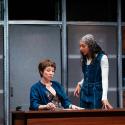
Still, Nancy Medina’s increasingly tense production gives life to Swithinbank’s perceptive writing, which thumbs its nose at sexist clichés, as when Dom is aghast that Lily and Ash are laughing together just after her miscarriage. As Ash says, “I can feel lots of different things at once.” Designer Debbie Duru’s traverse staging, with two claustrophobic walls of tall stacked shelving, uses simple furniture and a few blasts of haze to create an unsettling atmosphere, and the cast is excellent. Adelle Leonce’s slightly manic, but the also detailed performance, as the troubled Ash is instantly attention-grabbing, and neatly balanced by Phoebe Ladenburg’s more detached role as Lily. By contrast, Nick Blood’s Dom is sinister in his convincingly ordinary manipulative strength. He has power and he knows it. Sound designer Nicola T Chang’s high energy dance sequences are impactful, and punctuate the action. Whaaat a play!





Add comment