Scream’s commentary on and sly revival of the slasher genre was a phenomenon in the ironic Nineties. If any franchise is alive to the absurdity of six sequels it’s this one, where self-aware characters eagerly annotate evolving horror cliché. The latest “meta-slasher whodunnit”, though, as Scream (2022) handily had it, hasn’t put the requisite thought into justifying its existence.
Wes Craven's original trilogy boasted bravura comic-horrific opening scenes in Scream (1996) and Scream 2 (1997) and confidently opened out a sleazy Hollywood back-story in the Weinstein-produced Scream 3 (2000), sleek direction and a vigorous ensemble cast sweeping the slaughter along. Co-directors Matt Bettinelli-Olpin and Tyler Gillett and next gen leads Melissa Barrera and Jenna Ortega energised Scream (2022) and Scream VI (2023), before Barrera’s sacking for decrying Gaza genocide helped tear the new team apart. Original screenwriter Kevin Williamson thus returns for the first time since 2011 and directs, in a safety-first, legacy hire. With Neve Campbell back as heroine Sidney after skipping VI and early cast-members resurrected, we retreat to cautious fan-service.
The usual prologue returns to Greensboro, California and the home of half of the first Ghostface kill-team, Stu Macher (Matthew Lillard), last seen frying in the TV set Sidney dumped on his head. It’s now a shrine attracting a young couple who soon regret their inattention to Ghostface’s MO. The maniac’s transferrable identity beneath the Munchian mask is a strength and weakness, requiring increasingly Byzantine ties to the initial murders, rather than the mythic scope of Halloween’s enduring Michael Myers. As the pilgrimage site burns, Stu’s vengeful survival anyway seems a distinct possibility.
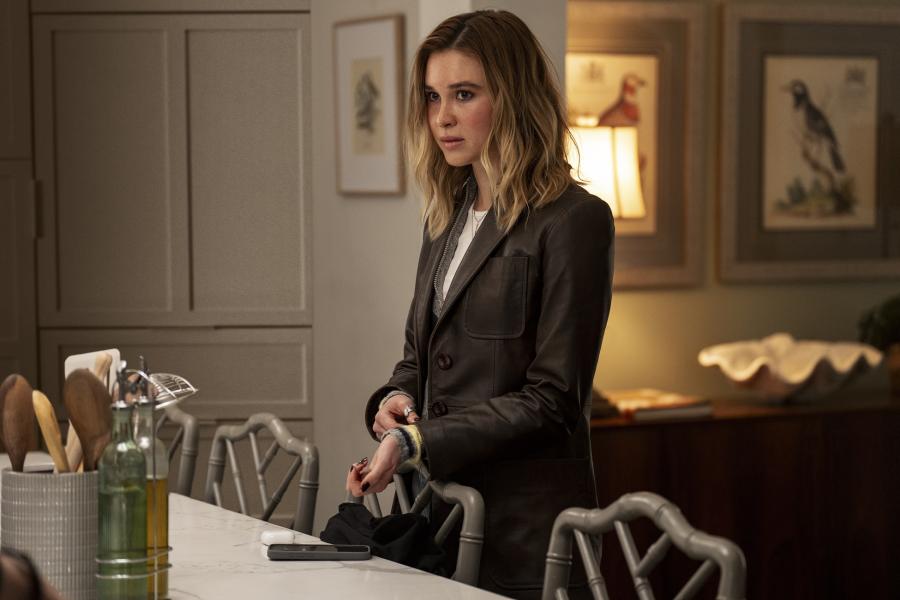
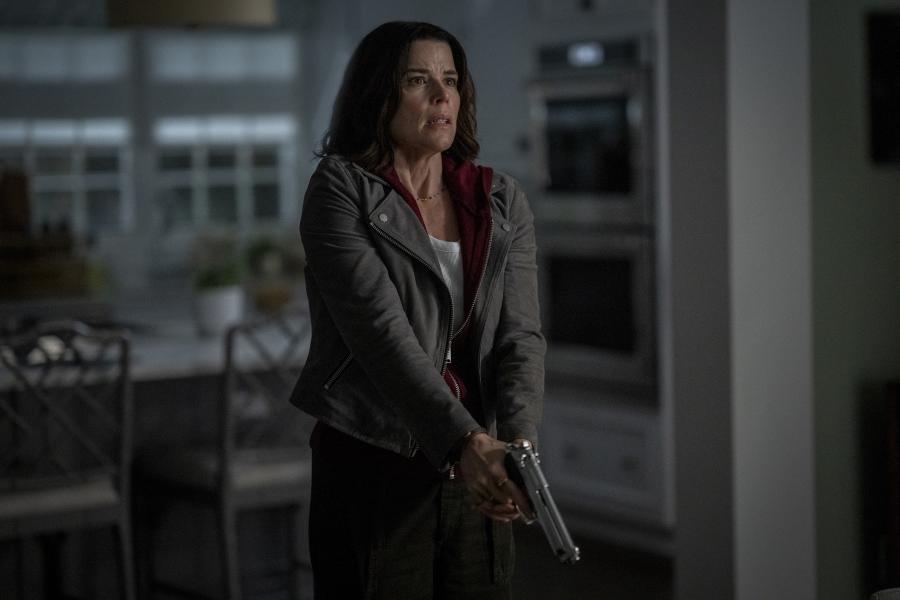
In the sole intriguing development, teen scream queen Campbell (pictured below), now plays Sidney as a middle-aged mum living prosperously on the proceeds of her autobiography and a hipster coffee shop in Indiana, where she’s married to the police chief and addressed as “Mrs Evans”. Like Jamie Lee Curtis, Campbell has carved out acting as well as career opportunities from her standby role. Isabel May (Yellowstone spinoff 1883’s tragic heroine), pictured above, matches her assured presence as teenage daughter Tatum, now due her own slasher rite of passage.
Williamson’s first directing gig since misjudged Helen Mirren black comedy Teaching Mrs. Tingle (1999) feels like a Nineties film, as cornfed teens spill into Midwest streets, essentially unchanged since he wrote Dawson’s Creek (Scream always seemed an excuse to butcher versions of his TV hit’s wholesome cast). The script’s adherence to regularly quoted genre rules is meanwhile increasingly ridiculous, not least Ghostface’s near invulnerability. The killer also pursues Tatum through a town left eerily empty after curfew, police and competently used phones having evaporated, like the early films’ nodding acquaintance with real world coherence. Loveless, baseline competent delivery of a box office cert proves a hollow ambition. Scream used to be fun.
Unlike Campbell’s supporting role in 2022 as Barrera and Ortega took centre-stage, her authentic presence is crucial now. “You’re kinda past your prime for a final girl,” she’s told. In fact, Scream 7 ends with a squad of mostly post-menopausal final “girls” taking charge. Along with the desexualised feminisation of a genre once requiring nubile nudity, we’ve come a long way. Scream has, though, run out of road.