Akira Kurosawa coulda been a contender. He used to be canon. Some of the critical sheen flaked off a while back, though. He hasn’t had a film in the top 10 of the Sight & Sound critics’ poll since 1982, the cognoscenti having pivoted to other Japanese masters such as Ozu, or Mizoguchi. Kurosawa is docked points for being too grabby, too Western, too prone to bourgeois sentimentality. His films commit the ultimate sin: they pander.
No polemics here, but if you wanted to take up a critical katana on Kurosawa’s behalf, you could do worse than adduce Red Beard. The director himself called it “a culmination”, meaning both a thematic summary and an artistic apotheosis. I hadn’t got around to it prior to BFI's new Blu-ray release, but it’s a perfect illustration of Kurosawa’s uncanny ability to locate a certain exquisite cinematic "sweet spot": the perfect balance of art and entertainment.
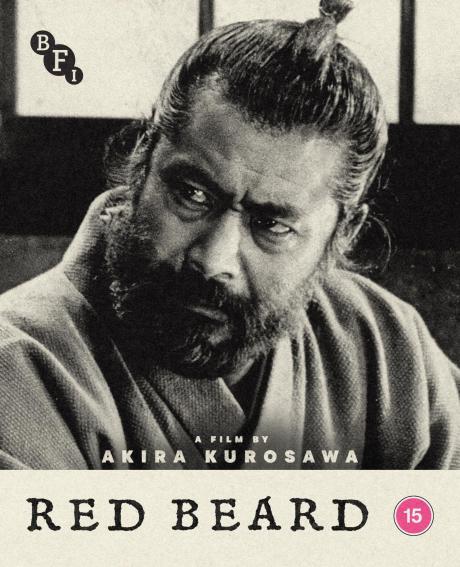
The structure is overwhelmingly linear: a Bildungsroman about a newly qualified but ambitious young doctor, Noboru Yasumoto (Yūzō Kayama), sent to pay a visit to a hospital run by Dr Niide (the great Toshiro Mifune). Niide, aka Red Beard, appears to be a tyrant, and his rural, underfunded facility reeks of “the smell of the poor”. But it’s no skin off Yasumoto’s nose because he thinks he’s visiting Red Beard for a quick official check-in: Hi and bye. Instead, he finds he’s been seconded there full-time and must submit to Niide’s whims.
Shocked, insulted and infuriated, Yasumoto rebels by refusing to work, getting hammered on sake, antagonizing colleagues, and loitering conspicuously around the segregated quarters of the hospital’s most infamous patient: a beautiful female serial killer known as "The Mantis". What could possibly go wrong?
Mifune plays Red Beard with his customary fusion of subtlety and panache. As Kenta McGrath says in his forensically knowledgeable commentary track, Mifune can juggle two emotional modes within a single scene. The man oozes gravitas, yet an ironic twinkle is never far from his eye. A master of what film folk call "bits of business", Mifune indulges in pensive chin rubs throughout his films with Kurosawa. Here his dense thicket of facial hair allows him to add a vigorous beard tug to his repertoire.
Despite having the titular role, Mifune recedes from the screen for swathes of the film. Much of it's dominated by Kayama, his darkly handsome eyes as kinetic as any balletic action sequence. Tracking the gradations in his perennial mien of disconsolate, wounded incredulity, while his arrogance crumbles and his humanity matures, is one of the great joys of the film.
Kurosawa had a brief, early career as a painter, and it shows. His meticulous compositions have an eloquence worthy of Vermeer. The beauty of the film’s sumptuous, high-contrast black and white cinematography is almost hallucinatory.
Some scenes now branded on my mind: bamboo umbrellas in the snow; Red Beard’s truculent scowl when he first turns to greet Yasumoto; the camera tracking across dozens of wind-blown flags and eerily tinkling bells; characters flitting through windows between swirly-patterned blankets hanging on washing lines; the eerie lighting and sinuous tension when Yasumoto comes face to face with the Mantis (the astonishing Kyōko Kagawa).
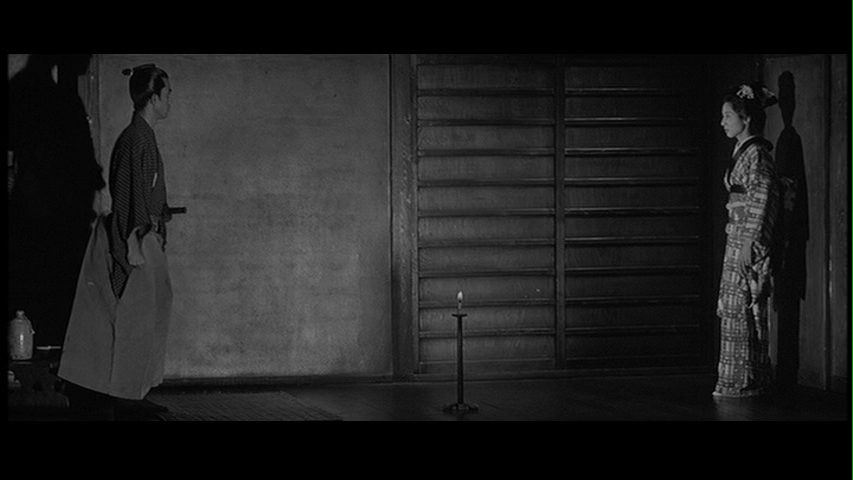
None of this is cold technical craft or meretricious wallowing in aesthetics for aesthetics’ sake. Maybe more consistently than in any other Kurosawa film, Red Beard achieves a unique synthesis of form and content, its surface effects manifesting underlying meaning. Masayuki Yui, narrator of the documentary ‘Kurosawa: It is Wonderful to Create’ (the relevant segment of which is included on the Blu-ray) summarises it well: “Kurosawa aims to depict the human soul, with the brilliance of morning dew.”
Incredibly, Red Beard is sometimes dismissed as a sort of Japanese soap opera set in a hospital: Dr. Kildare in kimonos. Jean-Luc Godard apparently considered Kurosawa overrated; well, Godard should know. “Kurosawa’s canvas is Dickensian”, said David Wilson (in Monthly Film Bulletin, January 1969), and the comparison is apt. But Kurosawa’s feints at sentimentalism are deliberate provocations, as Wilson pointed out: “The proposition that good begets good openly invites ridicule in a cynical world; but that, Kurosawa is saying, is the cynical world’s loss.” Not what you’d call pandering, or cheap sentiment.
Like a Dickens novel, this film is long: a hair over three and a half hours. But the film’s episodic structure is coterminous with its accretion of philosophical heft. Layering the back stories of supporting characters onto the main narrative like overlapping strips of newspaper on a papier mâché sculpture, Kurosawa gradually constructs a strong but never didactic moral message about individual empathy, shared humanity, and personal growth.
Red Beard took two years to make, cost a fortune, and provoked a permanent schism between Kurosawa and Mifune (the two men never worked together again). It also marked the end of a triumphant early phase of Kurosawa’s career, when his creative trajectory had seemed bound forever upward. He made great films after this, but never so consistently.
This is an important release from BFI. The transfer is sublime, the Blu-ray extras generous and varied, the booklet essays insightful. As McGrath attests in his commentary track, Red Beard acknowledges all the suffering, misery and injustices of life, yet still accommodates a scintilla of optimism. Like the delicate paper-cowled candles with which Kurosawa lights so many scenes, it offers a flicker of hope in the darkness.