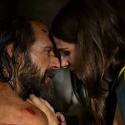
In Rose of Nevada, written and directed by Mark Jenkin, George MacKay plays Nick, a family man living in an impoverished present-day Cornish fishing village. He joins a trip on a once-lost trawler because he needs money to repair his roof. When the boat returns with a big catch, Nick and his colleague Liam (Callum Turner) are calmly greeted by the villagers as members of the crew that had disappeared a few years before Nick's birth.
Stuck in the vanished but more plentiful world of 1993, Nick and the morally laxer Liam respond in different ways. With typical understatement, MacKay conveys the dread, guilt, and anger of a conscientious man stolen by the past from his wife and daughter. It’s a haunting performance.
MacKay started out as one of the Lost Boys in Peter Pan (2003), first negotiated troubled waters in For Those in Peril (2013), and in 2019 made his international breakthrough playing the heroic Western Front messenger Lance Corporal Schofield in 1917; the same year, he brought a punk rock anomie to his portrayal of Aussie bushranger Ned Kelly in True History of the Kelly Gang. MacKay’s turn as the violent, deeply closeted homophobe Preston in Femme (2023) earned him a British Independent Film Award.
PAMELA JAHN: How much of a natural fisherman are you?
GEORGE MACKAY: Probably as much as my character in the film. I like the water, I like the sea, but I'm under no illusion that I'm anything other than a novice when it comes to fishing.
Could you easily relate to the people living in Cornwall?
During the first week of prep, we spent time there. Mark wanted us bedded in. At that time, I was also watching this documentary called This Fishing Life, which gives insights to the day-to-day experience of the Cornish communities. A big part of it is that people there don't speak very much. Being there, I almost wanted to be quieter than I am. Usually, I'm quite social, but I actually also like being quiet. I'm very good on my own. It's out of politeness that I fill silences sometimes.
Did you have to practice overcoming that habit?
I got Mark to interview me in character twice, where I would be Nick for a while, and unless something was necessary to say, he – as in Nick – didn't say anything. It wasn't sad or a bad thing. He simply answered as briefly as possible; he was economical with what he said, not for any kind of reason other than it just is what it is. And that's what I had written on my script, the Cornish translation for 'it is what it is', because that's at the core of his character. He just makes the best of things in a simple way in a very extraordinary situation.
Would you call it a lesson in austerity?
Yeah, in a way. The film opens with him going to a food bank. Many people in these seaside towns fall on hard times, especially in the winter when they can't go out fishing for a living. Also, if the tide's wrong, you can't get out of the harbour. They live at the mercy of nature. I remember one of the fishermen in the documentary had been out on the water for three days, but he didn't catch a thing. And all he said was, 'Well, that's why they call it fishing, not catching.' That taught me a lot.
When Mark Jenkin first approached you, was it clear that he wanted you to play Nick?
No, I read the script with both characters in mind. It was only after we met for the first time that Mark decided I'd be right for Nick. But don't ask me why, because we didn't talk about Rose of Nevada at all. We just had a very unconventional conversation about films we enjoyed, our attitude to filmmaking, directors that we liked. We chatted about sport, just about day-to-day stuff. In the end he said, 'I think that's everything I need to know.'
Who appealed to you first, though, Nick or Callum Turner's character Liam?
Well, truth be told, I had a slight leaning towards Liam initially. I read the script multiple times to have my interpretation of it and, therefore, I had an idea of who I thought he was and how I would play him. But when it turned out that Mark wanted me to play Nick, I was thrilled. In hindsight, I'm much more like him, we have a similar point of view on things.
What is Nick's coping mechanism to deal with the fact that he's suddenly living in a different time?
What I liked about him is his straightforwardness, his simple directness. He says to himself, "I'm going to try and get home. That's all there is." He takes this strange situation head on. And he's pissed off when Liam, for his own good reasons, doesn't want to go back.
Mark Jenkin's films are richly textured. There is something peculiar in both their form and content. How does that affect the work on set?
His filmmaking process is born out of the mechanisms of the camera. He has this wonderful ethos of having limitations being the key to creativity, like the fact that the camera only runs for 27 seconds. It economises what you can actually do, and therefore you get really innovative with those very few choices that you have. At the same time, he's very clear and precise in that he only shoots what is going to be in the film.
Can you think of an example?
Yeah, we might run a whole scene, but if he only needed that one line of dialogue or a single gesture, he would only run the camera for those bits. Also, because of logistical reasons to do with the tide and location, we were filming certain shots weeks apart – like, we would shoot one line Liam said, finish the scene, and then three weeks later we would shoot my part of that same scene. That can be disorientating for an actor, but Mark was always very clear on how he directs and why.
Has working with him changed the way you approach acting in general?
That’s an interesting question. Maybe certain strings or elements of that will carry over. On the other hand, in that same year I did a job [Mission] that was almost all improvised; it was the complete opposite. It's a British drama by [For Those in Peril director] Paul Wright in which my character is experimenting with extremes, and we would do that with the camera running and finding our way. We were doing 11-minute takes where you're just trying to come up with stuff and work around a theme rather than a specific script.
You were very young when you started acting in films. Looking back, do you feel that was a blessing or a curse?
Everything has its peaks and troughs. I only know my own experience of it, and there are so many things about my beginnings as an actor that I'm grateful for. It's part of my identity. As a kid, I had so many experiences where I watched other actors or was around really great experts without feeling any pressure – it was just great fun. Certain elements that I might call upon doing a scene today I learned by osmosis.
How do you remember the success of 1917 and the way it elevated your career?
Of course, certain things changed with the film, but I feel there's still work to be done. Ultimately, I approach acting on a very personal level in every sense of the word, and that's not dictated by the size of the movie or its reach. A film's popularity will always be defined by other people – it doesn't affect your own experience, because none of those people who later talk about the film were actually there on set. Understanding that made me concentrate even more on doing things that feel gratifying and important to me. Then you hope that it translates to the audience as well. Or as my character Nick would say, "It is what it is."