

Playwright and novelist Rodolfo Usigli wasn’t impressed with Luis Buñuel’s 1955 film version of his novel Ensayo de un crimen, unhappy with the changes made by the director and his co-screenwriter Eduardo Ugarte. Especially the introduction of some nuns “who die in a tragic and entirely gratuitous way. There is a good Buñuel and a bad Buñuel. And I got the bad Buñuel.”
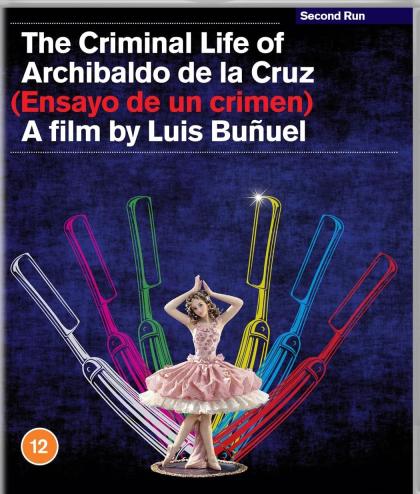
The fourteenth of the 21 films which Buñuel directed between 1947 and 1962 in Mexico, The Criminal Life of Archibaldo de la Cruz (Buñuel’s own English title) is a disquieting mixture of black comedy and psychological thriller, its titular antihero a man “who thinks he’s a murderer, and wants to be a murderer, but isn’t a murderer.”
In the first of several flashbacks, we meet Archibaldo as a rich, spoilt child growing up during the Mexican Revolution. He covets his mother’s music box, an object that his disciplinarian young governess suggests has the power to kill its owner’s enemies. Annoyed by her strictness, Archibaldo winds the box up to test it and immediately witnesses his governess’s sudden death from a stray bullet. It’s a horrible moment, made creepier by the pleasure and excitement that Archibaldo gets while gazing at the blood dripping from her torso and staring at her stocking-clad legs.
The adult Archibaldo (Ernesto Alonso) is a dandyish ceramicist, first seen in a hospital bed having told the story of his childhood to the disbelieving nun looking after him. He threatens to kill her, only for her to fall to her death down a lift shaft, Archibaldo then revealing more of his backstory to the judge charged with investigating the incident. The chance rediscovery of the music box in an antique shop reawakens childhood memories, Archibaldo convincing the salesman to sell it to him instead of to the couple who are looking at it.
Several moments play out like allusions to Hitchcock: the music box theme recalls the snatch of Lehar heard in Shadow of a Doubt, and Archibaldo’s fondness for a tall glass of milk is surely a reference to Suspicion. Buñuel even seems to anticipate Vertigo when depicting Archibaldo’s attempts to woo and dispatch Miroslava Stern’s Lavinia, purchasing a mannequin made in her image and dressing it to look exactly like her. The destruction of the dummy, Archibaldo dragging it by the hair before burning it in his kiln, is chilling.
Black comedies about killing can be a lot of fun, one superb example being Robert Hamer’s Kind Hearts and Coronets. But while Buñuel’s film is stylish, beautifully shot and darkly witty, it’s almost impossible to sympathise with a protagonist who derives such cold-blooded pleasure from plotting to murder the women close to him, Alonso’s voiceover betraying no hint of emotion.
Stern is superb as the feisty, intelligent Lavinia, making her character’s behaviour in the final scene all the more infuriating. It's a fascinating oddity, then, with Buñuel peppering the film with surreal visual flourishes. Second Run’s presentation is typically classy, with booklet notes by film historians Jordi Xifra and Cristina Álvarez López, the disc including the three video essays written and created by López for the ICA’s 2015 Buñuel season.










Add comment