“Your civilisation is young but controlled by minds which are old,” says one of the alien Alphoids in Toomorrow to the four young musicians beamed aboard his spacecraft. He’s also hinting at one of the film’s problems; Toomorrow often feels like it’s been helmed by a creative team rather creakier than the young target audience, one contemporary review describing it as "a film for youngsters made by oldsters who are attempting to commercialise everything that’s dear to the teenage heart". That parts of it it resemble an extended episode of The Monkees is unsurprising, given that one of the driving forces behind Toomorrow was music publisher Don Kirshner, commissioner of songs from the likes of Neil Diamond and Carol King for the Monkees to mime along to in the first season of their TV series.
Released in 1970, Toomorrow was a joint project from Kirshner and James Bond producer Harry Salzman, the pair envisaging a series of films featuring a brand-new manufactured band. A young Olivia Newton-John was cast, with Karl Thomas, Vic Cooper and Benny Thomas (pictured below with Newton-John) completing the quartet. Kirshner described them at a 1969 press conference as “the best-looking group that ever existed”, before they'd played a note together. Versatile British director Val Guest was hired to direct and ended up rewriting the screenplay.
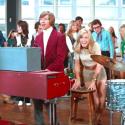
The finished product defies categorisation, Guest describing it as “the first space musical”, in which members of an advanced alien civilisation are attracted by the healing vibrations made by the titular group’s homemade synthesizer. Called Toomorrow because they’re “too much”, the band members are all students at the fictional London College of Arts, living, Monkees-style, in a chaotic shared house. The college sequences are fun, mostly filmed in Holland Park School, Guest’s screenplay even throwing in an erudite reference to Wagner’s Die Meistersingers. We get sit-ins, crusty academics in suits, Ford Anglias and some choice dialogue. “Any of you cats mind a groove?” asks drummer Karl, before the band starts playing anyway.
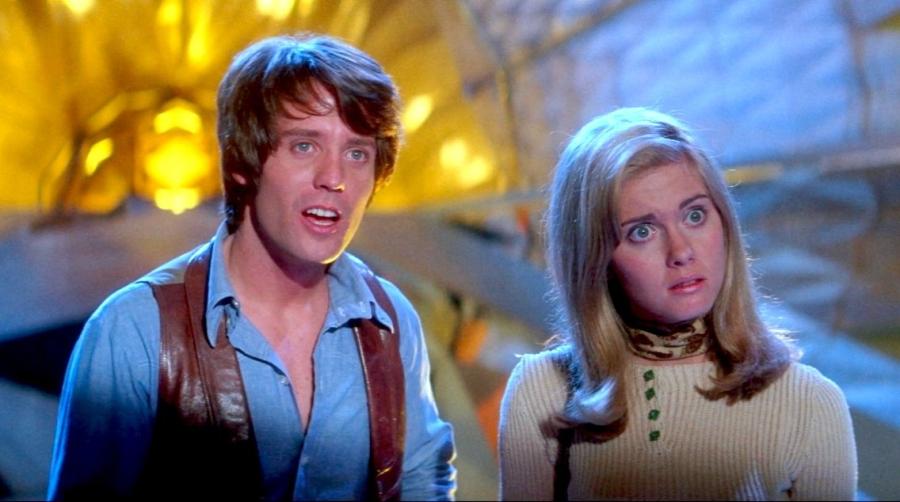
Watching them from a distance is Roy Dotrice’s suave John Williams, a disguised Alphoid charged with locating the mystery vibrations. He lures Toomorrow to his Hampstead mansion, after which they’re zapped into space, cleansed of Earth germs and introduced to his fellow aliens, in urgent need of “the vibrations of youth” to rejuvenate their home planet.
Hijinks duly ensue as the group overcome a series of arbitrary obstacles which stand in the way of them performing at Camden's Roundhouse. Think live action Hanna-Barbera cartoon, with gratuitous sex jokes. There are some funny moments, notably when Dotrice summons extra-terrestrial backup in the form of “one Earth female, generously proportioned, with long blonde fur”.
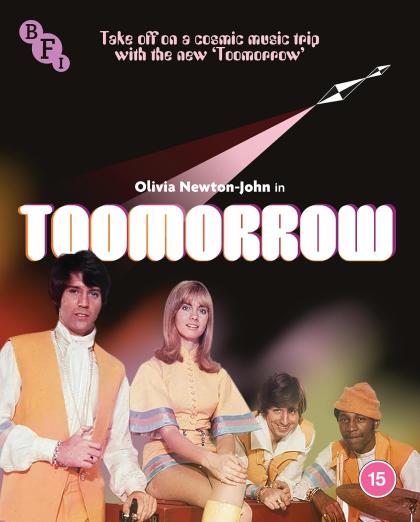
Toomorrow flopped badly, musician Bruce Welch (Newton-John’s boyfriend at the time) blaming the songs (“instead of going for the best songwriters available, Kirshner had simply handed the job to some unknowns"). The soundtrack album also tanked, Newton-John doing her best to distance herself from the project (“it wasn’t something I wanted to rave about”). The sequels were cancelled. So, no forgotten masterpiece, but a hugely engaging and endearing period piece, Guest’s large supporting cast visibly having fun. Look out for a luminous Shakira Baksh, who went on to marry Michael Caine a few years later.
The BFI’s documentation and bonus features are superb: Newton-John’s biographer Matthew Hild outlines the film’s gestation and production, and we get useful biographies of Guest and Kirshner. Disc extras include music historian Andrew Sandoval’s main feature commentary and a 1942 propaganda short about the dangers of sneezing, starring comedian Arthur Askey (Guest’s first film as director), plus a 1969 celebration of Swinging London. There’s also a pair of interviews with Guest and a Children’s Film Foundation musical short starring Alice the Chimp. Do investigate.