Steve Martin famously said that writing about music was like trying to dance architecture, so maybe making a movie about painting is like – I don’t know – trying to chant ceramics. But this Britain-New Zealand co-production has a go at following in the footsteps of films such as The Agony and the Ecstasy (1965) and La Belle Noiseuse (1991), both of which got us more than half-interested in the deeply mundane and scarily intense business of daubing paint.
It tells of the very extended process by which supermodel Kate Moss was limned by postwar portraiture colossus Lucian Freud in 2001. So here is a dogged survivor from Middle Europe’s intellectual swirl of the early 20th century trapped in a room with an avatar of vapid Cool Britannia culture from the century’s end. Sounds like it might work in a comedy vein, or even in the way that Laurence Olivier had to wrangle Marilyn Monroe on the set of The Prince and the Showgirl. But writer-director James Lucas has a more serious, reverential purpose: to show two drifting souls in a collision of minds and mutual rescue. He doesn’t quite succeed in making that gel.
We get an Olivier/Monroe-style contrast in performances, too. The precise, melodious elocution of Derek Jacobi as Freud is as beautiful to listen to as ever, with the actor in his late eighties now, several years older than Freud in 2001. Ellie Bamber, a surprising ringer for Moss, gives us more slapdash diction that seems equally well tuned – if only to the rootless sound of millennial Croydon, Moss’s home-from-nowhere.
Freud’s daughter Bella (Jasmine Blackborow) hooks up artist and model in a meeting at the National Gallery, which has been emptied of the regular public. It’s some kind of metaphor for both of their lives – especially for Moss, whose attempts to escape her crushing celeb status involve driving too fast in a vintage MG and persuading her chauffeur to go slumming with her at an S&M club in Berlin. Spending weeks of her life posing nude for Freud in his foxed and dingy Kensington studio (which looks like a set for a Beckett play) can only be a step up. Not to mention a reprieve from drugs and drinking champagne through a straw at early-morning photo shoots.
The stuttering drama has no decisive external pressures or fully realised supporting characters to give the duo lives outside the studio that could derail their prickly platonic bond. And the dialogue lacks the spark and charm that might have made the actors commune better (the way, say, Bill Murray and Scarlett Johansson did in another old-guy-plus-girl escapade, Lost in Translation). Lucas has two tactics to move things along, neither of which are properly cinematic.
First, there’s masses of exposition about who they are and where they come from, especially from Freud, and at times this is like lengthy interview material from a documentary. Yet the film can’t make up its mind if he’s a troublemaker like Joe Orton or Francis Bacon, or an Establishment national treasure as he cruises about London in a Rolls. Then there are several fast-cut montage sequences, mostly summarising Moss’s semi-wanton day to day. They’re stylish enough, like crack-fuelled perfume ads, but also don’t add to the drama.
This might not matter if we could get more inside Freud’s painting – its knobbly dynamism, its curious sense of action springing from features in repose. Kate Moss, on the face of it, seemed an odd choice of model – waify rather than fleshy, an ode to symmetry where Freud’s faces and bodies always seemed off-kilter. We don’t see enough of the artist’s technicolour obsession with skin, its energetic blotchiness somehow holding a key to life.
Freud is always barking at Moss for being late for sittings, while she complains about how hard she works as a model and speaks of her exploitation when she was 17. But she delivers him some opium to remind him of the old times, which sparks yet more of his backstory, much revolving around his big love of the 1950s, the Guinness heiress Caroline Blackwood (whom we see in dumb-show flashbacks). Moss reminds him of Blackwood, we guess, and she lures him to a club where Jacobi treats us to some of the best dance moves by an eightysomething ever seen. Only when she gets pregnant by her journalist boyfriend do events rise to a slightly surprising head.
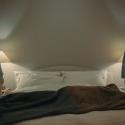
Moss was closely involved as an executive producer, though to her credit Moss & Freud doesn’t paint her in most serene of lights. The movie has a confident sheen, and with Moss involved Bamber’s Gen X togs are surely accurate. Nobody much liked Freud’s finished portrait of Moss slouched along a bed (though it sold for £3.5 million). At around this time, Freud was also painting the Queen – giving her a face that was purse-lipped, wry and mask-like. The monarch allegedly told him: “Very nice of you to do this. I’ve very much enjoyed watching you mix your colours.” That sitting could have made a movie too, though might have required more of a national treasure like Alan Bennett to pull it off.