Red, the colour of blood, passion, love and hate, is Almodóvar’s trademark and in Julieta, his 20th film (and surely one of his most visually lustrous), it’s never far away. It’s there in the opening sequence, a close-up of thick folds of red fabric moving like a curtain. Then we see, as the camera cuts away, that it’s a dress worn by Julieta, a woman in her fifties (Emma Suarez, pictured below).
She’s new to Almodóvar, as are most of the actresses in the film apart from his idiosyncratic muse Rossy de Palma and Susi Sanchez (the soundtrack is written by his usual musician, Alberto Iglesias). Julieta is packing up a small statue of a naked man, part of her preparations for leaving Madrid for Portugal with her boyfriend (Dario Grandinetti, also in Almodóvar’s Talk to Her). But she doesn’t go. The reason why not forms the narrative of the film.
It looks extraordinarily stylish, hallucinogenically so
It’s fascinating to see what Almodóvar has made of Alice Munro’s three linked stories, "Chance", "Soon" and "Silence", from her wonderful collection Runaway (the book is used as a prop in his The Skin I Live In). He sticks fairly faithfully to Munro’s plot about a mother and the chilling estrangement from her daughter, though he constructs an entirely new ending. And Julieta is a very different person from Munro’s Juliet. For a start she’s in vibrant Spain, not cold, less family-centred Canada. Almodóvar originally intended to make the film in Vancouver or New York and star Meryl Streep in the title role, but in the end he found working in such an alien environment impossible.
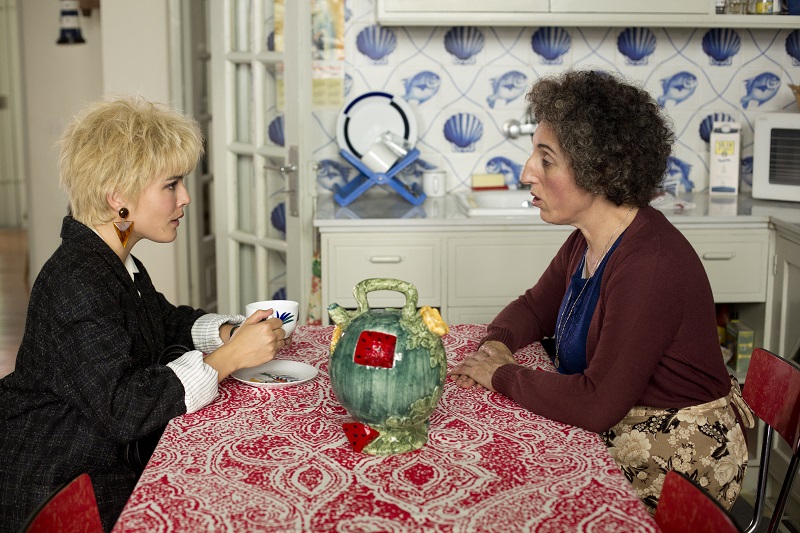
And the street scenes of Madrid, his home territory, are so alive, and the beauty of Galicia, Andalucia and the Pyrenees so thrilling, that you wouldn’t want Julieta to be set anywhere else. Like most of Almodóvar’s films, it looks extraordinarily stylish, almost hallucinogenically so. The clothes, interiors and furniture, down to the blue and white shell-motif tiles and ceramics in a fisherman’s house, are a designer’s dream. They’re so arresting that sometimes they threaten to overwhelm the action itself.
 The fisherman is Xoan (Daniel Grao), the married man whom the young Julieta, played by spiky-haired, primary-colour-clad Adriana Ugarte (pictured below with Rossy de Palma as Marian, the housekeeper) meets on a train in 1985. (Almodóvar says that although splitting the role between two different women is risky, he felt that ageing a 25-year-old with make-up doesn’t allow the profundity of age to shine through. Damn right, Pedro.) As in the Munro stories, the young Julieta is a classics teacher, and an unusually out-there one, who doesn’t let a little thing like being on a train get in the way of a night of passion en route. One thing leads to another. She is soon living beside the sea in Galicia with Xoan and their little daughter Antia. Xoan’s wife, who was in a vegetative state for years, has already died. Happiness seems within reach, but fate, guilt and the burdens of the past are soon upon us, reaching down through the generations. Storm clouds roll in.
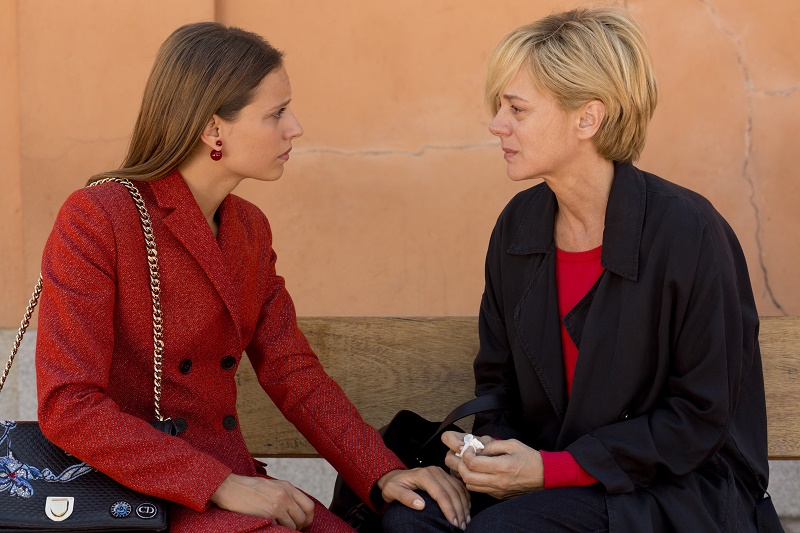
 "We get the lives we deserve," says Julieta towards the end of the film. But does she deserve her daughter’s silence, and is she to blame for the lack of spiritual dimension that Antia apparently longs for? This is as painful and mysterious as it is in Munro’s "Silence", though Julieta doesn’t carry the weight that Munro creates around the character in her three stories. For years Julieta bakes a cake – brightly coloured, of course – on the absent Antia’s birthday and then throws it in the rubbish bin. We see all this in flashback, until we arrive at the present again, with Julieta, somewhat reconciled to her loss, preparing to leave Madrid. Then a chance encounter with Antia’s childhood friend Bea (Michelle Jenner, pictured below, left, with Suarez) changes everything.
 The sudden denouement, which ties up loose threads a little too fast, is where Almodóvar must have decided that Munro’s ending was too low-key. In the original, there is no resolution, just resignation. Almodóvar gives us drama and turns a mother’s grief full circle. And as the camera pans out for a stunning aerial shot of the car (a red one, of course) driven by Julieta through the mountains to the strains of Chavela Vargas’s Si no te vas (the only song in the film), we can’t begrudge him that.
Overleaf: watch the trailer to Julieta