Director Charlie McDowell's The Summer Book is a beautiful, somewhat wistful film that follows the residents of a tiny Finnish island (daughter, father, grandmother) over a summer. The father (Anders Danielsen Lie, of The Worst Person in the World and Sentimental Value) is mourning the death of his wife, whilst his mother (Glenn Close) provides brisk, no-nonsense comfort, and his daughter, Sophia (Emily Matthews), struggles to come to terms with her new life and the loss it involves.
The film is adapted from Tove Jansson’s book of the same name and shares much of its episodic nature, as well as its simplicity. An island dweller herself, Jansson based the novel on members of her own family (her niece and her grandmother). Familiar themes from her other works (the charm and magic of everyday lives and a distinct hatred of no trespassing signs) are present, along with a rejection of sentimentality but the importance of empathy and understanding. The grandmother and Sophia talk about death and about her father’s mourning, but often in oblique ways, the grandmother gently shepherding her son and granddaughter through the complexities of their own particular ways of grieving. It would be easy to make a treatment of this subject trite, but Jansson’s source text, as well as the particularities of the film itself, reject this. The characters also feel very real – they bicker and fall out, they mourn their youths, and (in the case of Glenn Close in a beautiful, truly human moment) they go skinny-dipping to remind them of their connection to their self and to the world around them.
The Summer Book's light touch extends to the narrative itself, a series of vignettes that explore moments of deep feeling which are rarely climactic. One episode takes Sophia and her grandmother to an island, where a family whose perfect cabin they sneer at invites them in for cake and Sophia encounters the model of the mother figure she has lost. Another takes Sophia, her father, and her grandmother to a lighthouse-topped island when a ferocious storm blows in. Her father is stuck out at sea in a boat with a faulty engine and the possibility of death strikes Sophia. In these moments the loss at the heart of the film and of their family is close enough that it can be reckoned with, in the form of a scenario that can be approached but which cannot overwhelm them. There are moments when the story strays into cliché, such as when the father’s poplar tree starts to produce green leaves, but this isn’t laboured, and is offset by the majority of the rest of the film’s way of dealing with these themes.
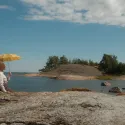
Beyond the story itself, The Summer Book is truly beautiful. Shot on 16mm film, the softness of the analogue stock evokes summers past, a grainy, golden light permeating the movie. The camera rests on waving grasses, limpid pools, and the blurred horizon of the sea. The cabin that the main characters inhabit throughout the film is satisfyingly spartan, recalling childhood holidays with no electric light and clouds of midges over a cold sea. Hania Rani’s soundtrack is very present throughout, but it never felt overwhelming, its woodwind and piano notes in keeping with the 1970s setting. Truly, this felt like a soft but honest little film, not without grief, both present and future (the grandmother’s persistent cough and reluctance to give up smoking feels very Chekhov’s gun), but a heart-warming narrative nonetheless. At times I was distracted by the rare bum note of Glenn Close’s heavy accent, but really this is the perfect film for the end of summer – gently sad, poignant in all the right places, evocative of the season just past as well as all those lost ones of your youth.