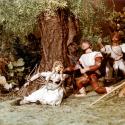
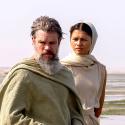
Among the many singularities of Pasolini’s films, the proportions of his narrative structure have to be the strangest. Here we, like the young Jason who grows before our eyes, get a six-minute introductory lecture from the hero's foster centaur which tells us what to look out for in the obscurities that follow: all is sacred, nature is never natural, myth and ritual are a living reality, this is a story of deeds, not thoughts. Then there’s hardly any dialogue for the next hour or so: look away, if you’re squeamish, at the climax of the chthonic rituals to which Medea's Colchians who guard the Golden Fleece seem bound.
These taxing scenes are shot in what I guess to be the singular Cappadocian heart of Turkey. Then, after Medea’s equally brutal departure with the Argonauts, we’re whisked to Corinth, which is puzzling. Not least because the palace is the Campo Santo of Pisa, its fortifications the castle at Aleppo. But even more because it takes time to work out that years have passed, children born, and foreign enchantress Medea cast aside by Jason in favour of pretty young Corinthian Glauce. Vengeance is bound to follow – but bearing in mind Pasolini’s exclusion of magic, his making real of the ancient past, how? Will there be a flaming garment, an airborn chariot littered with dead infants? Again, there are tricks up the sleeve which I won’t spoil.
Medea’s virtues are bumpy, its artfulness seeming more artificial than ever, but the chief draw here is the BFI restoration
Suffice it to say that Callas, whose American-Greek-accented Italian is heard on the soundtrack chosen for the British Film Institute's restoration, holds the centre by acting with her eyes. Her singularity is unquestionable, her strange beauty all internalised, the sense of age’s slow ravaging subtle but palpable. From a 1970 Observer interview reproduced in the booklet, which makes up for a lack of extras on the DVD, there’s further proof that Callas was an original thinker among artists in harmony with Pasolini’s approach.
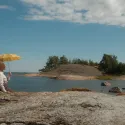
Jason is played by the Olympic triple jumper Giuseppe Gentile, which explains the singular draw of a powerful pair of legs. Otherwise, expect none of the nudity and hardly any of the sex which followed in Pasolini’s Decameron, Arabian Nights and Canterbury Tales. Medea’s virtues are bumpy, its artfulness seeming more artificial than ever, but the chief draw here is the BFI restoration given in both standard and Blu-ray formats, which means that the filming of diverse landscapes and emerging civilisation’s role within them never looks less than ravishing.