Alejandro González Iñárritu’s stunning, painfully sincere - if somewhat laborious - latest is a heartfelt paean to fatherhood, built around an agonising escalation of misery. It is bolstered by a mesmerising performance from Javier Bardem as a terminally ill man experiencing physical deterioration alongside spiritual elevation, who bridges the gap between this life and the next.
Biutiful is set in Santa Coloma, a deprived district of Barcelona populated primarily by those on society’s fringes. Javier Bardem plays Uxbal, the father of two young children and one of the cogs in a criminal machine which exploits illegal immigrants of Chinese and African descent who are employed for factory and construction work and as street sellers. Uxbal liaises between the workers and their bosses and bribes the police to turn a blind eye. At first remaining ignorant of his own role as a facilitator of the exploitation, he mistakenly believes he is doing his bit to help those in desperate circumstances.
Learning that he is in the latter throes of cancer, Uxbal is presented with a dilemma regarding the care of his children, of whom he has custody. He is separated from his chaotic bipolar wife, Marambra (Maricel Álvarez), who, as we are made aware, is drinking and sleeping with his even more wayward brother Tito (Eduard Fernández). Should he reunite with a woman who represents a considerable risk for the sake of his family?
Iñárritu describes Uxbal as “a sun surrounded by satellite planets” and he is unarguably the centre of the film’s universe. Bardem is hypnotically hangdog and wears his guilt, conflict and medical prognosis like a five-stone overcoat; the film is utterly mired in his character’s despair. It’s a blinding performance which all but eclipses the perfectly credible characterisations that surround it.
On the one hand, Iñárritu has the courage of his convictions, as he presents a flawed but ultimately sympathetic man in unflinching, almost miserabilist, detail. However, as the director of Amores Perros and Babel - and therefore considering Iñárritu’s previous form at juggling multiple, complex narratives - the narrowed focus occasionally feels jarringly blinkered, and the film a little like a platform for Bardem’s performance rather than a fully realised world.
Furthermore, there’s something a little galling about centring a film, which is in part about the horrific exploitation of the disenfranchised, so acutely on one (white) man’s misery. Ironic given its integrity in other respects, Biutiful subjugates the illegal workers to sorely underwritten supporting roles, whilst an Oscar winner struts his (albeit formidable) stuff.
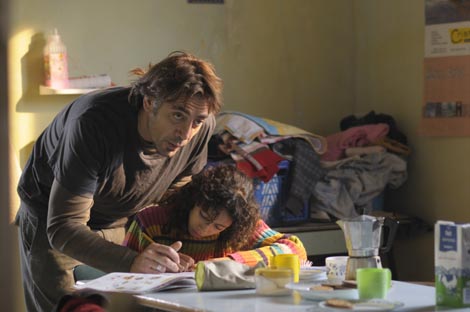 These peripheral characters’ stories are glimpsed but not explored: for example, the sweatshop’s boss, Hai (Taisheng Cheng), who agonises over his true sexuality, or a Senegalese woman, Igé (Diaryatou Daff), who at one point holds the fate of Uxbal’s children in her hands, but whose own background is hastily sketched in. Perhaps most troublingly of all, when catastrophe befalls the illegal workers, the film fails to have the requisite emotional impact due to our enforced distance from those affected.
There are minor missteps elsewhere. A poignant moment between Uxbal and Marambra is rendered ridiculous by a distracting glockenspiel accompaniment. The film’s overarching spirituality, for the most part, works well (especially given its cyclical structure) but the occasional dubious utterance stands out. Just for example, when Uxbal visits his friend Bea (Ana Wagener) and confesses, entirely reasonably, his concerns for the future of his children (pictured above), she chides him and tells him not to be naïve for (of course) “the universe takes care of them”. If the intention is to present this as anything other than wisdom, it doesn’t come off.
Iñárritu once again gives us a world viewed through his dirty kaleidoscope – vivid, tarnished and occasionally uncanny. There’s an appropriate dark beauty to proceedings as we find ourselves steeped in Uxbal’s undesirable plight, although the film’s tight focus is both its strength and a weakness. Whilst it at times feels like an exercise in endurance and is certainly not flawless, Biutiful is arresting and earnest, with a satisfying and imaginative circularity.
- Biutiful opens on Friday, 28 January
- Find the films of Alejandro González Iñárritu on Amazon
- Find Javier Bardem on Amazon
Watch the trailer to Biutiful