“You don’t love Schubert’s music?” Such, according to the greatest of living Schubert interpreters Elisabeth Leonskaja, was the response of her mentor Sviatoslav Richter to students who omitted the exposition repeats in the piano sonatas. Daniel Barenboim doesn’t observe them either, on the evidence of yesterday afternoon's concert, but four recitals and much in them ought to prove that he does love Schubert’s music, or rather has his own vision of how it ought to go. It’s not his fault if focus on the composer seems to have taken second place to the public's media-fed fascination with the piano gold-lettered BARENBOIM above its keyboard, or to standing ovations for the living legend regardless of the variable level of the interpretations
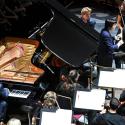
Let’s just say of the Sunday-afternoon third in his series that it always fascinated even when it felt odd or wrong, and that Barenboim put Schubert’s infinite variety to the test with an unusual three-act play in which pain was but the occasional episode in a general drama of happiness, to reverse Hardy’s end-of-novel maxim. Like Jessica Duchen and Gavin Dixon, covering respectively the first and second programmes on theartsdesk, I come down firmly in favour of the much-discussed instrument constructed by Chris Maene. In the first bars of the recital, there wasn’t the shine we expect from a Steinway, but exceptional clarity never cancelled out an upper register with a very individual “ping”, a sonorous bass or the music-of-the-spheres pianissimos which I’d been led to believe I wouldn't find in Barenboim’s Schubert.
There they were, shifting expected centres of gravity in two of the "acts". In the E flat Sonata D568, a late refashioning of an 1817 work originally set a tone lower, they hovered over the magical other world of the Menuetto: Allegretto, making a subtle transition from the perfunctory minor key of the preceding Andante molto to the blithe flow of its finale. In the second movement of the D major Sonata D850, glowing genius rendered not too preciously sublime, it was the second strain which took us to a poarallel universe and steered us almost painfully back to Schubert’s version of humanity.
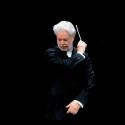
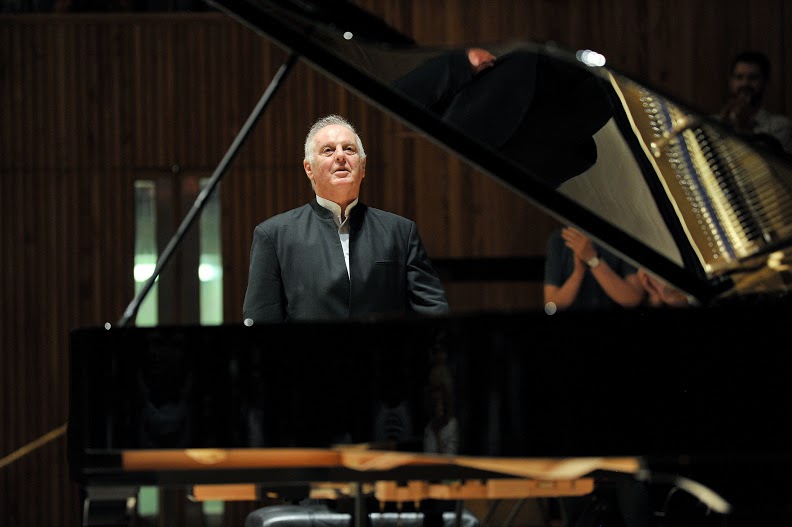 The corresponding movement of the A minor Sonata D784 would have felt cramped to lovers of the Richter way with Schubert – that’s me, for one – but just right to others. Likewise the D major’s ecstatic outpouring, still young man’s music with the wise knowledge or mortality always imminent. It could have spread its wings more freely. But that wasn’t Barenboim’s intention (the pianist pictured above by Chris Christodoulou), and he was persuasive enough to command respect for his point of view. Where he undoubtedly wobbled was in the first two finales, teetering in erratic tempi in a way that didn’t heighten the expressive intent simply because Schubert’s repeated rhythmic patterns weren’t well enough articulated.
So we come back to those missing exposition repeats, which simply rob the first movements of their equilibrium, or at least the way it goes out of kilter in developments which give the lie to any generalizations like the programme’s “his was an essentially gentle art” (what an opportunity missed not to have had real Schubertians involved in printed and spoken word around the series). I know the Brendel school tends to omit the repeats, but not (as in the case of a more consistently ethereal Schubert interpreter than Barenboim, Imogen Cooper) always.
The biggest casualty was the cutting-short of the mostly crouched tragic tone that needs sustaining in the A minor’s unique first movement. Not only could we all have done with hearing the thrumming repeated chords of its counter-theme’s benedictions three times rather than twice, but the wider scope of its three successive movements left a retrospective feeling that the equally momentous launch had been too short. The most typically Schubertian sensitivities in Barenboim’s third concert came last, in the hesitations of the waltz strain in the D major’s Scherzo and the leisurely happy end, with different speeds deliciously delineated and a playfulness in Barenboim’s playing if not in his demeanour that took me back to his Mozart recordings of the 1970s. So we could float away serenely, even if the ubiquitous standing ovation wasn’t exactly appropriate. The main thing, anyway, is that the unexpected materialized in the middle of the Barenboim circus: Schubert really did come first.