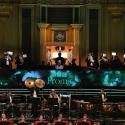
Aaron Copland’s gleaming, monumental Fanfare for the Common Man was written to mark the USA’s entry into World War II. Those thunderous drums and soaring trumpets symbolised the moment when America formally announced itself as the greatest power in the world and its most ardent champion of democracy. How poignant, then, to hear it as a resonant opening to this year’s BBC Proms, in a programme that celebrated America’s 250th anniversary while reminding us that we no longer know what this superpower stands for. Nonetheless, in the moment, the crashing tam-tam and the crescendoing brass provided a rousing start to the world’s greatest classical music festival.
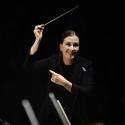
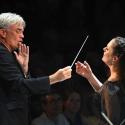
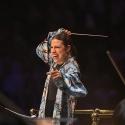
The Ukrainian-born Finnish Dalia Stasevska is a true Boadicea of conductors – though she stands shorter than many of the musicians over whom she presides, she has a fire and charisma that could inspire many to follow her into battle. After the Copland, she led the BBC Symphony Orchestra into an agile interpretation of George Gershwin’s An American In Paris, the 1928 symphonic poem for which the composer personally acquired four Parisian taxi horns to be used at the premiere.
Paris, of course, was the world’s great cultural centre till New York acquired the mantle, and at the same time as being a jaunty homage to the French capital, Gershwin’s composition was a prime example of his home city’s growing artistic pre-eminence. Stasevska conjured order out of the gleeful chaos, allowing us to shift from the bustle of early morning traffic jams to the homesick yearnings of the evening, evoked by the songbird sweetness of orchestra leader Stephen Bryant’s violin and a delightfully woozy trumpet.
Gershwin famously travelled to Paris hoping to study composition with Ravel – there is a story, which many believe to be apocryphal, that the Frenchman chastised him “Why would you want to be a second-rate Ravel when you can be a first-rate Gershwin”? So it’s a nice touch that the first half of the evening ended with Ravel’s own nod to Gershwin’s jazz-influenced culture, his G major Piano Concerto which he started to compose the year after An American In Paris was first performed.
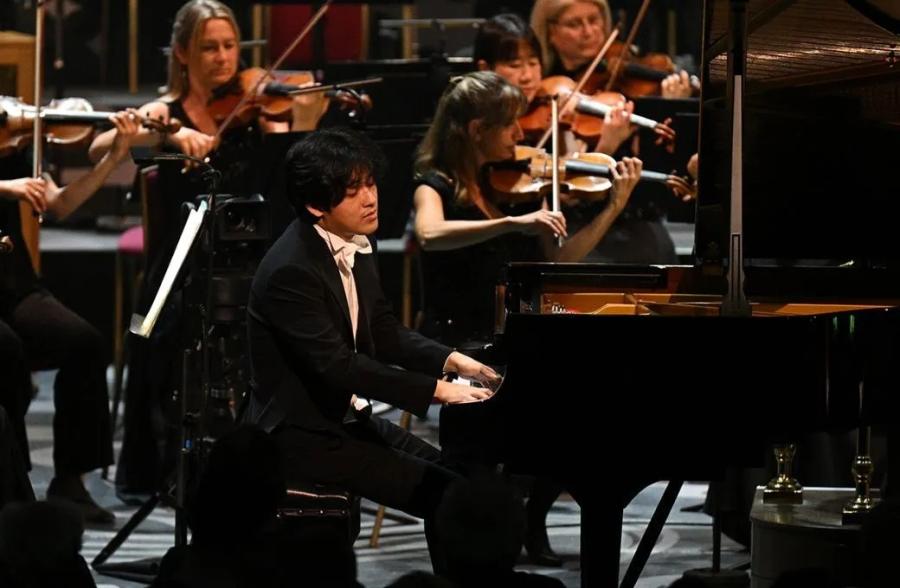
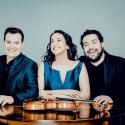
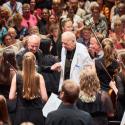
The 22-year-old Korean super pianist Yunchan Lim (pictured above) was the star attraction here, and it was utterly indicative of his philosophical, deliberately unpredictable approach that despite his shimmering technical brilliance he refused to deliver the concerto with anything even hinting at flashiness.
This was an interpretation that owed as much to the concerto’s more contemplative Basque influences as it did into its urban pizzazz. The opening Allegramente movement – in which the development is normally characterised as a “lively romp” – was eloquent and at times almost ghostly, revealing a dark magic in the slyly shifting harmonies.
The second, gorgeously contemplative Adagio assai movement, was performed with a quiet soulfulness that brought the whole arena to a rapt silence. The final Presto movement took off with a more agitated clatter, but the meticulousness of Lim’s technique and the silvery panache of his execution made you feel more as if you were gazing out at the stars than surveying the bright lights of a city.
I was lucky enough to have two perspectives on his performance, after getting up at six to queue for additional tickets so that my teenage son and his friend could watch Lim up close from the arena. The pair of them – who can do scepticism and monosyllables as well as any teen – were completely transported by what they had witnessed. My son commented that Lim’s immersion in the piano was so complete, that it was almost as if the piano had become a physical extension of who he was. He also said that despite having watched numerous videos of Lim online, not one of them could convey the uniqueness of his command of the keyboard.
After the interval we were welcomed back to the world premiere of Josephine Stephenson’s new composition – commissioned by the BBC – That the sunrise not leave us unmoved. In a very different way to the Copland, the work was a response to war, in this case emphasising the joys that civilisation should be celebrating in order not to be consumed by the horrors of conflict.
Stephenson, who was inspired here by Emily Dickinson’s poems, is a versatile composer who has collaborated with musicians ranging from David Bowie to Heloïse Werner. In this piece for orchestra and choirs (the BBC Singers and the BBC Symphony Chorus) the mood ranged compellingly from cobwebbed melancholy to a profound sense of beauty infused with terror.
The penultimate work of the evening, Gerald Finzi’s 1947 For St Cecilia – performed for the first time at the Proms, even though it in fact premiered at the Royal Albert Hall – was a celebration of Englishness that struck a strong contrast to the American dreams of the start. While the Edmund Blunden poem that inspired the work features portraits of saints including St Valentine, St Swithin, and of course, St George, musically it pays tribute to stalwart British composers such as Elgar, Parry, Purcell, and, erm, Handel.
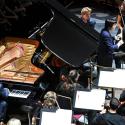
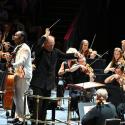
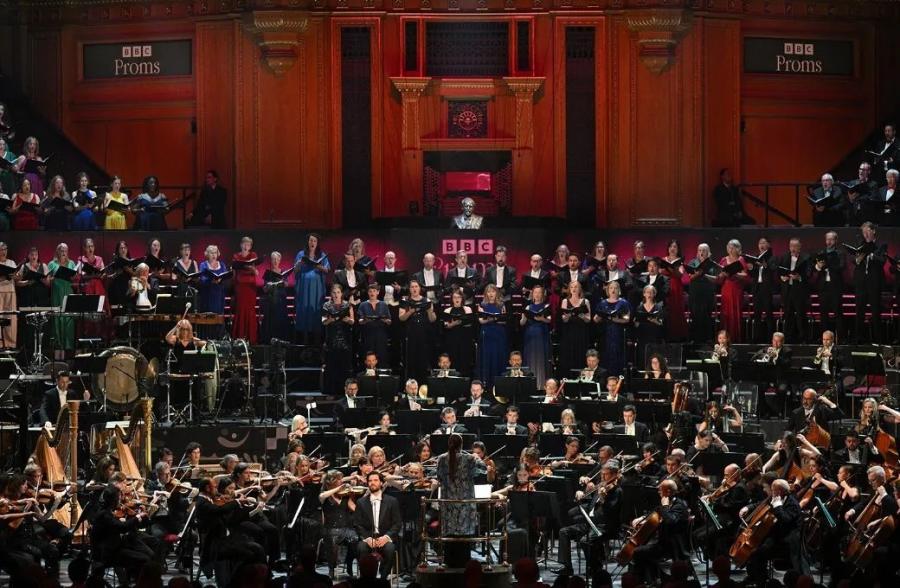
This was a work that gleamed magnificently when the BBCSO and the combined choirs were in full flight (pictured above), yet there were other parts that felt fustily traditional, evoking a Britain of scones and cream, well-chewed pipes, and leather elbow patches. There was a golden warmth to Thomas Atkins’ solo tenor performance, which ranged from rapturous melancholy to sunlit optimism. But it also seemed indicative of how Britain and the US would develop that For St Cecilia, with its cosy harmonies and pastoral nostalgia, was composed five years after the monumental future-gazing Fanfare for The Common Man.
According to the published programme, that was it, but Stasevska had a surprise in store, with a full orchestra and choir performance of the viral hit of the summer, Oasis’s Wonderwall. Britain may be out of the running for winning the World Cup, but we’re still producing great music, and as the phone torches waved back and forth across the auditorium, it seemed that in this, at least, there’s some hope for creating national unity.