

This was my first Prom of the season – always an exciting moment, even in my fourth decade as an attendee. I was hearing the BBC Philharmonic under its newly appointed Principal Guest Conductor, the excellent Anja Bihlmaier, in a programme of two giants of the 19th century Romantic repertoire separated by warp & weft by the American composer Sarah Gibson.
This was not the originally billed commission beyond the beyond, as Gibson died of cancer at the age of 38 on 14 July, with the new piece unfinished. It was replaced by warp & weft (2021), based, according to the programme note, on the work of artist Miriam Schapiro, who promotes the “decorative” arts practices of women (in this case, weaving) that are usually dismissed by the “high art” establishment. Schapiro’s term “femmage” – a portmanteau of “feminist” and “collage” – is very appropriate to warp & weft, in which Gibson juxtaposes colourfully-orchestrated panels focusing alternately on melody (the weft) and harmony (the warp). She uses a full battery of percussion – and includes effects like the wind section ripping up pieces of newspaper – which bind the piece together, although it is quite dispersed in its structure. An American accent speaks through – I was reminded of someone like William Schuman, also hints of Ives and John Adams – and the piece was at its best in the string chorale where warm chords suddenly soured. Ultimately I wasn’t convinced the piece added up to more than the sum of its parts, but I was glad to hear it, a suitable tribute to a composer taken before her time.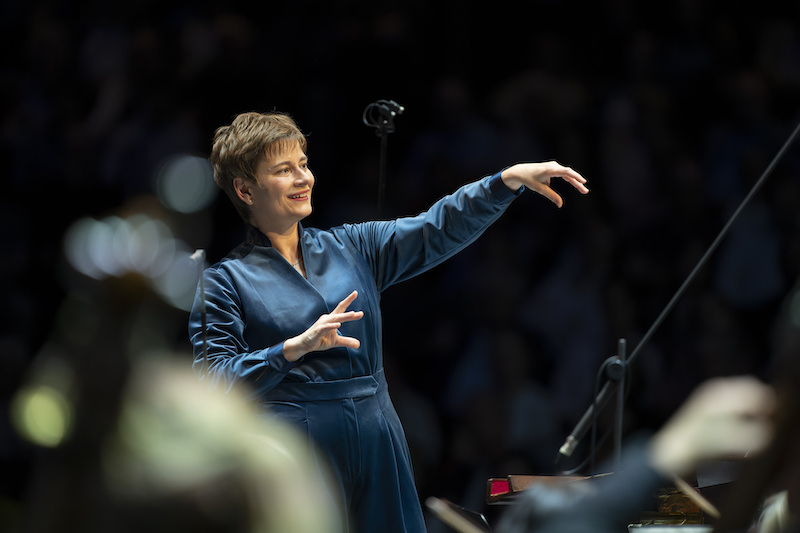 We were on more familiar ground with Beethoven’s Violin Concerto and Brahms’s Fourth Symphony. The Beethoven was a top-five favourite of mine when I was about 12, but it’s a long time since I’ve heard it. Tobias Feldmann’s reading reminded me what a collegiate piece it is, with the violin on the same side as the orchestra, unlike the struggle for dominance of many Romantic concertos. Feldmann played like the first among equals, happy to fly above the orchestra, but his sound always grounded in what was going on around him. I was struck afresh by the radical timpani part: is there a concerto with a more important one? From the four-note tattoo that kicks things off, Paul Turner was the driving force of the piece, although not through brute force but rather subtle persuasion. Feldmann was muscular when he needed to be, but was most engaging in the lyrical Larghetto and in the perky theme of the finale. Anja Bilhmaier (pictured above by Andy Paradise) absolutely entrancing to watch, always a twinkle in her eye, and lovely horizontal arm gestures giving a broad sweep in preference to the up-and-down of many conductors.
To finish was the furrowed brow of Brahms’s Fourth Symphony. Serious in intent, deeply intellectual, intricately constructed – but not perhaps easily lovable. Bihlmaier found a Viennese elegance in the opening, and other more relaxed, dancing moments, but also an intensity where that was needed, aided by a very tight wind section, in their punctuating chords. The second movement had a pleasing sense of intermezzo, a Bihlmaier encouraging a lightness of touch, and in the third movement fun almost threatened to break out, as the shackles came off. But it was back to seriousness for the monumental finale, in which Bihlmaier built up quite a head of steam in the final pages, the orchestra her very willing companions.





Add comment