

This beguiling “semi-staged” performance of Mahler’s First Symphony is the latest attempt in a growing movement to interrogate the relationship between classical music performers and their audiences. It’s strongly reminiscent of the point when theatre directors were ripping up the rulebook in the Nineties, whether they were staging their works in site-specific locations, plunging audiences into complete darkness, or subverting expectations with new uses of video projection and puppetry.
Inevitably there were misses as well as hits, but thirty years on, there’s no doubt that the theatre scene is considerably richer and more sophisticated for this intense period of reinvention. One of the chief furnaces of creativity – and one which every self-respecting critic made sure they were visiting monthly – was the Battersea Arts Centre, which was run by Tom Morris, who was rewarded for his vision by being taken on as associate director of the National Theatre.
A little over a decade ago, Morris turned his attention to the classical music world through such ventures as the Bristol Proms, which brought their own blend of experimentation and subversion. His latest contribution to the classical music renaissance is a version of Mahler’s First Symphony that’s as enjoyably revealing as it is inclusive. It should be appreciated that Morris is a man who could quite easily be resting on his laurels – the return this month of War Horse to the National Theatre, for which he was initially co-director and is now sole director – has won five-star raves across the board. But at a point when the Aurora Orchestra is wowing us with semi-staged performances from memory, the Southbank Centre is pairing up orchestral music with everything from film to acrobatics, and Through the Noise is bringing classical musicians to nightclubs, this holds its own in the ongoing re-examination of what classical music performance might be.
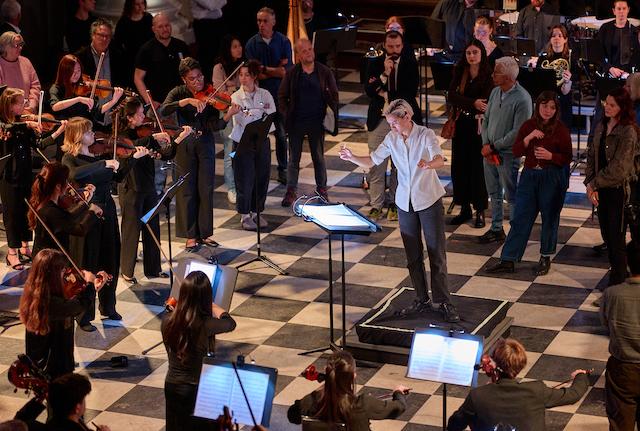
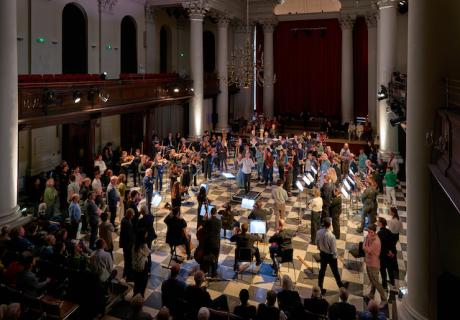
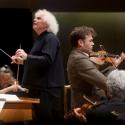
I’ll get the minor gripes out of the way first – there were occasional smudged notes, and the expressive range did not always fell as if it could propel you to the top of the mountains that Mahler loved so much. Yet there was plenty of magic in this reworking that Morris has done in collaboration with the conductor Stephanie Childress and the Sinfonia Smith Square Orchestra – which was set up for young musicians at the start of their career. Smith Square Hall was reconfigured so that the musicians were arranged at the centre, and the audience members sat around the edges. In the spoken introduction from Morris and Childress, Childress talked about Mahler creating a “surround sound” effect with his orchestra, something that we were invited to experience by walking through the players as they performed.
The lights dimmed as the strings played the sustained A that opened the first movement, hypnotising the audience with the gentle whistle of bows being drawn over strings. Gradually the orchestra’s musicians processed through the semi darkness as they took up their first positions for the evening. Pinpoints of white light on top of the music stands looked like a miniature galaxy of stars. As the woodwind started to chirrup like birdsong, and the horns introduced stripes of gold, it felt like watching a pastoral landscape slowly coming to life at sunrise.
The moment the orchestra was in place, members of the audience didn’t hesitate to get up to start their alternative experience of the symphony. An eight-year-old boy was transfixed as he stared at the harp, while I began my journey immediately behind the timpanist as he subtly checked the tuning of his drums. Wandering round the edges of the orchestra, it was fascinating either to experience textures from the music that you hadn’t noticed before, or simply to look at the score over different musicians’ shoulders. Some audience members bravely invaded the space between the musicians and the conductor straight away, scrutinising them like scientific specimens, while others stood next to the musicians quietly enjoying the cultural intimacy.
One esteemed critic has questioned the 3D aspect of the production, commenting that as a conductor Mahler “wanted absolute control over instrumental balances and blends”. I would counter that what you lose in perfect balance, you gain in heightened appreciation of the jostle of dialogues between different instruments in the orchestra. At the end of the first movement, the orchestra reconfigured, and I walked over to be next to the cellos and double basses. This proved a fascinating vantage point to zoom in on the way the spiky pizzicato of the cellos was answered by the swooning lilt of the woodwind, or the jaunty rhythms of the double basses being eclipsed by the horns and bassoons.
That stronger sense of the different voices brought with it a greater appreciation of how this work bridged romanticism and modernism, never more so than in the third movement, where the sombre Frère Jacques theme interchanged schizophrenically with wild klezmer-style folk music. Some members of the audience started dancing during the folk passages, though the mood quickly turned more sober with the return of the opening theme.
The final stormily agitated movement (Stürmisch bewegt) began with a flash of lights that some might have found excessive – but I didn’t – followed by angry red lighting, which I did. There’s enough heat and anger in the music and there’s no need to signpost it in this way. Still, it was thrilling to be amid the musicians as they shifted from the tempestuous to the swooningly lyrical to fleeting echoes of birdsong in the Alps. At the triumphant ending, sitting on the floor, it was possible to feel the vibrations from the drums through my spine.
This was not a definitive version of Mahler’s First Symphony, but it felt like an important one – and there was no mistaking how enraptured the audience members were. Morris’s experiments may or may not lead to the classical equivalent of War Horse – more importantly they’re breathing oxygen into a scene with an increasingly broad range to offer to classical music lovers of all persuasions.




Add comment