

There was so much to be thankful for throughout the three days I spent at the Aldeburgh Festival this year. First, of course, to have struck gold in so many of the concerts I caught was lucky enough in itself. But the context has never felt more vital as breezes cooled the beach at Aldeburgh and the Alde estuary at Snape while London sweltered in unnaturally high temperatures and a humidity quite different from the fresh airs of the Suffolk coast.
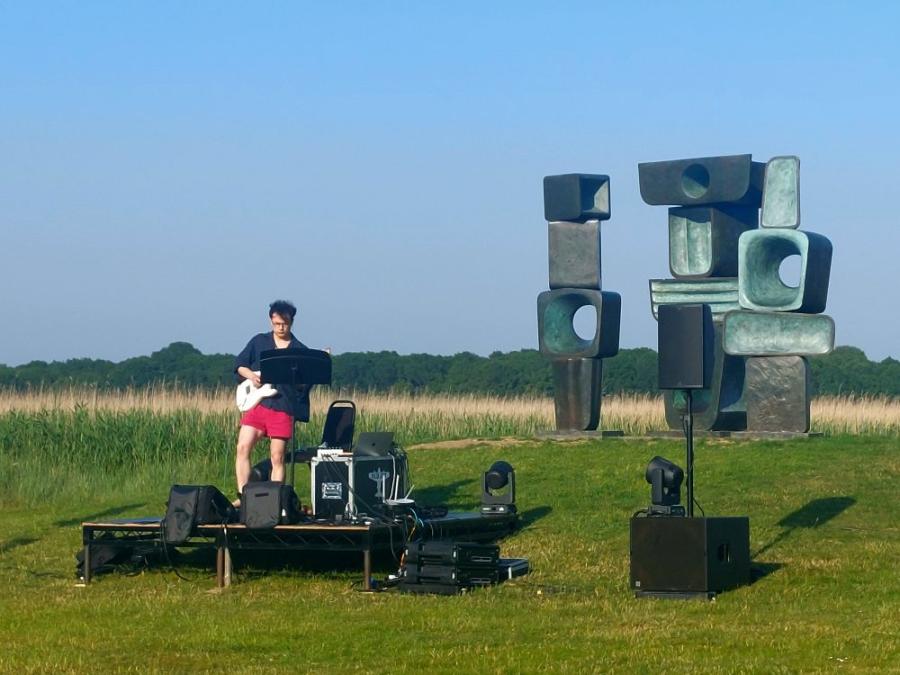
My last afternoon, after an emotional workout in Aldeburgh's Jubilee Hall (see below), was simply magical: a walk from Snape towards Iken that never produced a sweat or any noise other than the wind in the clumps of trees and the very occasional birdsong. Back on the lawn outside the Maltings, in front of Barbara Hepworth's Family of Man - the best-sited group of sculptures I can think of - that most phenomenal of guitarists Sean Shibe was rehearsing the late evening programme of electric guitar music, much of which he's already given classic status: among others, Steve Reich's Electric Counterpoint and Shibe's adaptation of Julia Wolfe's LAD, originally for nine bagpipers resounded around the reed beds in the late afternoon light (pictured below).
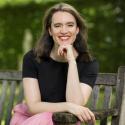
Alas, I was on my way back to London by the time the concert started, hitting the heatwave at midnight before leaving it again on a Friday morning train to Scotland. But Shibe had already helped create the ideal vision in a perfect Britten Studio programme with fellow Scot Nicky Spence and a young pianist who more than held her own, former Britten-Pears Young Artist and multiple prizewinner Francesca Lauri (pictured below with Spence).
You could not have predicted from the schedule who was going to work with Spence on what. The six mesmerising songs from Schubert's Schwanengesang - one Rellstab, the famous Serenade, and five great Heine settings - were an intense collaboration with Shibe. Spence, like his equally amazing fellow tenor Allan Clayton, can run the gamut of tone and volume. Having heard Vickers in the voice at the start - Spence is now, if you put him in a category, a Heldentenor - I was amazed at the sensitivity and introspection in all the Heine mood-pictures. Shibe's ability to draw you in to listen more closely was at its best in "Ihr Bild" and "Am Meer", while "Der Doppelgänger" rose from spooky start to terrifying climax. Nor sure that Spence should have broken the mood to comment, with wit that for once didn't quite hit the mark, on Shibe's tuning up, but poise was quickly restored in the music.
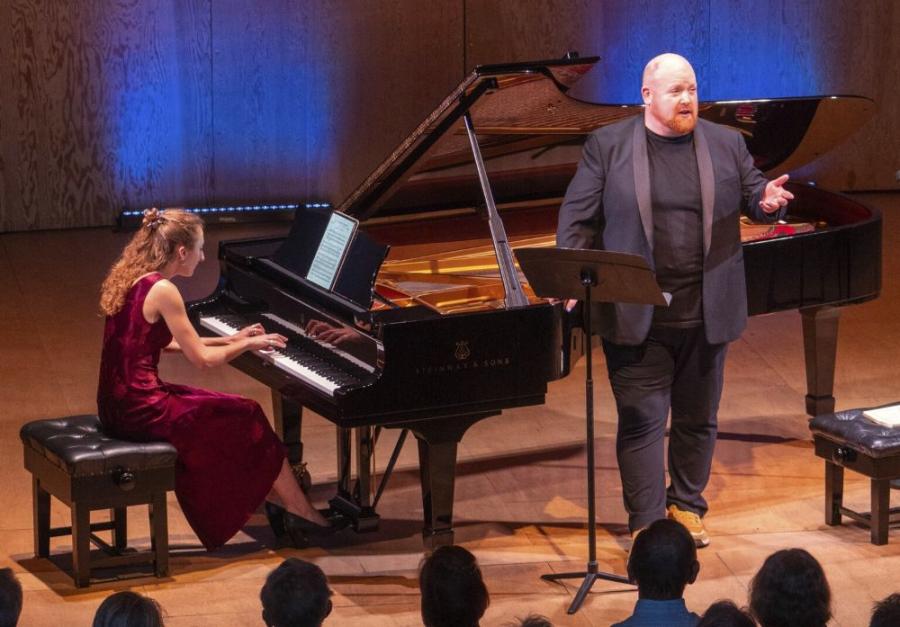
I've heard Spence before in Britten's late song-cycle Who Are These Children? - it has to be one of his most impressive calling cards - and the often epigrammatic poems of William Soutar run the gamut from playful to (once again) frightening. Lauri's deft touch helped bring off the wisps of comedy and there could have been no more impressive conclusion, either in the writing or the performance, than "The Auld Auk". Liam Bonthorne and Benjamin Mead had interspersed the songs with others from Cheryl Frances-Hoad's Magic Lantern Tales in last year's Britten Weekend at Snape, a bold idea, but undoubtedly Who Are These Children? works best as an uninterrupted sequence.
The point at which the recital went even deeper cast its magic through to the end; Shibe's echoes of the Earl of Essex's exquisitely-set meditations on retreat in Britten's Second Lute Song from Gloriana intensified the dream-idyll, and tears shed carried through to the vivid spirit of "Ca' the Yowes", Lauri resonantly kicking off four Britten folksong arrangements shared between the three. Finally, as encore, an ineffable version of McCartney's "Here, There and Everywhere" proved that it's up there among the greatest songs of all time. Perfect.
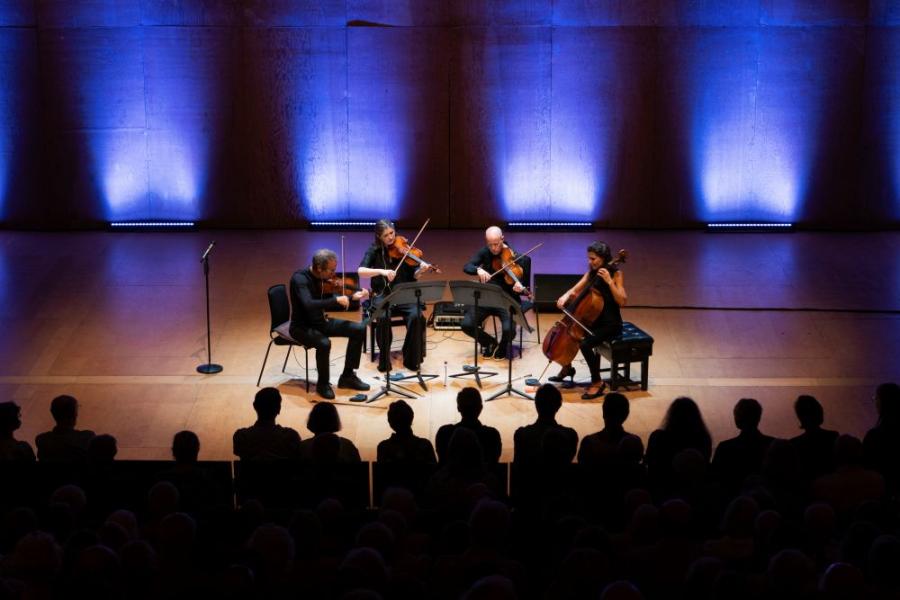
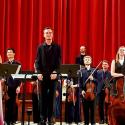
In the previous day's Britten Studio concert, the ever-engaging and hard-working Carducci Quartet (Matthew Denton, Michelle Fleming, Eoin Schmidt-Martin and Emma Denton pictured above) made the most impact with a World Trade Centre memorial piece I hadn't heard live before, Steve Reich's WTC 9/11, following Different Trains' principles of finding melody and harmony in recorded spoken word: here fragmentary voices from the time of the horror, memories of witnesses and psalm recitations from those who sat with the bodies - so song itself ended up as the balm.
This was a perfectly proportioned sequence. Whereas even though Kurtág's 12 Microludes are, as the title suggests, aphoristically brief as the title implies, they intrigue as soundscapes rather than compel as a whole. The now 100-year-old composer is either a perfectionist or a control freak - or both - as first violinist Matthew Denton's memories of the quartet's studies with him implied, one minute of music rehearsed over a whole day.
In the second half, a first-rate Adagio (Poem) by the remarkable Rebecca Clarke more than held its own in the company of Debussy's String Quartet: silvery-fluent performances both, and curiously it's Clarke who leads first-rate material the most impressively un unexpected directions. I heard the Carduccis open a concert at the Dublin International Chamber Music Festival with this brief masterpiece, and it still doesn't give up all its intriguing mysteries.
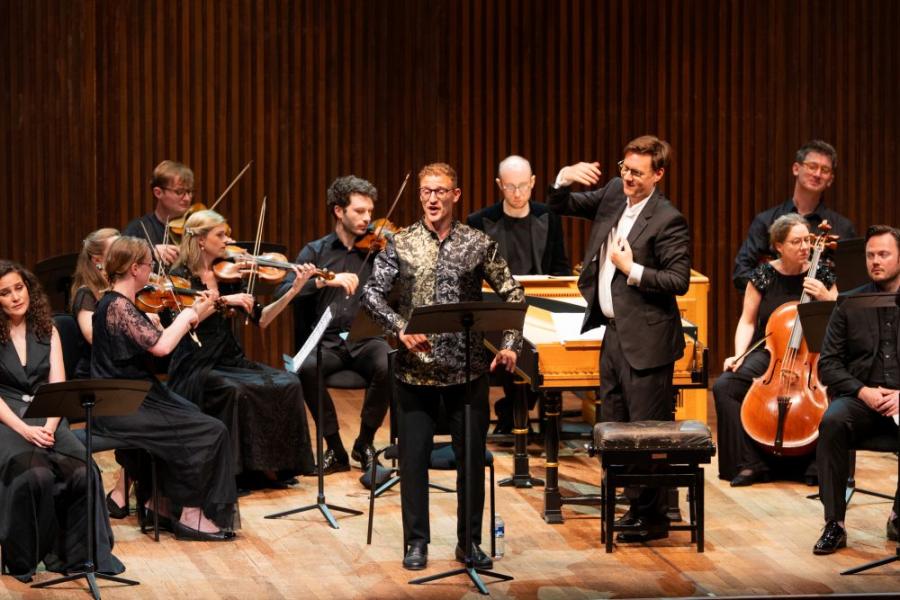
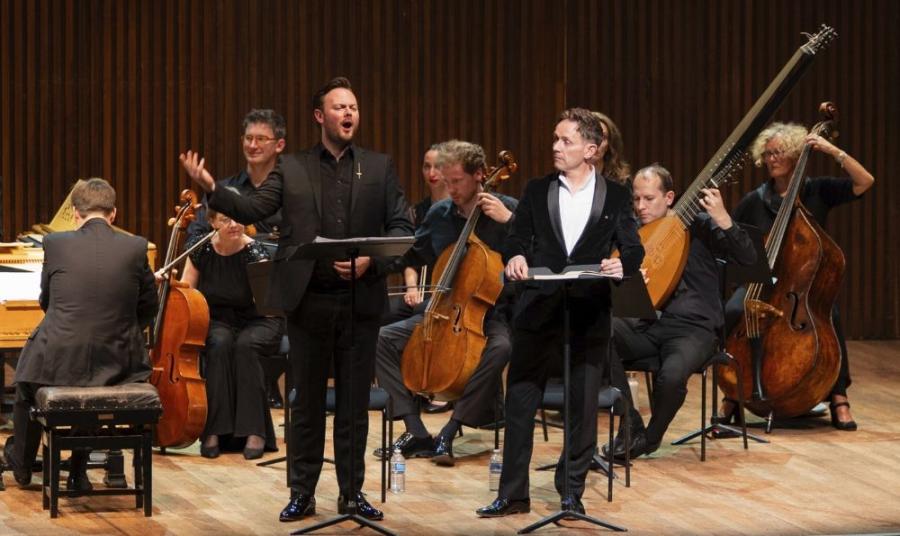
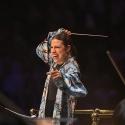
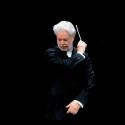
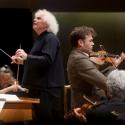
Philosophical reflections on the passing of time and what beauty needs to do about it are given consistently entertaining form in the 21-year old Handel's inventive semi-opera Il trionfo del Tempo e del Disinganno (Disillusion). La Nuova Musica with a fine quartet of soloists in the main Snape concert hall never let our attention slip for a moment. David Bates has evolved from a conductor of unwieldy gestures to one of focused energy, encouraging his fine players to take delight in spirited energy.
The nominal star here was sopranista Federico Fiorio as Bellezza (pictured above with Bates), unusual casting which worked, though despite the brilliant top it's not a meltingly beautiful sound, so crucial for the beautiful denouement aria. Whereas Iestyn Davies proved still to be on top limpid form as Disinganno. Soprano Chiara Skerath showed fun and involvement as flighty Piacere (Pleasure), while Nick Pritchard (pictured below singing with Davies looking on), most singular and thoughtful of tenors, showed more vividness in the recits than the arias, where the orchestra might have been kept down a little. Maybe it's inevitable that one enjoys the flashier Part One to the journey of a soul in Part Two, but that's because Handel is Handel and not Bach.
For the full choral works, we had to wait on a very welcome return to the beauties of Blythburgh Church, and a very ambitious programme of Britten gems interspersed with anthems and madrigals by Weelkes and Wilbye, magisterially despatched by the (professional) Aldeburgh Festival Singers, conductor James Burton and organist Richard Gowers.
While proof of Britten's ineffable word-setting rested with the fact that I could remember every phrase of the Festival Te Deum despite not having sung in it for over 40 years, the other three works by him on the programme were ones I hadn't experienced live. Rejoice in the Lamb captures the essence of Christopher Smart's naive and personal form of worship with some delicious commentaries from the organ (famously so when considering cat and mouse). The solos were all taken with strong personality.
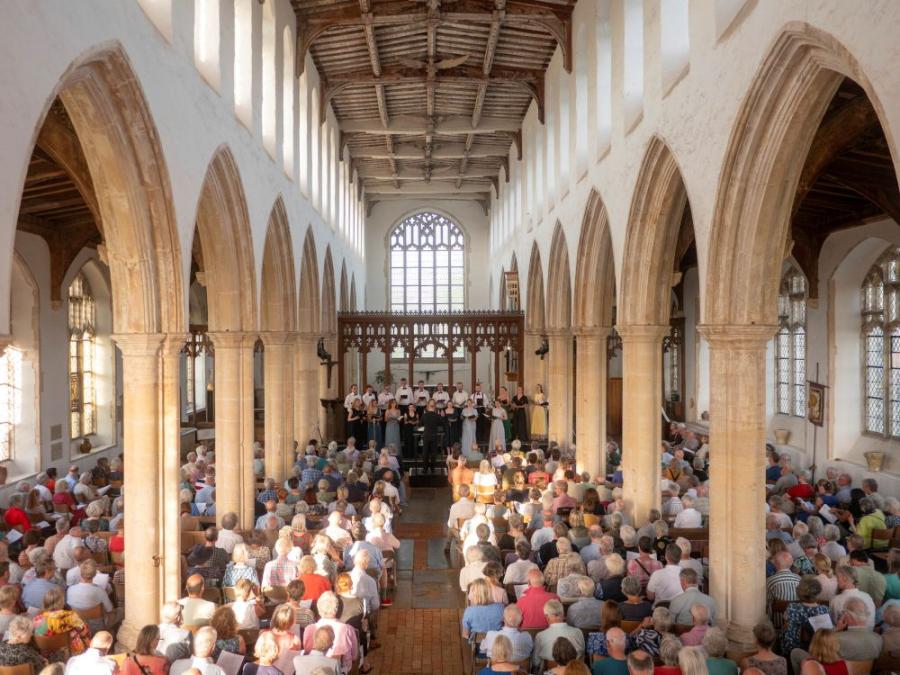
The 1956 Antiphon, to equally direct words by George Herbert, played with the main choir in front of the rood screen and three angel voices from the back of the church, complementing those justly celebrated along the nave roof. Most difficult came last, as it more or less did in Britten's life, Sacred and Profane of 1975, alert as ever to many of the strange possibilities in its medieval texts: none stranger than the concluding black comedy of "A death" ("Then rests my house upon my nose/For the whole world I don't care a jot" in the modern rendering of the last two lines).
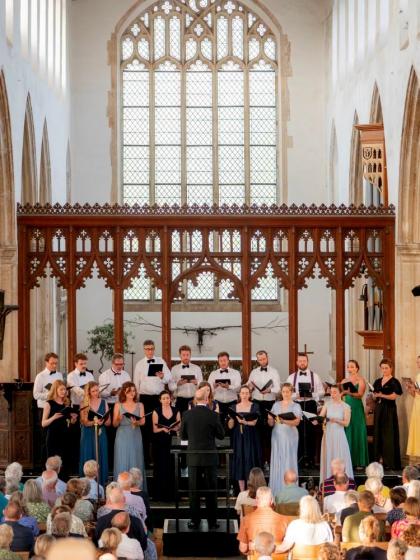
In between, Wilbye seemed to have the edge over Weelkes, especially in the almost Gesualdo-like anguise of "Death hath deprived me", his homage to his close friend and fellow madrigalist Thomas Morley. But Weelkes came close in expressive emotion with "Weep, weep, mine eyes". Deepest thanks to this team for pulling off so tough a programme.
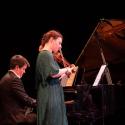
I stand even more in awe of Maria Włoszczowska, an as yet unsung great among violinists to stand alongside the likes of Janine Jansen, Lisa Batiashvili and Vilde Frang. With obvious sincerity, she spoke first in the Jubilee Hall about the honour of presenting, with pianist James Baillieu, a homage to the music Britten and Menuhin played on a shattering visit to a part-destroyed Bergen-Belsen in July 1945. What the programme was exactly, we don't know: some idea has been given by Auschwitz and Belsen survivor Anita Lasker-Wallfisch in the letter she wrote to her cousin three days after the event, noting that "I cannot imagine anything done more beautifully" than the playing of the accompanist - whom she didn't know at the time.
The vagueness left Włoszczowska and Baillieu free to make their own dedicatory shape. The violinist admitted she had never played the supreme challenge of the Chaconne from Bach's Partita No. 2 at the start of a concert before. It will always stand as the epitome of German culture's immortality in the face of unspeakable Nazi horror, and I've never heard a more moving performance, by virtue of Włoszczowska's unflashy threading through all the variations, perfect intonation and rapid runs all to be taken for granted. Even Beethoven, in the Adagio sostenuto-Presto movement from the "Kreutzer" Sonata, felt more surface-vital after that.
Baillieu might have reined in his foot-stamping exuberance here just a little, though he didn't overwhelm his more introspective violinist. In the second half which brought joy and consolation, as Britten and Menuhin surely did to all those starved souls, if only for the duration, the partnership was perfect. Light-footed sunshine graced all the memorable melodies of Grieg's First Violin Sonata, while the transcription of Debussy's gift-to-be-simple "Girl with the Flaxen Hair" went straight to the heart. Tchaikovsky waltzes ended the official programme with a good grace, but the recital ended with the audience-stilling intensity of Ravel's "Kaddish". We're told there was 30 seconds' silence after its recent performance in Bergen-Belsen; this one lasted even longer.
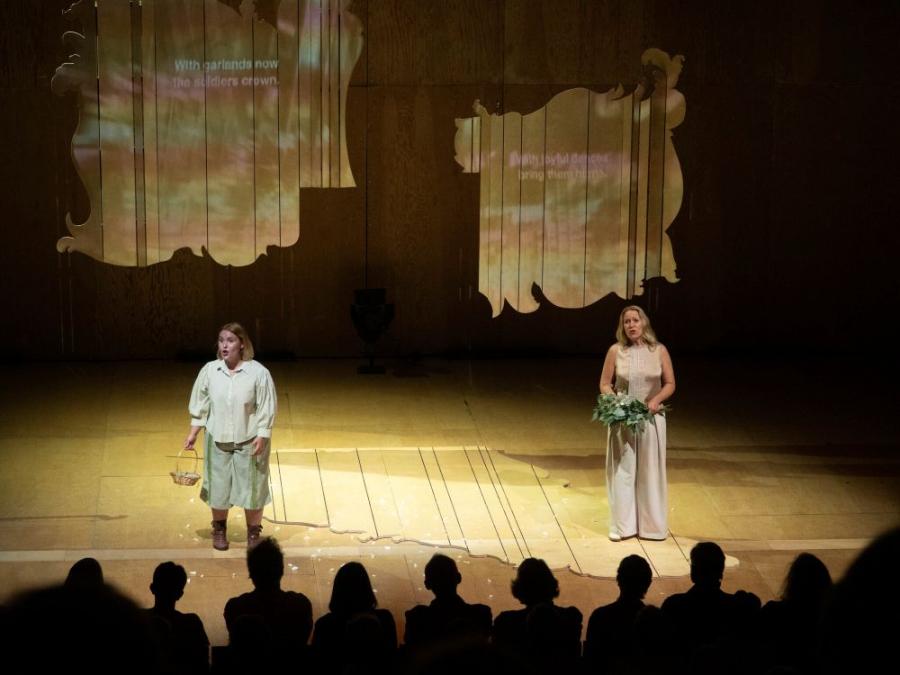
The last event I witnessed, In the Belly of the Beast, was the only one not entirely riveting from start to finish. That may have been because Élisabeth Jacquet de La Guerre's early 18th century cantatas sometimes outstay their welcome, in contrast to the proportion of everything else I'd heard. It was ambitious of director Jennifer Fletcher, Mahogany Opera and the Dunedin Consort to try and give three dramas about Adam, Jonah and Jepththa - Biblical men in contrast to the women of the previous venture, Out of Her Mouth, albeit with their stories told from a female perspective - a dramatic context. But the extras didn't add much, and focus remained on the expressive singing and playing (two, briefly three, players downstage right, sopranos filling the rest of the space). And the English translation, aiming for a contemporary flavour, often felt awkward.
Carolyn Sampson, with characteristic radiance, told of Adam's expulsion from Eden (no Eve), while Mariana Rodrigues, with greater dramatic intensity, sent Jonah into the belly of the whale via a rather prim storm. They joined in the painful myth of human sacrifice (the two pictured above), Rodrigues as the doomed king's daughter making a spellbinding exit up the auditorium stairs (the one truly dramatic moment of the sequence). My own exit was less graceful, terminating in the furnace that greeted me when I opened the door of my London flat, but the three days had provided plenty of air-conditioned visions.



Comments
Nicky Spence and Sean Shibe
Thanks for writing about the mesmerising Aldeburgh Festival concert with Nicky Spence and the guitarist Sean Shibe, including songs from Schubert's Schawnengesang alongside Britten. Shibe, new to me, is a clearly a great musician. His structural understanding of the songs, and disciplined instinct for how to support a lieder singer, was up there with the great names of the past. And the aching poetry of Spence's singing was astonishing.
Sean Shibe
He was clearly one of the great originals among musicians from the start. First he drew us in with the quietest playing, then he blasted us with the electric guitar transcriptions featuring his recorded self (in Anstruther Town Hall as part of the East Neuk Festival was where I first heard him. We were given ear plugs at the door, but the sound was well enough adjusted for us not to need them). His partnerships and commissions will continue to grow and flourish.
Add comment