Who needs hallucinogenic drugs when we have Debussy's two books of Préludes? In the hands, that is, of a pianist magician who holds the key to this wild parade, demi-real wonderland, call it what you will. I've only heard two wizards equal to the whole sequence: on disc, Krystian Zimerman, graced by a wide recorded range the old masters could never command, and now, in the concert hall, Alexander Melnikov. Between them, they prove that Debussy can be not only ravishingly remote, but violent, too, and scary as hell.
Debussy's curiosity spans thousands of years, from ancient Egyptian funerary vessels to blackface American minstrels in Eastbourne - where, incidentally, the Channel views may have inspired the orchestration of La Mer. And where else would a water-sprite be followed by the members of the Pickwick Club roaring the National Anthem? Melnikov had the measure of each natural and human phenomenon in the gallery of 24 great paintings. It helped that he conjures the range of a full orchestra, a gift accorded to few pianists (Sviatoslav Richter was one who mastered it; comparisons may not be helpful but Moscow-born Melnikov cites him as a model, and seems to be next in line as Richter's heir to the mighty Elisabeth Leonskaja). The sounds varied from the sliver of a line barely heard at the end of Canopes to the rockets that metaphorically blew the roof off the Wigmore Hall in "Feux d'artifice" ("Fireworks). How adept, too, Melnikov was at capturing the strangenes with which Debussy works both ends of the keyboard in song, an increasing feature of the second book.
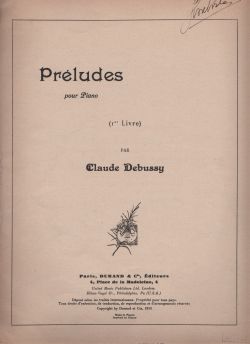 It was the intellect setting the seal on the imagination which made this a great performance rather than a merely excellent one. Never more so than in "La cathédrale engloutie", the heart of Book One; you could always tell when Melnikov was preparing for the Big Numbers by his selective imitation of Rodin's Thinker before embarking. The dazzling radiance of the holy glory which rises from the sea in radiant block chords was followed by intense sadness that the vision must pass; that it returned, becalmed though distant, at the end, brought consolation. Its parallel in Book Two was the stomach-flipping mystery of "La terrasse des audiences du clair de lune" ("The terrace of moonlit audiences"), another fugitive vision, this time of height rather than depth.
Subtle hesitations wrought extreme desolation, as in "Des pas sur la neige" ("Footsteps in the Snow"), while at the other end of the human range of emotions, "Bruyères" ("Heathers") came across as an ecstatic, inspired improvisation. So great were the contrasts, guided by intense care over articulation even when the sustaining pedal cast incandescence, that neither half felt its length; both seemed to whizz by, despite those stretches where time becomes space. Note-perfect? Not entirely, but it doesn't matter, given the absolute clarity of intention. After setting the hall alight, Melnikov returned to calm seeming simplicity with "The Little Shepherd" from the Children's Corner Suite. This is a pianist who can do it all. His next epic at the Wigmore has to be the three Prokofiev so-called "War" Sonatas, which he has just recorded with equal mastery.