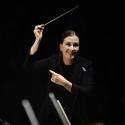
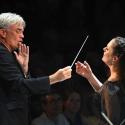
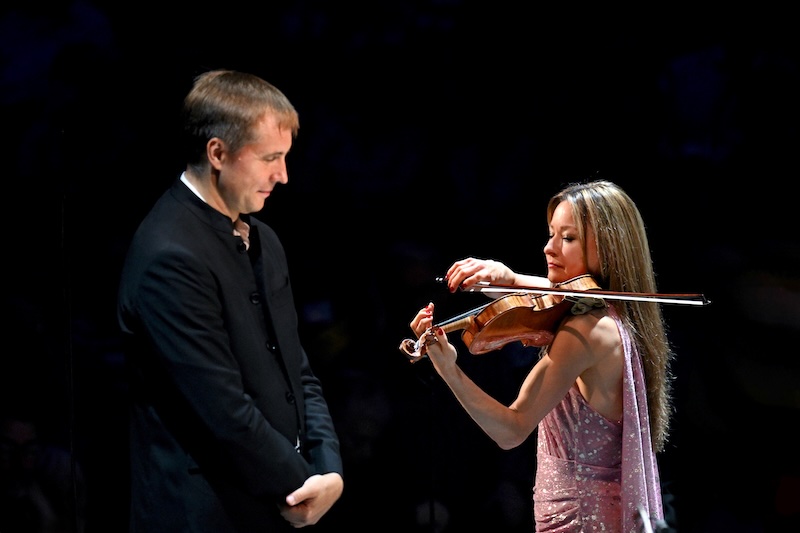
The matinée (★★★★) was a set of three cityscapes, depicting Rome, Rio and London. Respighi’s The Pines of Rome is a terrific orchestral showpiece, low on memorable musical content but high on vivacity, gorgeous in its Technicolor scoring and performed here with pizzazz by the RPO, especially in the second and fourth movements. After the rumbustious opening movement, there is a sudden chilling of the temperature as we move to the Roman catacombs, frozen string chords supporting a haunting off-stage trumpet. The fourth movement is a giant crescendo underpinned by a trudging timpani, before the brass reinforcements arrive in a gleaming climax. The ending was a blaze of orchestral colour, Vasily Petrenko (pictured below) acclaiming his band with arms outstretched.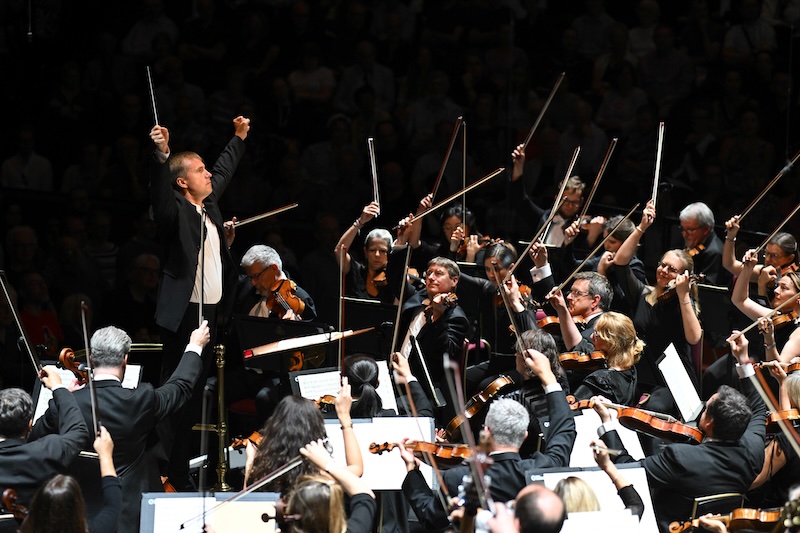 I know – and really like – Darius Milhaud’s Le Boeuf sur le Toit, a salad of Brazilian-inspired tunes which swings along with joie de vivre and a (for 1919) very fashionable spicing of bitonality. It’s charming, breezy and, if unquestionably lightweight, a lot of fun. I hadn’t previously heard (or even been aware of) the composer’s own version with solo violin, and honestly he probably shouldn’t have bothered. The violin part, though played with a mixture of sultry warmth and extrovert shine by Arabella Steinbacher (pictured below), really doesn’t add anything, even at times distracting from the orchestral bustle. The interpolated cadenza about halfway through, although spectacularly played, interrupted the flow and left me pining for the original.
 Vaughan Williams’ A London Symphony is a chunky piece – even in its slimmed-down later revision it runs for some 50 minutes, and it perhaps runs out of steam a bit towards the end. But the slow second movement was a highlight of my Proms season, the essence of Vaughan Williams, the RPO’s strings hushed and still under fragile solos by Patrick Flanaghan (cor anglais) and Matthew Williams (trumpet). The whole movement was cleverly paced by Petrenko, with plenty of room for the pathos to emerge of its own accord.
I was a bit more ambivalent about the evening show (★★★). The Ruth Gipps that opened, an eight-minute tone poem on painting by William Blake, written by the 22-year-old composer in the midst of World War II, has all the uncertainty of the time in which it emerged. It’s somewhat bitty in its construction and, although the orchestration is confident, it felt somehow less than the sum of its parts.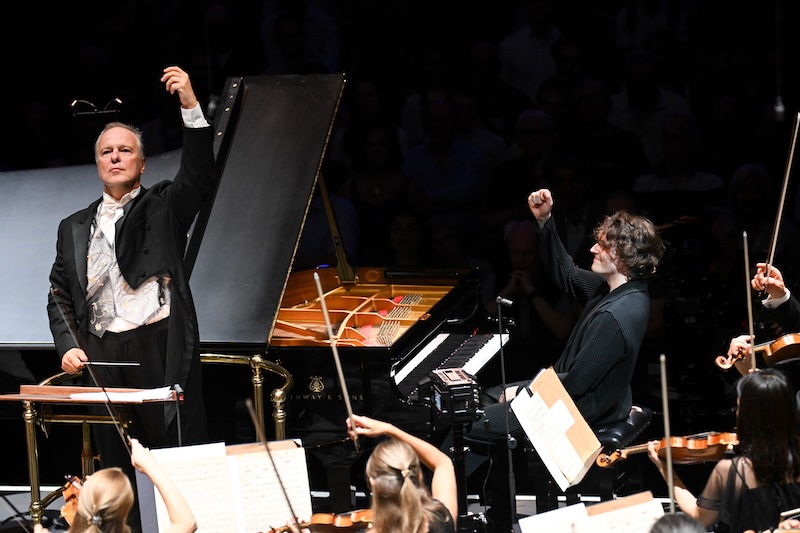 There is no doubting the composer’s voice in Grieg’s Piano Concerto, written when he was just 24 and played by the 24-year-old Austrian Lukas Sternath (pictured above), on his Proms debut. The first movement took a little while to warm up, feeling a bit tentative, both in orchestra and solo part. But the second-subject dialogue between cellos and piano had a languid sureness that set things going. The second movement, which makes me melt, was lovely, Sternath playing with poise, which became a perky brio in the finale. And his encore, Richard Strauss’s Morgen, had the whole hall leaning in.
 The second half was given over to Arthur Bliss’s large-scale cantata The Beatitudes. I’m a big Bliss fan, and have welcomed the chance to hear more of his music in this 50th anniversary year, but I’m afraid The Beatitudes is a bit of a dud. Written for the same celebration of the re-opening of Coventry Cathedral that introduced Britten’s War Requiem, The Beatitudes was roughly elbowed aside in a way that was embarrassing and upsetting for Bliss. It would be a lovely end to the story if it turned out to be an unheralded masterpiece, but it isn’t.
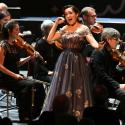
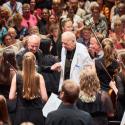
This is Bliss in formal and portentous mode, as if striving too hard to write something fitting for the occasion, missing the lightness and wit of his best music. The superb solo singers Elizabeth Watts and Laurence Kilsby (pictured above) did their best to sell it, the BBC Symphony Chorus and BBC Singers were their usual wholehearted selves, and Sakari Oramo led the whole thing with aplomb, but the minutes hung a bit heavy. There are some gripping passages of orchestral writing, contrasting with some lovely moments of calm and reverence from the soloists, but I was left ruing the missed opportunity to programme the Colour Symphony, or Meditations on a Theme by John Blow, as more fitting monuments to the great Sir Arthur.