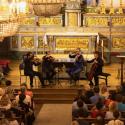
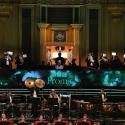
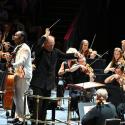
Many Londoners would already have experienced the musicality incarnate of Peter Whelan and his Irish Baroque Orchestra. A smaller ensemble rocked two of Irish National Opera’s Vivaldi specials in the Linbury Theatre – one a major award winner – and the best Messiah I’ve ever heard in the Wigmore Hall. Their first Prom was pure celebration, and how they filled the Royal Albert Hall, both collectively and solo-wise, in the revised Dublin version of Alexander’s Feast.
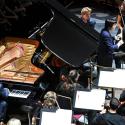
Surprisingly, this is only the second ensemble from the Republic of Ireland to visit the Proms; I was in the Arena 46 years ago (ouch) when the (then) New Irish Chamber Orchestra revealed the beauties of four Bach cantatas to a very sparse audience. This Handel cornucopia was gifted a sumptuous ensemble wowing a nearly full hall: a 42-strong Irish Baroque Choir as opposed to the 12, soloists included, for the Wigmore Messiah, nine woodwind and four horns to help out with a concertante extravaganza between the three parts in the spirit of the two organconcertos heard at the Fishamble Street, Dublin performance in the annus mirabilis of 1742 (the year of Messiah's unveiling to the world in the same venue).  The essence of Alexander's Feast is nothing like the dramatic oratorios of the 1740s, more an Ode to Saint Cecilia who makes a late appearance after her forbear, Timotheus, has called all the tunes, celebratory, amatory, melancholy or bellicose, at the banquet held by the Macedonian conqueror to mark his victory over Paersian Darius: "he [Timotheus] raised a mortal to the skies,/She [Cecilia] drew an angel down", in Dryden's serviceable text.
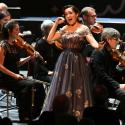
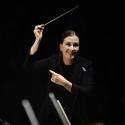
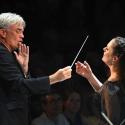
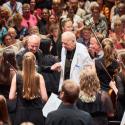
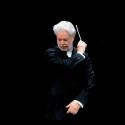
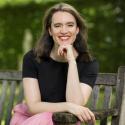
Handel's fluency, though, is breathtaking, with recits sounding like arias, solos and duets giving way to elaborate choruses, and the master of it all last night was the sinuous and word-insistent Whelan, one of those conductors like Yannick Nézet-Séguin and Mirga Gražinytė-Tyla through whom music seems to flow like an electric current. From the Overture onwards, crescendos grew to incomparable lushness, while hushed dynamics were used to draw the listener in over the big spaces.  Painting the scene with the clearest words, the superb Irish Baroque Chorus was matched by the three soloists of the Dublin version. Rising (or, more accurately, risen) stars Hilary Cronin (pictured above) and Hugh Cutting (pictured below) projected an easy conjuring of every situation with top notes that radiantly rang with support from the warmth the Albert Hall has to offer at its best. Cutting, who moved me to the core in the IBO's Bach St Matthew Passion in Dublin, proved he's the best countertenor on the planet, good enough to convert a student of mine who'd been averse to the species when Alexander's Feast was performed in Dublin Castle.
In Part One, Cutting launched the "mournful Muse" in Part One, as the victor sorrows over the fall of his rival; and how glad we were that Whelan had worked with Donald Burrows on the reconstruction of "Your voices tune" at the start of the very short, blissful and non-Drydenesque Part Three, crowned by a rapturous soprano/alto duet and final chorus to sacred harmony. If tenor Stuart Jackson didn't at first benefit in the same way from the vast venue, he projected the full vividness of the jaunt in praise of Bacchus and later the rousing of the furies (a not entirely logical sequence of words from Dryden). Everyone has to convey the drama of every moment when Whelan is at the helm. The instruments came into their own, too. Leader Huw Daniel exquiaite complemented Cutting for "Softly sweet, in Lydian measures". In the rich Concerto a due cori in F major - four movements at the start of Part Two, the fifth and sixth between Parts Two and Three: all four horns, two in one chorus left, two in the other right, deserve a credit: Anneke Scott, Martin Lawrence, Bart Cypers and Peter Moutoussis added to the performance's glory.
What could possibly come after the jubilant final chorus? Answer: a crisp, bouncy "Hallelujah!", setting the perfect seal on an incomparably happy Prom. May Culture Ireland go on to support more debut Proms visits from the excellent National Symphony Orchestra and Irish National Opera, who have to bring their peerless concert Berlioz Béatrice et Bénédict with Fiona Shaw overcoming the selective masterpiece's dramatic shortcomings.