

The latest production of Tennessee Williams’s sultry, brutal yet poetic masterpiece is mainstream theatre that dares to go out on a limb. Directed by Benedict Andrews, it may occasionally miss a beat, but its risk-taking comes with an innate sense of the play’s scorching pathos and an unnerving, dare one say exhilarating taste for the jugular that matches that of its primal male.
Gillian Anderson is Blanche DuBois, the Southern Belle whose sanity is fading with her fortunes, riding the streetcar named Desire to the New Orleans home of her sister Stella (Vanessa Kirby) in a last-ditch bid for survival. Spinning fantasies and lies to conceal the frailty of her situation, Blanche becomes locked in a misguided battle for her sister’s affections with Stella’s blue-collar husband Stanley Kowalski (Ben Foster, pictured below) that she will lose in spectacular fashion.
This might be one of the funniest Blanches ever One expects Andrews to deliver a certain originality and muscularity in his interpretations. Even so, his staging within the Young Vic’s round, with designer Magda Willi, is particularly striking. For a start, the pair eschew the customary recreation of down-at-heel New Orleans for a minimal, all-white set comprising the bare essentials of an apartment – bed, dining table, kitchen, lavatory, bath; the whole is so neutral and anaemic that it could be a hospital ward – a fitting place, one might say, for the mental illness that’s about to enter.
They then send this world into a spin, literally, cutely choosing the moment of Blanche’s first drink (of many, many drinks) to put the set into a near-constant, slow revolve. As the actors glide before us in a whirl of costume changes, manipulations and boozy, emotional, sometimes physically violent confrontations, the direction lifts the drama outside space and time, accentuating its mythic quality.
 There’s another effect, of creating a space that might be an arena, for the battle between the moneyed and the working class, old America and the new, self-delusion and rough reality – Blanche in one corner, Stanley the other, Stella both the referee and prize. But if it’s a boxing match, it’s one between mismatched fighters, the more powerful of whom is happy to keep punching when the other is on the canvas.
The constant movement inevitably has its frustrating moments, when a sight line or a sentence drift away from you; intentionally or otherwise, a sudden stall in the revolve in the final scene left me cut off from Blanche in an appalling piece of timing. But these moments are outweighed by the sheer exhilaration of the invention, which also includes a powerful use of rock and blues (including PJ Harvey’s "To Bring You My Love") during scene changes that adds to the drama’s electrical charge. It’s not a production where anyone is likely to drift.
Anderson was born to play Blanche. She has the hauteur at her fingertips, and the cracked mysteriousness in her eyes; she’s played Miss Havisham, after all, another woman eaten up by the past. The airs and aloofness are perfectly in place at the outset, as she arrives in a gold dress and heels to match her blonde locks, with a Louis Vuitton bag that she casually leaves at the door for Stella’s landlady to carry through. This might be one of the funniest Blanches ever, as Anderson drapes herself around any vertical prop in order to flirt with Stanley, and inveigles one drink after another with the alcoholic’s cheeky deceit.
In the first act I would have liked her to show more of the cracks in Blanche’s fragile psyche. It’s as if the actress is capturing Blanche’s desire to hold it together a little too well. But there’s menace as well as comedy in her seduction of a newspaper boy – an echo of former promiscuity and scandal. And as Stanley dismantles her façade, alienating her local suitor (a fine Corey Johnson) in the process, and Blanche is forced to revisit her guilt over her husband’s suicide, the disintegration is spectacular and heartrending.
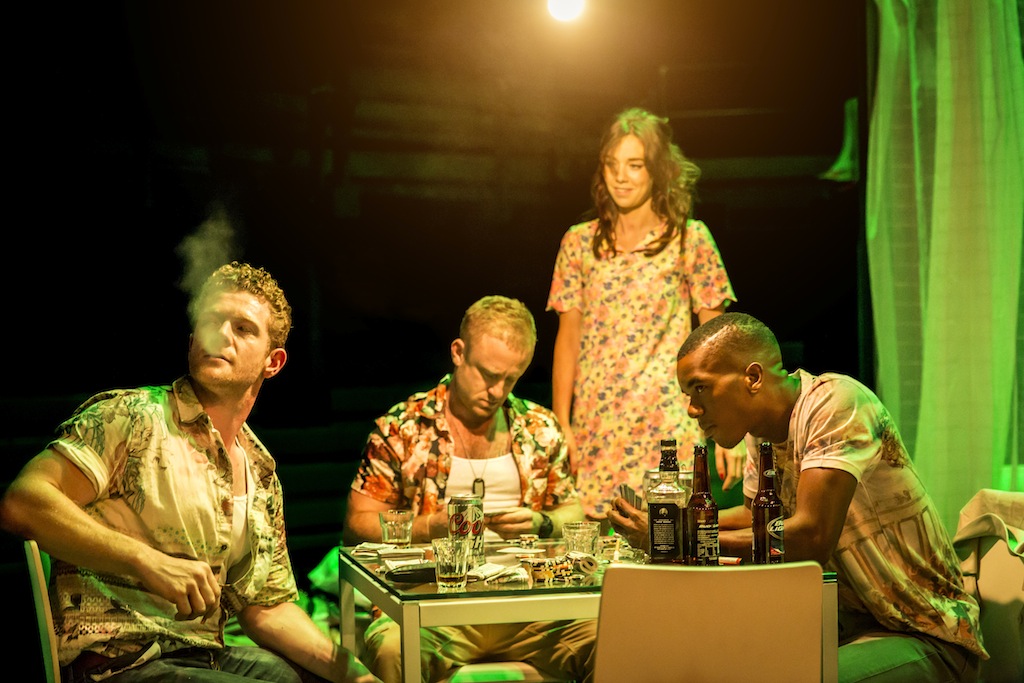 Though primarily a character actor in Hollywood films, and in just his second stage role, Foster is hugely impressive. Roaming the apartment like a pitbull, like Brando he captures both the ferocity and neediness of a man who knows that, romantically, he is punching above his weight. The scene in which he listens, unseen, as Blanche is describing Stanley as an “ape” is played with enormous subtlety, as is the chilling reversal of Blanche’s vain attempts at seduction, as he tells her, “We’ve had this date with each other from the beginning.”
As Stella, Kirby (pictured above, with Branwell Donaghey, Foster and Troy Glasgow) doesn’t resonate quite so well; it’s difficult to see her having come from Blanche’s world, or to see her in Stanley’s, yet there’s no tension to accompany the question. That said, we do believe her torn emotions between the two people. And her agonised scream of “Blanche” as her sister is carried off to the mental institution – suddenly rivalling Stanley’s famous cry for Stella herself – fittingly marks the play’s terrible resolution.
- A Streetcar Named Desire is at the Young Vic until 19 September











Add comment