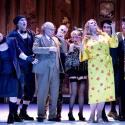
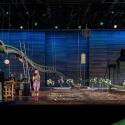
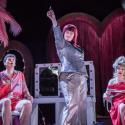
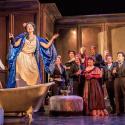
Love it or loathe it, the powerhouse effect is back at English National Opera. The era which gave its name to the sobriquet, that challenging time in the 1980s and early 1990s when Davids Pountney, Alden and Fielding skewed the stage and Mark Elder matched their vision in the pit, now has an equal. The ENO calendar year has just ended with Rupert Goold's Chinese restaurant shake-up of a Turandot , everything we saw beautifully thought out and focused to knife-edge brilliance, and every sound emanating from the ENO Orchestra and Chorus under Ed Gardner sensual-perfect. Alas, the kind of vigorous debate it's generated is hardly reflected in Susie Gilbert's hard-working, diligent history of the company.
Gilbert can't be faulted in keeping a firm grip on the progress of "Opera in English" from Waterloo's Cut to Sadler's Wells and on to St Martin's Lane. If, however, you're looking for a lively record of the many weird and wonderful productions which have processed through the cramped old house on Rosebery Avenue and the vast arena of the London Coliseum, your vision will be limited. There's a bizarre over-dependency on Opera magazine for comment, which means literate waspishness from Rodney Milnes, and some of the other critics quoted, chiefly Mozart-loving David Cairns, hit the mark. But opera critics are not, by and large, a very visual or theatre-friendly bunch, and we need much more from two who are, Tom Sutcliffe and Edward Seckerson. As it is, you'd get the unbalanced impression from reading this that the Pountney-Elder-Jonas powerhouse trio were far too reliant on trendy, self-repeating European theatre.
Since Gilbert seems reluctant to give her own opinions in the manner of Zoe Anderson's pithier Royal Ballet commentary (also published by Faber), we have to presume, and are sometimes told, that the often threadbare clutch of adjectives are drawn from her chosen critics. About the cast of Matthew Warchus's lively Cosi fan tutte, for example, we learn that "Mary Plazas was a sexy soprano Dorabella, and Susan Gritton a bright Fiordiligi. Toby Spence and Christopher Maltman were convincingly cocksure young bloods and Andrew Shore a commanding Don Alfonso". That gives me no flavour of one of ENO's most thoughtful, if quickly discarded, shows of the last decade. A line or two on the essence of many operas not all readers can be expected to know wouldn't go amiss, either.
True, production summaries are only a small part of this chronicle. The sometimes parlous state of ENO's future, an interesting subject in itself, often gets lost in acronyms and pound signs; recent management "difficulties" are brushed over due to confidentiality clauses. An important part of the picture, singers' relationships with the company, and the way a voice could be used in the vast barn of the Coli and discarded, never gets a look in.
So what's worth reading? All the early Old Vic history, certainly, enlivened by the extraordinary figures of Emma Cons and her niece Lilian Baylis, the nature of a theatre which was there to draw the masses away from drink but in which smoking was permitted. I learnt detail I never knew about the company's tireless touring efforts during the Second World War, keeping the flame of opera alive around the country on a shoestring, and about the frustrated search for a home on the South Bank. Key events at Sadler's Wells are vividly remembered by the ever-direct Charles Mackerras, one of Gilbert's liveliest mouthpieces (though the polyphony of experienced voices giving their wisdom in interview is too limited). And of course there comes for everyone interested in the subject a frisson of recognition on reaching the productions of one's youth.
This, then, smacks of a company-sanctioned history, thorough and well-proofed - though less well indexed - revealing the small warts but not the administrative cancers which nearly killed this most robust of patients. Disaster and imminent closure, it seems, were frequently very close indeed, and artistic identity often faltered; yet the brief of reaching out to a wider audience with cutting-edge direction and design is very much alive and well at the end of 2009.
Since Gilbert seems reluctant to give her own opinions in the manner of Zoe Anderson's pithier Royal Ballet commentary (also published by Faber), we have to presume, and are sometimes told, that the often threadbare clutch of adjectives are drawn from her chosen critics. About the cast of Matthew Warchus's lively Cosi fan tutte, for example, we learn that "Mary Plazas was a sexy soprano Dorabella, and Susan Gritton a bright Fiordiligi. Toby Spence and Christopher Maltman were convincingly cocksure young bloods and Andrew Shore a commanding Don Alfonso". That gives me no flavour of one of ENO's most thoughtful, if quickly discarded, shows of the last decade. A line or two on the essence of many operas not all readers can be expected to know wouldn't go amiss, either.
True, production summaries are only a small part of this chronicle. The sometimes parlous state of ENO's future, an interesting subject in itself, often gets lost in acronyms and pound signs; recent management "difficulties" are brushed over due to confidentiality clauses. An important part of the picture, singers' relationships with the company, and the way a voice could be used in the vast barn of the Coli and discarded, never gets a look in.
So what's worth reading? All the early Old Vic history, certainly, enlivened by the extraordinary figures of Emma Cons and her niece Lilian Baylis, the nature of a theatre which was there to draw the masses away from drink but in which smoking was permitted. I learnt detail I never knew about the company's tireless touring efforts during the Second World War, keeping the flame of opera alive around the country on a shoestring, and about the frustrated search for a home on the South Bank. Key events at Sadler's Wells are vividly remembered by the ever-direct Charles Mackerras, one of Gilbert's liveliest mouthpieces (though the polyphony of experienced voices giving their wisdom in interview is too limited). And of course there comes for everyone interested in the subject a frisson of recognition on reaching the productions of one's youth.
This, then, smacks of a company-sanctioned history, thorough and well-proofed - though less well indexed - revealing the small warts but not the administrative cancers which nearly killed this most robust of patients. Disaster and imminent closure, it seems, were frequently very close indeed, and artistic identity often faltered; yet the brief of reaching out to a wider audience with cutting-edge direction and design is very much alive and well at the end of 2009.
- Opera for Everybody is published by Faber and Faber at £25.
- Check out what's on in the ENO season
- English National Opera's website