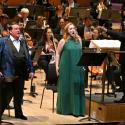
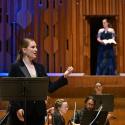
Mozart's Idomeneo is subjected to a famous bit of abuse in Milos Forman's Amadeus. "A most tiresome piece," a courtier critic sniffs. "Too much spice. Too many notes." As it happens, not a wholly inaccurate statement. The work is quite an exotic curry of an early Classical opera. And in last night's concert performance at the Barbican, conductor Thomas Hengelbrock and the Balthasar Neumann Ensemble presented the dish in as richly fruited, densely scented, dramatically packed a rendition as you could imagine. One could fully see why Enlightenment ears might tire of its pungent demands - and why we might delight in them.
Having said that, the colourful musical clothes hang off a rather stiff little Neo-Classical story. Idomeneo, King of Crete, has made a pact with Neptune. If Neptune saves him from a deadly storm, Idomeneo will sacrifice the first person he sees when he returns home from Troy. This turns out to be his son, Idamante, who is already in a tragic pickle, having fallen for a Trojan prisoner, Ilia, who feigns lack of interest. What rescues a slightly awkward dramatic road are objective correlatives - storms, monsters and gods - that allow Mozart to penetrate the inner life of his characters through symbolic colour painting.
Hengelbrock and his orchestra (who both memorably delivered the Royal Opera House premiere of the little-known Baroque opera Niobe, Regina di Tebe last year) wasted no time in developing the turbulent theme of the evening, with an overture that offered no steady ground whatsoever. They then mounted an impressive climb up that extraordinary opening exposition of what should be dead backstory with Ilia, the exquisite, effortlessly dramatic Camilla Tilling. The tension is passed onto Christina Daletska's Idamante, who fights with her love. Considering Idamante's suicidal thoughts, it wasn't inappropriate that Daletska should have such a fragile, pained tone of voice, but with the sharp oscillations of her vibrato juddering like a butterfly and constantly threatening to shred her vocal line it was sometimes a bit of an ordeal.
Steve Davislim was a subtle and lustrous presence as Idomeneo, internalising the squalls of his Act II aria "Fuor del mar" almost as brilliantly as the orchestra externalised them. Mozart's stormy neon colours cracked across the Barbican Hall at the hands of the soloists of the brass and woodwind sections and the busy timpanist, Stefan Rapp. Tamar Iveri was a supremely impressive last-minute replacement for Anna Caterina Antonacci as Elettra. She knew the score inside out. She displayed a surety with the emotional contours of this tragic character (a refugee in love with Idamante) almost better than her colleagues. Her mad scene, in which she becomes a thing of pity and terror, was a triumph. Again the orchestra lead the way, the strings digging so deep you could hear the wood of their bows clattering the body of their instruments. Hengelbrock had unleashed the hounds for this scene.
Yet for all the riotous tempests (often capped by strong choral outbursts from the excellent Balthasar Neumann Choir) that befell us, the thing that rattled the soul the most was the Act III quartet. It's a passage that appears to slink and slide through every nook and cranny of the body spiritual. So many notes. So much spice. Emotionally exhausting. Unforgettably ravishing.