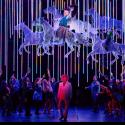
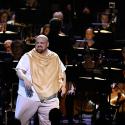
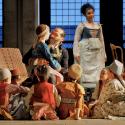
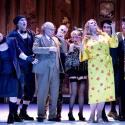
There are three aspects of English National Opera’s most ambitious project to date in Manchester that demand attention.
One is the work itself: Royce Vavrek and Du Yun’s Pulitzer Prize winning Angel’s Bone, seen as an outstanding creative work of 10 years ago, now getting its UK premiere. The second is the artistic achievement of inter-city musical collaboration bringing it to life in Aviva Studios’ “warehouse” space, where boundary-breaking comes as standard. The third is the approach of director Kip Williams (whose UK opera debut this is), designer Marg Horwell and their team, offering it as a technically highly mediated, immersive experience for an audience who for the most part had to stand up for its entire 80-minute duration.
With five main roles, a small chorus and a 10-instrumentalist ensemble, the work betrays its origins as an even shorter, chamber piece. Du Yun’s music is kaleidoscopic in nature, drawing on a variety of styles from cool modernism to pounding rock, and consequently offers something for almost everyone. The homophonic choral writing I found very beautiful – and the sheer variety of expression called for from the principal singers not only demands performers of exceptional ability but also stimulates the listener again and again. A bit of slinky slow foxtrot and the overwhelming backing-track power of the big climaxes have their own attractions, too.
Vavrek tells the story of a seemingly everyday husband and wife, at odds with each other: “This is not the dream that you promised me,” she tells him. “I need you to…” But one day they are surprised to find two young angels, complete with wings, in their compost heap. They’re “runaway children”, he says – with some insight. At first the angels appeal for help and the husband tells them “This is your haven”… but his wife has other ideas. Before long the two of them have decided to exploit their “good fortune”, and, having literally clipped the wings of their guests, they decide “Let us reap their magic, their beauty”. It’s almost a Paradise Lost event, not because of angelic pride but human greed.
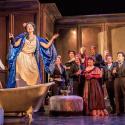
What follows is described in the creators’ and publicists’ words as a parable of people trafficking and modern slavery, but the striking thing to me was the parallel with today’s American, TV-fuelled religiosity. The couple keep the young angels at home confined to a bathtub, but go on TV and tell the viewers: “They will do anything, bless anything …” The big selling point, as they begin to reel in donations from the gullible, is that blessings can be bought.
Of course, it all goes pear-shaped in the end, and the angels end up “battered, bruised, beaten”, while the couple are back to square one – except that she is pregnant with the male angel’s child (“a little cherub flutters in my womb”). The chorus, who have been commentating, Greek tragedy style, on each event as it ensues, repeat a mantra that “Feathers are prickly things”, and while the remorseful husband flagellates himself to oblivion, our mercenary wife decides to exploit her story of “a man who forced his wife to pimp” and is back in tele-evangelist mode with a promise that her child will “bring so many blessings…” After that it ends, with a massive musical crescendo.
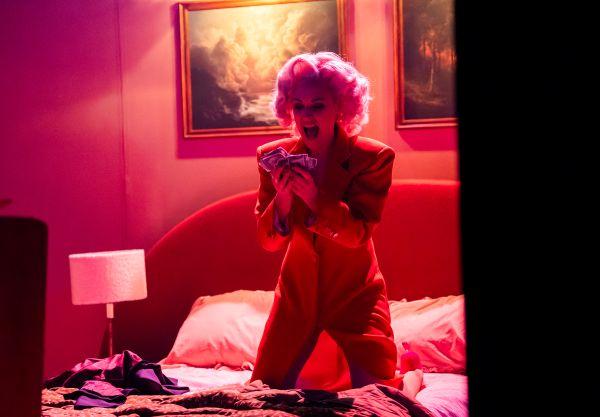
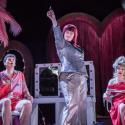
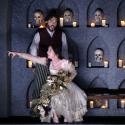
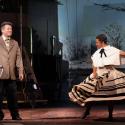
The musical team brought together for this production are remarkable. Principally, Allison Cook (pictured above) as the scheming but vulnerable wife has some very wide-ranging tessitura to negotiate as well as a huge gamut of emotion, which she does with great skill. She sings with a very English sounding diction, while Rodney Earl Clarke, as her husband, keeps himself American (I suppose this is to universalize the story), and their power and emotive qualities are well-matched. Mariam Wallentin, as the Girl Angel, and Matthew McKinney, as the Boy Angel, are effective singing actors in what – bathtub-confined much of the time – are physically confined circumstances. And male soprano Keith Pun, who often sings with the chorus as a kind of archangel, has a lovely pure and near-unearthly quality.
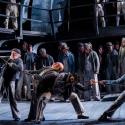
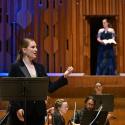
Kantos Chamber Choir, Manchester’s own, are extraordinarily good: not only do they have to sing some tricky music, often in motion, while maintaining balance and tonal quality, but they act as subsidiary characters in the story and at several points have solo roles to undertake – one in particular who stood out was Camilla Seale, a rich mezzo, who represented a member of the public who – crucially – is disappointed by not receiving the “blessings” promised from contact with the captive angels (“I have called, but you don’t answer…”). The 10 musicians of the BBC Philharmonic do sterling stuff under the baton of Baldur Brönnimann, whose control of many moving elements in the production was exemplary.
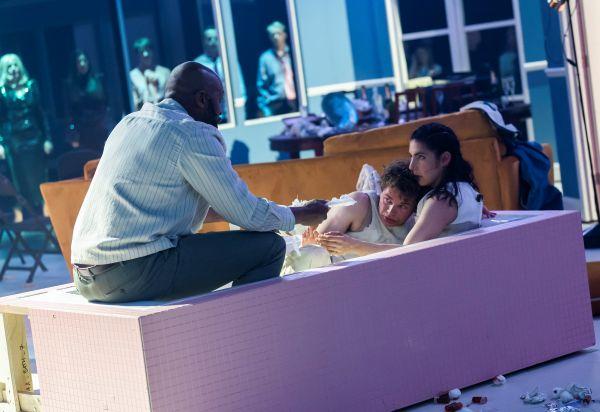
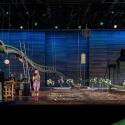
I could repeat all those quotations above because the production is surtitled much of the time on four giant screens suspended around its central slowly revolving turntable where the action takes place, and which are the vehicle for real-time hand-held camera work by three people who are on the set along with the singers. This is immersive performance of the kind that Aviva Studios specializes in, seen in other forms in theatre works there but probably never so comprehensively used as it is here by Kip Williams and team.
What it means in practice is that the audience, gathered around the central circle about six-deep like a crowd for a royal appearance, can see very little (except for those in the front row) by simply looking forwards. The “stages” assembled for the opera’s successive scenes (and it does seem to be written as a sequence of scenes) are like a three-dimensional single-storey house, so it’s now-you-see-them-now-you-don’t as it slowly revolves, and what you miss in direct vision is supplied by the screens. It’s incredibly accomplished technically (and the singers are mic’d, so the sound is engineered, too), and one of the trumpeted virtues of the Aviva-ENO collaboration on this production is the use of paid trainees on technical and backstage roles, so that can certainly be accounted a success. I was lucky enough to be given a seat in the limited viewing area for those who didn’t feel able to stand for the whole show, but what it was like for those who were on their feet is another matter. There were small folding stools available if you asked for them, but they would have made one’s viewpoint even lower so made little difference.
What is less clear is how this could all go on to the London Coliseum stage in October, when we are told “The production will… transfer… with the same cast and creatives,” but that the audience will be seated. Will it simply be reorganised for the proscenium stage? ENO’s artistic director Annilese Miskimmon, in her introduction to the printed programme booklet, seems to describe the two outings as different projects – “Each production,” she says, “will be shaped by the venue in which it is performed, creating two distinct experiences…” So wait and see what they have to offer then.
Further performances on 14 and 15 May at 7.45pm and 16 May at 2pm at Aviva Studios and 16, 22, 23, 29 October 2026 at 7.30pm, on 17 October at 6pm and on 31 October at 2pm, with ENO Orchestra, at the London Coliseum
Recorded for broadcast by Radio 3 on 6 June (then for 30 days on BBC Sounds)