

Before last night's still-shocking saga of a downtrodden soul began, Southbank Artistic Director Mark Ball came on to tell us that while concerts were mere events, Multitudes, "our multi-arts festival powered by orchestral music", was offering experiences. Rachel Halliburton, who reviewed Bach's The Art of Fugue with acrobats, would agree; Bernard Hughes, though, found Messiaen's Turangalîla ruined by a "tiresome film". I felt the same last year about Shostakovich's Tenth Symphony burdened with a very tangential animation by the usually wondrous William Kentridge.
At his best, Kentridge offers overload in the best sense: his English National Opera production of Berg's Lulu was so rich that I had to go twice. I wish there were the same opportunity for this one-off presentation of the composer's earlier, 1925 masterpiece Wozzeck, based on Georg Büchner's extraordinarily modern, visionary play. left in fragments at his death in 1837, about a soldier persecuted so badly (and specifically) by society that he kills the thing he loves, his woman Marie, and then himself.
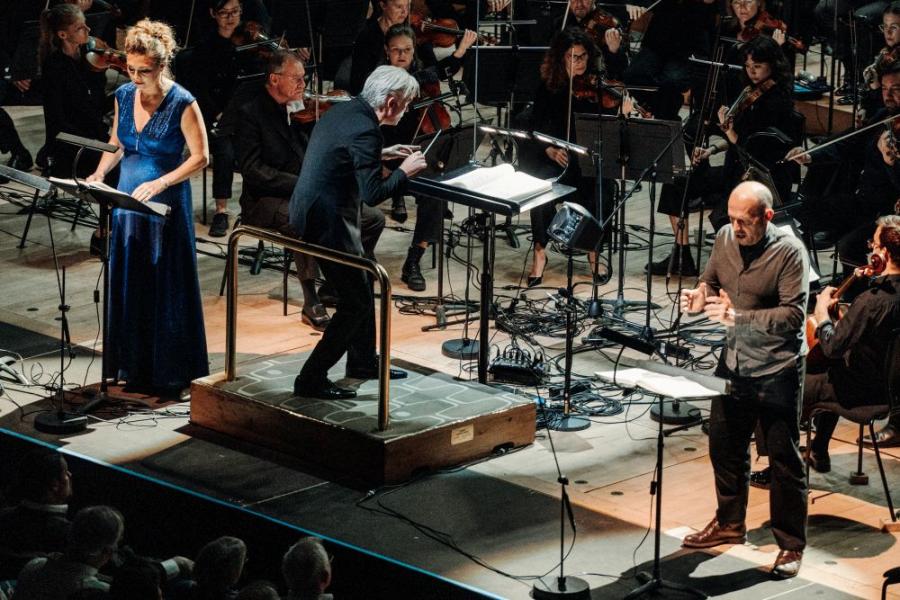
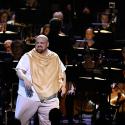
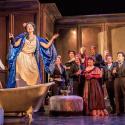
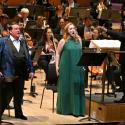
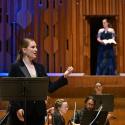
Preliminaries looked unpromising, even worrying. On the big screen were photos of the main characters, definitely not the singers, including Wozzeck, not a soldier but a near-invisible worker on the fringes of metropolitan life, and the Captain as a banker, perhaps, a disagreeable-looking figure at the other end of the social scale. The "Wretches Like Us" – it's a quotation from the opera, but I've left it off the Southbank Centre's restyled title, since this is totally Berg's work and "us" is not, of course, the audience – seemed to be suffering from some kind of horrible skin condition. Once Edward Gardner lifted his baton and magical-seductive sounds immediately poured with precision from the London Philharmonic Orchestra, eyes were riveted on Peter Hoare nailing yet another characterisation, every note in place, every semi-comic gesture meaningful, pitted against Stéphane Degout's frighteningly still Wozzeck (Degout pictured above with Annette Dasch).
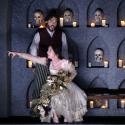
It quickly became apparent, though, that Ilya Shagalov is a very creative video artist whose use of thousands of photos really deserves the often-used term "visionary". It's a pity the more visceral of them weren't caught by the hall photographer. UPDATE: for debate on the IMO creative use of AI, see the discussion in the comments.
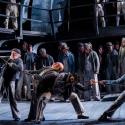
Shagalov's visions are as fractured and disturbing as Wozzeck's, as bizarre as the unreal nature of Berg's queasy setting and Büchner's text. Locations shift within scenes; unintended substitutes like the high-rise posh restaurant for the street where Captain and Doctor babble, Wozzeck later hovering on the outside, or the container site for the single barracks room at the end of Act Two, are compiled in multiple shots.
The hospital experimentation Wozzeck undergoes to take money for his woman was almost unwatchable, but no violation of the horrible things being discussed. There's virtuosity in the most rapid flick-through of shots, but it always suits the music. The only moving image is the still surface of the lake where Wozzeck has murdered Marie and drowned. A wood at night, with negative images, and the blood-red moon are faithfully rendered. Faces livid with rosacea become waxy-white, then mannequin-blank. Any liberties too far? Just one, for me: the fact that the child who witnesses such adult baseness and violence is unborn; how does that make sense of the final scene, where a boy is told his mother is dead? A general recurrence, or what? The crows and birds that have dominated take over here; a small group of Tiffin Boys in school uniform delivered the children's cruel games.
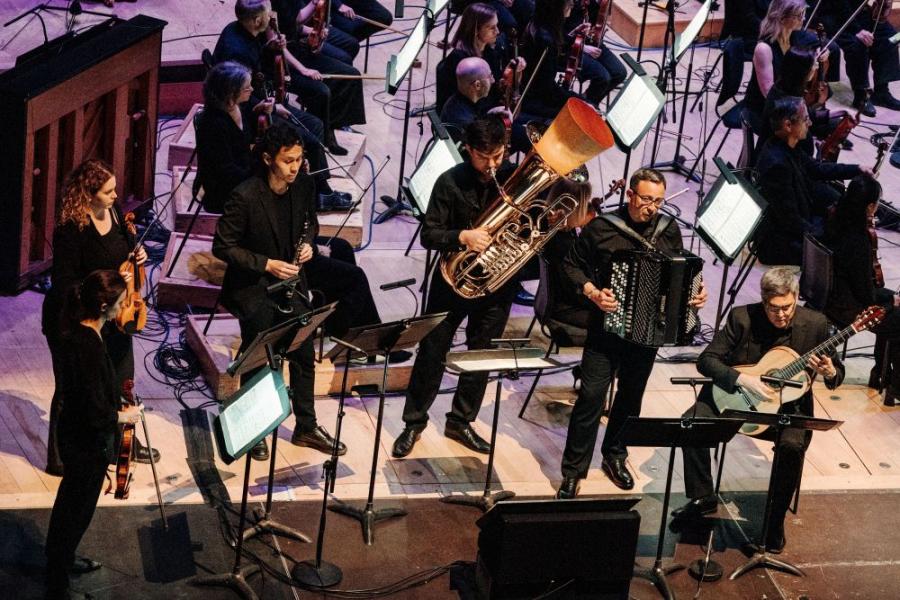
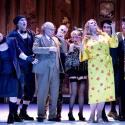
Musically, it was all not only faultless but went further than any Wozzeck I've seen or heard, with the exception of Abbado's in Vienna (experienced on film only). Gardner, who conducted Carrie Cracknell's extraordinary ENO production back in 2013, had total control of the nightmarishly difficult textural shifts, maintaining perfect balances within the orchestra that brought out Berg's still-Wagnerian leitmotifs in sometimes unexpected places as well as between orchestra and voices. The pub dance band (pictured above) was heard with exceptional clarity. Gardner's singers were as much with him as his incredible players. Degout was as ideal a combination of the lyrical and the scary as you'll ever get in the role. Annette Dasch might not have been tonally lustrous, but captured every nuance as debased, terrified Marie, strongly offset by Kitty Whately's unkind neighbour Margret; when there was less going on in the physical performances, as with Brindley Sherratt's Doctor and Christopher Ventris's Drum Major, the screen images hold us totally.
Every bit of casting proved strong, down to Adrian Thompson's Fool (a kind of tar monster attached to Wozzeck in the nightclub of the film) and Callum Thorpe's First Apprentice (various drag queens the visual equivalent). The London Voices cut like a razor in the club before haunting us in sleep humming.
I can honestly say I've never seen anything quite like it. With a lesser master in control of the film, it might have gone horribly wrong; what we had was a total fusion of a kind unknown, I'd hazard a guess, to any opera "production" before this. It has to be seen and heard again. Only one complaint: the online-only programme was inadequate; it's disrespectful not to provide biographies of the singers, and I wanted to know more about Shagalov as well as the woman who shared the stage with him at the end (it turned out to be Nina Guseva, not mentioned in the text).

Comments
No mention of...
the entirely AI-generated imagery? You say "Ilya Shagalov is a very creative video artist whose use of thousands of photos really deserves the often-used term "visionary"." But when the final product we saw on-screen was entirely composed of the output of prompts entered into an app - when the creative choices regarding image content, lighting, colour balance are all made by the app, with the role of the 'creative artist' reduced merely to someone making suggestions to a computer - I think we've lost sight of any genuine artistry.
AI imagery
I was unaware of the role of AI in the photographs, because nowhere in the programme or anywhere else I looked was there any mention of them. How did you know? It raises the question of whether AI can be pressed into the service of a great creative (as I believe on this evidence Shagalov to be). Because for me the visuals corresponded so completely with the music, I would say in this instance it was. And I won't use AI in my own work.
Well, Shagalov says as much…
Well, Shagalov says as much on his Instagram 26 story. But even aside from that, how could you possibly think those were real photographs of real people? The images were very obviously AI-generated: between the inconsistent locations and details, the uncanny valley faces, the obviously unfilmable things (Shagalov clearly did not film divers finding a knife in a lake, much less set a billboard on fire for the sake of his photo project!), and the lack of any credits for the 'models'.
Shagalov's response
Makes total sense to me. I don't know what the source is, because it was put up on Bluesky out of context.
Shagalov's response (2)
For some reason the screenshot didn't take. So here's most of Shagalov's text.
'Dismissing AI in this context is like dismissing photography in the 19th century, or serialism when composers like Alban Berg began expanding musical language. New tools always look like shortcuts to those who don’t understand how they’re used.
Shagalov's response (3)
The rest didn't take. Here it is, all in one paragraph in case that makes a difference. 'Nothing here is “automatic”. Generating 10,000+ images and shaping them into a coherent structure is not pressing a button, it’s closer to editing a film frame by frame.
Shagalov's response (4)
Continued. *For your information, it took over five months to create this piece. If anything, this reaction exposes a gap: people are critiquing a process they’ve never actually encountered from the inside. You’re free to dislike the results.
Shagalov's response (5)
Again the weird cutoff. The end: 'But calling it ‘not real work’ doesn’t make you critical – it just makes you outdated.'
Your condescension is unbecoming.
I don't 'do' Instagram. And why would I not think those were real people? Ultimately the only question is whether it was any good or not. and I insist that the worl was done (over four months) at the highest level. I'm reproducting below Shagalov's response.
I thought the visuals were a…
I thought the visuals were a complete and irrelevant distraction, no more than a jerky 90-minute slide-show devoted to the study of rosacea; and - worse - because the subtitles were incomprehensibly chosen to be yellow of all colours - frequently illegible altogether at the bottom of the slide-show screen when projected over a lighter ground. And, like Gardner's conducting, it was surely far too fast to register properly.
Wozzeck
It was predictable that this performance would generate strong feelings. Whether the montage is lens based or predominantly AI isn't the point. We live in a technologically determinist world, and Shagalov is using developing technology in a compelling, challenging and creative way here, as artists have done since the first daubs of paint on cave walls. Bayreuth is producing an AI Ring Cycle this year. I certainly look forward to what AI can do in opera
Bayreuth AI
Curious that Bayreuth is rushing ahead into the era of AI when it still hasn't moved into the age of surtitles!