
The longest and most densely historical play by Georg Büchner (1813-37) is a potential monster. In German, Dantons Tod can run to four hours or more. There's little action and much speechifying. In plays by his equally wordy, history-obsessed predecessor, Friedrich von Schiller, there are at least fights, battles, a lot of love - and some sex.
theatre reviews
james.woodall

carole.woddis

The Martin McDonagh phenomenon is a curious one. He burst upon the world in 1996, aged 26, born in Camberwell, the son of Irish parents. The quirk of fate that placed him in south east London may or may not have been the making of him. But by pure accident, and whether he actually knew the people involved or not, it aligned him with what was to become the abiding zeitgeist of the mid-Nineties: BritArt and Damien Hirst and Tracey Emin.
alexandra.coghlan

How do you construct a compelling play about the greatest of fictional detectives without either mystery or reveal? The cryptic answer, in the form of Jeremy Paul’s 1988 theatrical two-hander The Secret of Sherlock Holmes, is far from elementary.
bella.todd

Revivals of George Bernard Shaw’s Pygmalion are generally too busy making an artistic case for the play over the My Fair Lady musical to worry about listening out for contemporary resonances. But in many ways Simon Cowell is the Henry Higgins of our day: betting with his fellow X-Factor judges that he can pass off such-and-such under-privileged teen as a pop star; putting them through their paces before a rigorous public test; and showing little regard for what will happen once they have been torn out of their reality and developed a taste for limos and red carpets, and Judgment Day has come and gone.
In fact when Rupert Everett first spoke in 2009 about wanting to revive Shaw’s subverted phonetic fairytale, it was with his eye on glamour model Katie Price for the role of Eliza Doolittle – the raucous cockney flower girl whom Professor Higgins wagers he can pass off as a Duchess following six months’-worth of lessons in her own language. Instead, in Philip Prowse’s new production for the Chichester Festival, Everett plays Higgins opposite Honeysuckle Weeks – a Sussex girl and graduate of the CFT youth theatre whose own perfect elocution was bought at nearby girls' school Roedean.
The casting may not be so witty as Everett hoped. But from her strutting entrance into Higgins’ office demanding lessons (a riot of Edwardian eccentricity in unbuttoned ankle boots and thread-bare feathered hat) to the parasol-assisted, pointy-toed walk and painstakingly articulated swearing of her first society outing, Weeks approaches almost every scene with the hint of a smile playing permanently across her high cheekbones. This has both the effect of giving her Eliza an extra twinkle of intelligence, and making you cast around for her co-conspirator.
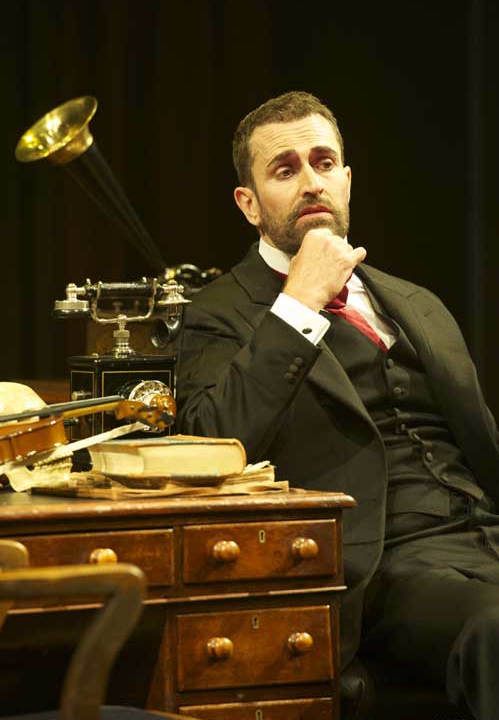 Such an Eliza needs a watchful Petruchio to respond to her playful, calculating Kate. But she doesn’t find it in Everett (pictured right), here returning to the UK stage after a 15-year absence, who spends a good deal of his stage time flipping his coat tails and speaks as if the script bore the word "incorrigibly" before every sentence. His Higgins is excessively sulky, slouchy, selfish to the last, and when not visiting his mother (Stephanie Cole), inhabits an office that has more than a touch of Sherlock Holmes’ lair about it.
Director/ designer Prowse’s concertina-like stage back folds open into towering bookcases crammed with case notes, with Peter Eyre’s commanding but gentlemanly Colonel Pickering comfortably ensconced in an armchair à la Dr Watson – sharing his friend’s enthusiasms for the project but not his bad-mannered eccentricities – and regular interruptions from Susie Blake’s disapproving but indulgent housekeeper. Everett’s Higgins even enters the scene (via the stage lift) with a violin tucked under his rather famous chin.
It’s not a bad performance. But his trademark languor is at odds with the side of Higgins so passionate about his work that we first meet him out "collecting" dialects on a stormy night. And as the run progresses we’d hope for more flair, at least, in his delivery of Shaw’s colourful insults (at their first encounter alone Eliza is called a "bilious pigeon" and "squashed cabbage"). After all, this is the man who described Madonna in his memoirs as "an old whiny barmaid".
Shaw’s play is a social comedy with two serious, at first seemingly jarring, agendas: his very real concern with the increasing sloppiness of speech (he chaired the BBC’s Advisory Committee On Spoken English – this was a few years ahead of the codification of RP), and his great humanitarian interest in women’s rights. But it’s hard to feel that Chichester’s Eliza is ever really in danger. Phil Davis’s Alfred Doolittle, the father who sells Eliza for a fiver and recommends Higgins wallop her into submission, is very funny but never really threatening, and ends up marrying his latest wife – a woman so unladylike she’s actually played here by a man – to a peal of comically funereal church bells.
Pygmalion concludes much less happily than My Fair Lady. Unswayed by Higgins’ plea that he is in fact the least class-conscious person of all because he treats everybody equally awfully, Eliza leaves his household to marry the rather wet but eager toff Freddy (Peter Sandys-Clarke). Prowse closes the play with Everett hunched stage front, his back to the wedding scene, looking uncomprehendingly at the bunch of flowers Weeks has pointedly tossed into his lap from her bouquet. Is this Pygmalion unable to declare his love for his creation, or perhaps even to feel it?
What this production does make very clear is that this pathologically self-absorbed, hobbyistically misogynistic and to varying degrees troubled bastard has excluded himself from society to an even greater degree than Eliza, tripped over by theatre-goers in Covent Garden Flower Market, found herself in the opening scene. But Everett’s under-powered portrait brings us no closer to understanding quite why.
OVERLEAF: MORE GEORGE BERNARD SHAW ON THEARTSDESK
Aleks Sierz

While films frequently spawn sequels and prequels, theatre — with the spectacular exception of the Bard’s history plays — tends to go for one-offs. In Peter Nichols’s new play, which opened at the tiny Finborough fringe theatre last night, the main character is called Steven Flowers — and yes, those of you who are paying attention have by now correctly guessed that is a follow-up to Privates on Parade, Nichols’s hit play of 1977 (last revived at the Donmar in 2001). But as well as being a follow-up, how does this new play stand up on its own?
james.woodall

Shakespeare’s two-part Henry IV cycle locks together the first modern plays in English. They strive for something quite new in drama, retaining a structural boldness and complexity seldom encountered in contemporary theatre. That's how "modern" they are (or seem). And in reiterating what others must have said oft and better, I intend no abutment on that deadly phrase “early modern” into which historians, and most annoyingly many literary critics, now incorporate the word “Renaissance” - which Henry IV of course also magnificently is.
Matt Wolf

The Menier Chocolate Factory could scarcely be on mightier form, or so it seems, punching far beyond its weight as a small, out-of-the-way south London playhouse that is nonetheless responsible at the moment for five commercial transfers between London and New York.
sheila.johnston

Jeff Goldblum is a big guy, 6'4" tall to be precise, and, though his character inhabits an improbably spacious, high-ceilinged New York apartment, he roves around it like a crazy caged animal in this intensely athletic and entertaining revival of Neil Simon's disturbing 1971 comedy.
alexandra.coghlan

"Oh! My Daddy, my Daddy!" It’s a cry that has echoed through the childhood of generations of English children, reducing all but the very staunchest to tears. Whether encountered through Edith Nesbit’s book or the classic 1970 film, The Railway Children is a national touchstone, sitting alongside Peter Pan and Alice in Wonderland at the core of a proper English upbringing.
David Nice

John Adams thinks his and poet June Jordan's fantasia on love in a time of earthquake flopped at its 1995 Berkeley premiere for two main reasons. The characters - three blacks, two whites, a Hispanic and an Asian - were deemed too self-consciously multiculti: odd when America knew that was just how LA was then, even more so than Stratford East today (for once, the audience reflected the cast in this co-production with the Barbican). And Adams was shocked to find the pop and classical worlds so rigidly defensive. I've spoken to plenty of folk who hate the piece, trapped as they are behind the barriers its 24 vernacular numbers try to break down. Yet it seemed no problem for anyone in the theatre last night, chiefly because the ensemble of seven brilliant young singer-actors was totally on top of their tricky music. They'll never have to master anything as complex again, so they have every reason to be proud.