

Birgitta Trotzig’s Queen is a strikingly poetic, persistently grim semi-fairy tale set at one of the edges of Europe: a strange, windswept shore where pregnant women fall through the ice, family farms are barricaded in the winter to keep out the destitute, and their “great barn doors face the coastal wetlands”. This agrarian community ekes out its existence in a merciless, flat land by the Baltic Sea, and the novel focusses on a family of such farmers: Judit (the titular Queen), her brothers Albert and Viktor, Viktor’s widow, and Judit’s troubled parents. The landscape they inhabit is bleak and cruel, and forms a pertinent backdrop to Trotzig’s descriptions of the dark, rich, complex lives taking place therein.
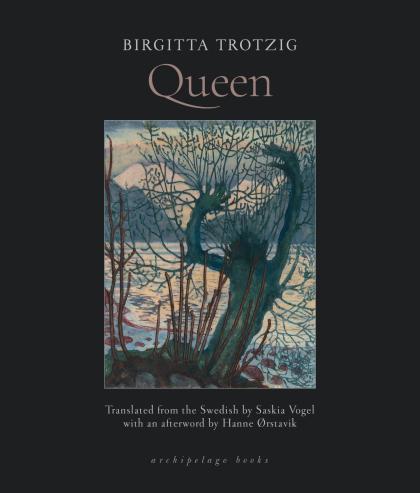
First published in 1964, this new translation from the original Swedish, by Saskia Vogel, is preceded by an introduction by Sarah Moss. As far as I understand, this is the first long(ish)-form translation of one of Trotzig’s works into English, though Trotzig is a well-known literary figure in her native Sweden. Born in Gothenburg, she wrote primarily prose poetry and fiction, and was known for the textual darkness that permeates her texts, as well as her religious – often eschatological – themes. A late convert to Roman Catholicism, and fascinated by mysticism, Queen displays that “Holy shadowless light” counterpointed against the deep internal shadows of its characters; and the descriptive richness renders everything as either the deepest black or the starkest, deadest white: “as mute as the blind milk of membrane around an extinguished eye”.
Queen mainly takes place in Bäck, a rural Swedish community, from the 1850s until roughly the 1940s. Queen Judit is stony and proud, ruler of her brothers, Viktor and Albert, and their shrinking family farm. There is something devilish and obscure about Viktor, and pathetically pure and white about Albert. Judit reigns over all, suppressing some part of herself in order to keep her family and their farm together. Her true self, that is, is described as being trapped at the bottom of a well, wanting “to slip out of the Queen’s stiff dead garb”. There is therefore an existential conflict within Judit: she is quasi-mother to Viktor, but also incestuously jealous of him; she shows great care but also great cruelty. In her position as defender of the farm, she resembles her Biblical namesake, who slew a general to save her city. When Viktor’s widow – “her adversary” – turns up, she is almost broken by it: here is a visitor that she cannot send away, who will force Judit to fundamentally and irrevocably change.
The haunted figure of Viktor’s widow comes to Bäck after her husband’s immolation, wrapped in an ill-fitting overcoat: “her interior had been emptied and now was full of fire-shadows, shadows solely”. Queen is dense with gothic imagery, something likeJane Eyre or Frankenstein, where each character is described elementally. Indeed, as with Jane Eyre and the foreshadowed threat of the conflagration of the madwoman in the attic, flames flicker throughout Queen; eyes, for instance, are described as “dark mirrors reflecting mirror and flame, flame and mirror, into infinity”. The troubled characters that struggle through Queen are always close to incineration from within, tormented by their own lives.
At times, the intensity of Queen can be overwhelming, and the weight of description and of feels a little dense. But the brevity of the book (142 pages) makes the story feel something like a long-form prose poem, which mitigates the intensity somewhat – too much longer, and the sheer weight of description would be cloying. The emotional depth of Trotzig’s descriptions of grief, loss, and the intransigence of Judit are compelling, as well as the central story of a wayward brother and his returning widow. It’s the perfect book to read in the dark, in the middle of winter, in the middle of a rainstorm.
- Queen by Birgitta Trotzig (Archipelago, £9.99)
- More book reviews on theartsdesk











Add comment