

I’m a latecomer to John Robins and Elis James’s hugely popular podcast, having only started to listen during a period of illness last year, when I quickly became hooked. The two (plus producer Dave) have an appealing chemistry that makes them a pleasure to spend time with. Prior to that I was aware of Robins as champion of series 17 of Taskmaster – a perennial favourite in my household – but had not seen his stand-up. Although his stage and podcast persona is of an obsessive neurotic driven mad by the petty obstacles in the path of everyday life, this new memoir narrates the more significant battle that has plagued his life since his teens: alcoholism.
It tells – through the subtitle’s conceit of chapters covering Twelve Drinks That Changed My Life – of his obsession with drinking which reached a suicidal climax in 2022, followed by (to date) over three years of sobriety. It’s clear the sobriety was hard won and maintained through constant effort, and that the obsession hasn’t gone away – “I’m really craving a drink right now,” he says on page 301 – and I am sure everyone who reads this book will sympathise with self-confessed inability to drink in moderation and hope he continues to be successful in his abstention. Robins has covered this territory in a stand-up show in 2023 (available as a digital audio download) and on podcasts – but how does it fare as a book?
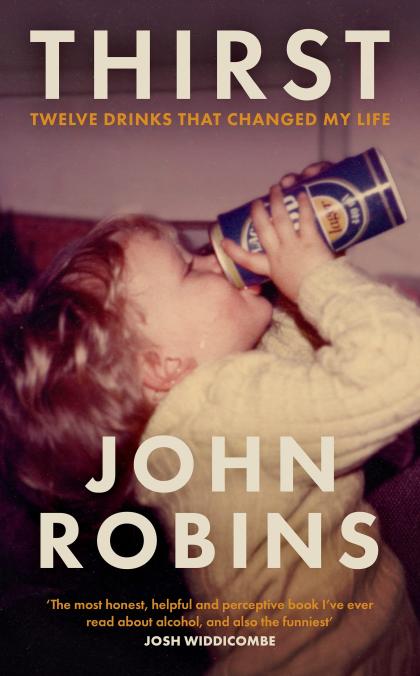
Robins’s drinking started with a glass of wine as a seven-year-old, got worse during his student years in Oxford (when it was combined with compulsive gambling), and dominated his years as a public figure – although interestingly his comedy debut came during a year of sobriety: “I immediately replaced alcohol with stand-up.” He traces it all back to difficult relationships with both his father – who abandoned his family and went to Canada when Robins was six “because God had told him to” – and his step-father, himself a recovering alcoholic. Robins describes never being relaxed in his childhood home, and how this tension pervaded his life from then on. It certainly forms the basis of his humour, where his shtick is of constant faux-exasperation at the world, and his coping mechanism one of approaching everyday tasks with hyper-rational strategies. But, as he says, Robins’s early home life had long-term implications for his mental wellbeing which, to be fair, he hid very well in his work (although hosting a successful podcast about the perfect pub was a bit of a giveaway). Certainly, going back to podcasts made when he was at his lowest ebb he was always professional and never seemed drunk on air.
For all that it is shot through with typical Robins riffs, Thirst is a serious book and quite bleak for much of the time. He is aware that there may be people reading who need the kind of help it took him so long to find, and it is chockful of pearls of wisdom about alcoholism, which range between the insightful and the platitudinous. There are some good jokes – “a loft is just a bin you live under” or a description of Lent as “Stoptober but God is watching.” But there are also acres of self-analysis, characterised by a perennial personification of alcohol – “‘this was alcohol working in its cunning and powerful way” – and a plethora of things “someone wise once said.” This is the formulation he uses for things said to him in AA, so not credited to individuals - and fair enough - but does become grating as a stylistic device.
As Robins says: alcoholism is “categorically NOT A LAUGH” and this book is evidence of that. As someone who has had some second-hand experience of alcoholism, a lot of what he says rings very true, but it is also, for stretches, quite boring. And I hesitate to say this, as Robins is self-lacerating enough about his own failings, but as his reader – not his therapist – I wanted more comedic memoir (the stuff about him finding friends at school, and an anecdote of a terrible poetry circle meeting at university are really entertaining) and less navel-gazing. Of course, this is a book about alcoholism, so maybe I’m wrong to criticise it for not being what it isn’t trying to be – or maybe Robins needed to wait a bit longer before writing it, to acquire more perspective?
Ultimately he is able to pull himself up from his lowest ebb thanks to the intervention of a comedian friend, and that is to be celebrated. But perhaps my biggest takeaway from the book is to realise the central importance to Robins’s comedy of the presence of his podcast partner, Elis James. James is less showy in his comic voice, gentle and kind where Robins is brittle and a (self-described) “tedious know-it-all”, and yet also the essential obverse side of Robins’s coin. The podcasts are a joy to listen to – and a testament to their friendship, which endured through Robins’s lowest times – in a way this book isn’t.
A therapist once said to him: “John, I’ve seen hundreds of clients over the years, and they’re all essentially saying the same thing to me: ‘I will do anything to feel better. Just don’t ask me to change.’” So credit to Robins for finding the courage to change and vanquishing (hopefully permanently) his addiction. But the experience he describes is akin to mine reading this book: quite hard work.











Comments
Sorry the introspective…
Sorry the introspective piece on how alcoholism nearly killed him wasn’t funny enough for you, you absolute freak
On the multiple references…
On the multiple references to "someone wise once said", I think you missed him explaining that was how he was attributing quotes to people from AA. For obvious reasons, he kept them completely anonymous.
Thank you, I did miss that…
Thank you, I did miss that and have altered the review
Someone Wise
I’m sure the editor will listen to your note on “someone wise” with all your references. Shame you didn’t read the part of the book where that device was explicitly explained.
Thank you, I did miss that…
Thank you, I did miss that and have altered the review
The repeated ‘someone wise…
The repeated ‘someone wise once said’ is when he’s quoting what someone told him at an AA meeting. It’s a nod to this while keeping them anonymous, and it’s explained in the book.
Thank you, I did miss that…
Thank you, I did miss that and have altered the review
Add comment