

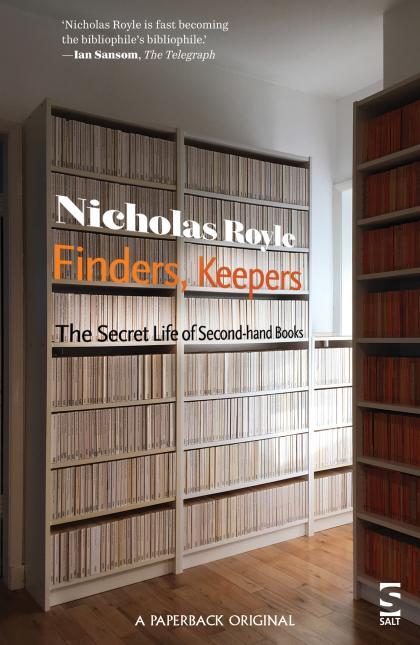
Browsing second-hand books is one of life’s reliable gentle pleasures. Nicholas Royle, though, in Finders, Keepers: The Secret Life of Second-Hand Books, takes it to the next level. And this is his third book relating the many small adventures he has devised to augment the basic activity of accumulating more and more books.
Small? Definitely. Does the book harbour a train ticket? Royle takes the train indicated, if the ticket is affordable, and reads some of it en route. A street map is even better, as it allows Royle to indulge one of his other obsessions: walking. If there’s a house address, he may post the book there or, better, deliver it in person, with a note asking if the present householder recognises it. Sometimes they reply. Same routine with a business card.
Along the way, there are more shops to visit, free book swap boxes to inspect, books on garden walls (some, regrettably, put out in weather that does not suit artefacts made of ink, glue and wood pulp), and fellow walkers-while-reading to observe and sometimes compare notes with. And there are other connections between books to pursue. How about a collection of books with Christmas wishes inside, of books with London in the title, with identical titles, or just one that promises the simple pleasure of building a complete series – like the Picador paperbacks he pursued indefatigably in the first of his books-about-books and still picks up when he sees one because, well, it might be nicer than the one already on his shelf?
All of this is of little possible concern to anyone else. It works because Royle – in other work a short story writer, novelist, anthologist, editor, publisher, and long-time teacher of writing – has a nicely honed style that acknowledges this while inviting the reader to collude with his conspicuously low-stakes quest for today’s as-yet undiscovered tomes.
The effect is stealthily cumulative. Come along for the ride – or the walk – with this mostly genial, occasionally waspish voyager through book land, and you start to enjoy each new find. Soon you are rooting for him to earn a reply from the home-owner getting news of a book that used to live in the same house, hoping the library to which he seeks to return a stray book still has it in their catalogue, marked overdue, or keen to hear the author’s verdict on whether Tracks (Robyn Davidson, Picador, a non-fiction account of travelling across Australia) or Tracks (Louise Erdrich, Picador, third of four novels about life on a Native American reservation) is the better read.
For anyone still susceptible to the lure of the printed book, Royle’s droll recounting of his obsessive pursuit of these connections offers the succession of modest rewards that keeps one reading. Might it do more? Well, perhaps. It’s a delight to imagine someone later this year, or in a decade, coming across Royle’s book in a second-hand shop (I’m thinking it’s a book to read but maybe not to treasure for a lifetime), dipping in, taking it home, and being inspired to emulate some of his quirky bibliomaniac habits.
Otherwise, it stands as a beguiling antidote to the overblown “big idea” genres of trade non-fiction. There’s no great thesis, though I suppose one could work up something about the rich connections enabled via print that e-books confined to one’s Kindle or Kobo cannot supply. Royle has given us another determinedly inconsequential book, and that is its charm.
Well, not completely inconsequential. Over the years I’ve volunteered in one of Amnesty UK’s excellent second-hand bookshops, I've developed a habit of discarding any extraneous inclusions, like old bus tickets or shopping lists, as well as – where possible – erasing inscriptions. In future, I think I’ll leave them be.
- Finders, Keepers: The Secret Life of Second-Hand Books by Nicholas Royle (Salt, £10.99)
- More book reviews on theartsdesk











Add comment