As a boy growing up in the 1970s, I loved lazy afternoons spent on the red shag carpet of my family’s living room while listening to my parents’ collection of LPs.
Sharing top billing, alongside Jacques Brel is Alive and Well and Living in Paris, was the Hollywood soundtrack to West Side Story. At the time I had no idea who wrote the lyrics. And if you’d told me, I would not have recognised his name: Stephen Sondheim.
I can’t even imagine what that little boy would have said if someone told him that decades later he’d become an expert not on Sondheim’s musicals but on his games and puzzles.
Back then I was focused on how Edward Packard’s 1976 choose-your-own-adventure book Sugarcane Island introduced the concept of reader agency; on mastering games on my Atari console; on tackling puzzles in each issue of Games magazine; and learning how to code games on my home computer.
I don’t think I even knew the name Stephen Sondheim when I first attended the historically rocky preview period of Passion on Broadway in 1994. After that, however, I was hooked. Assassins. Road Show. And with a seemingly endless series of revivals and concerts, hardly a theater season passed without a chance to revel in Sondheim’s challenging, entrancing work.
Meanwhile, something had to pay for those tickets. As an educator in after-school programs, I worked to develop the leadership skills of young people of color around global issues, using the mediums they enjoyed. By the turn of the century that meant video games. In 2002, I launched one of the first programs teaching young people to create digital games on social issues. That began a journey of over two decades producing and designing games on topics as diverse as medical racism, gut microbes, and AI-generated art.
When Stephen Sondheim passed away in November 2021, I had been a fan of this remarkable composer and lyricist for most of my adult life. Yet I knew little of the man behind the music. A few months later, for my 53rd birthday, my wife presented me with three books, a gift that would unexpectedly change my life.
The first was an academic treatise on Sondheim’s work in musical theatre (Robert L. McLaughlin’s Stephen Sondheim and the Reinvention of the American Musical). I devoured it, enjoying my chance to revisit each show through McLaughlin’s postmodern framework. Yet it also left me wondering: what other frames might a writer use to glean new meaning from the master?
The second book was the 1998 Meryle Secrest biography Stephen Sondheim: A Life. This was the first time I learned about Sondheim the man. Who were his friends? What drove him? What was his personality? It left me wondering what other sources might tell me about the man behind the music and his intervening years.
The final book was a recent one: James Lapine’s 2021 oral history Putting It Together: How Stephen Sondheim and I Created “Sunday in the Park with George.” In it, Lapine recounts, in discussion with Sondheim, how the two first met. “You were coming off Merrily We Roll Along, which closed on Broadway prematurely a few months prior,” Lapine reminded his collaborator. “You were in a pretty dark place.”
“Well, yes,” Sondheim replied. “That was a bad time.” The hostile critical reception shook him. “They couldn’t wait to shoot us down,” he recalled nearly four decades later. “I thought, I don’t want to be in this profession; it’s just too hostile and mean-spirited.” When he met Lapine – soon to be his creative partner on Sunday in the Park with George – he was also thinking, “What else can I do?”
As Lapine recounts, Sondheim told him the answer: “I thought, I’d love to invent games –video games – that was what I really wanted to do.”
When I read that, I thought: Who are you, and what have you done with Stephen Sondheim?
I couldn’t reconcile what little I knew about Sondheim as a musical genius with how much I knew about the world of game design. That contradiction fascinated me and launched a multi-year quest to reconcile the two.
In order to do that, I needed to learn more. Much more. With Sondheim’s passing, I couldn’t go to the source. But research libraries across the United States were more than happy to assist. I spent months working with several institutions, from Yale University’s Beinecke Rare Book and Manuscript Library, where I listened to Meryle Secrest’s audio recordings for her 1998 biography of Sondheim, to the Library of Congress and other collections holding material so rare few even knew it existed
That was just a start. My goal was not an academic treatise but a gripping, enlightening narrative. To create that I needed to speak with the people who were “in the room where it happened.” His friends. His colleagues. His game and puzzle collaborators. Over the next two years I spent dozens of hours in more than sixty interviews (plus email exchanges with many more) speaking with puzzle and game designers like Will Shortz, who shared their experiences with Sondheim and their thoughts about the mind of a puzzler; with collaborators like librettist John Weidman, who described playing board games, Atari, and escape rooms with his friend; and with peers like lyricist and crossword constructor Richard Maltby Jr., who gleefully recounted his memories of attending Sondheim’s notorious game parties more than fifty years earlier.
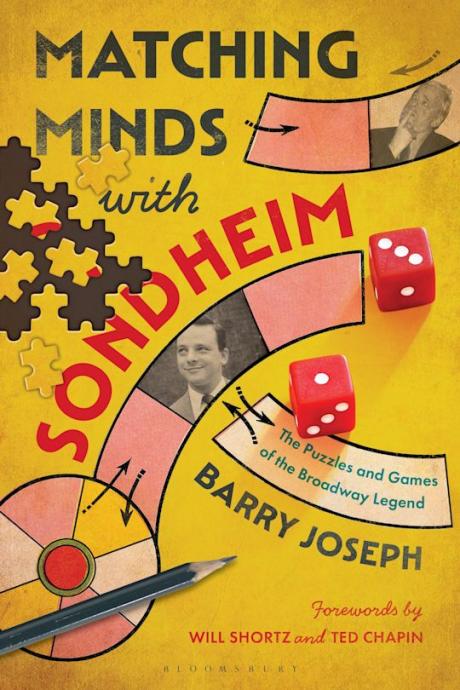
Along with the library research and the remarkable anecdotes I was amassing, the third source of material was his puzzles and games. In the beginning, I expected them to be white whales; I might speak with people who could share accounts of their sightings, but I never expected to see one myself. I knew the items I sought were old and often ephemeral from board games he designed in the 1950s; parlour games and cryptic crosswords he constructed for parties in the 1960s; treasure hunts he constructed across a half century and many other playful inventions
Early on I launched an Instagram account, @MatchingMindsWithSondheim, as a way to hang out a shingle and let people know I was interested in their memorabilia. And, to my surprise and delight, it worked. Week after week, this remarkably rare and often previously unknown material began to come my way: the winning treasure-hunt clue sheet from a 1973 party for the cast of A Little Night Music; Sondheim’s carefully curated collection of the British publication Games & Puzzles; photographs of antique European game boards that decorated his walls. And even after the book’s publication, new treasures continued to surface.
As the research bore fruit, I had to decide what kind of pie I might bake. Academic analysis? Puzzle compendium? Biography? In the end, I created a combination of all three. The book opens with two images: first, a beautiful, rarely seen portrait of Sondheim in his New York City apartment, smiling as he reaches for his dog, Max. Upon turning the page, the reader encounters the same photo – but with a caption that shifts focus from Max to the puzzles and games surrounding Sondheim. It was a way to signal the book’s intent: to re-center a topic long at the periphery.
The book is in two parts. The first 250 pages explore, one chapter at a time, the many facets of Sondheim’s ludological interests: parlour games, treasure hunts, board games, word puzzles, and physical puzzles. Each chapter is its own mini-biography, tracing Sondheim’s relationship to a form of play, analyzing its significance, and considering what it reveals about the mind of a great puzzler. A narrative arc emerges within each chapter, populated by recurring and one-time characters alike.
Taken together, these chapters explore two themes that only came into view for me toward the end of my research. For decades, Sondheim often used a particular phrase to explain his worldview: “order out of chaos.” In a 1995 interview on CBS News Sunday Morning, he said: “A puzzle is, like art, making order out of chaos.” In one sentence, he tied puzzles and art together as parallel acts of sense-making. “Take a jigsaw puzzle,” he continued. “It’s chaos. Put together, it’s a picture.” So if art is how we make sense of the world, a puzzle encapsulates the moment when chaos dissolves into order – a sharp, exhilarating “aha.”
Crafting puzzles, then, is a way to design experiences that offer solvers the opportunity to experience that “aha” moment, of making order out of chaos.
Games, however, are different. When solving a puzzle you connect with the mind of its creator. When playing a game you connect with the players around you. So while my book explores how Sondheim used puzzles to create moments of clarity, it also highlights the many ways he used games to create moments of connection for his friends, colleagues, and loved ones.
This part of the book ends with a retelling of my ten-and-a-half hours at the 2024 Sondheim auction, in which many of his household items were sold to the highest bidder: a $20,000 thesaurus; a $6,500 cat bed. By my count, half of the roughly 3,500 individual items within the entire auction (organized into 153 lots) were related to puzzles or games, together netting nearly $400,000. Over one day a collection Sondheim had spent a lifetime assembling dispersed, like a blown dandelion, out into the world. Make a wish!
I could have ended the book there, but there was more work to be done. Now that Sondheim’s puzzle and game oeuvre had been documented for the first time, someone needed to analyze it. At first, I assumed that someone else would do it. One of the pleasures of writing the book was the community that formed around my Instagram account, @MatchingMindsWithSondheim. I used it to share progress, new discoveries, and requests for help. Many stepped up as readers – some for a chapter, some for the entire manuscript. I am tremendously grateful to all of them, especially Gail Leondar-Wright, who insisted the oeuvre deserved game-design analysis – and that I should be the one to begin it.
That led to the second and considerably shorter part of the book, where I distilled principles of strong game and puzzle design from Sondheim’s work. My hope was to inspire readers to craft their own.
If the first part of the book required dogged research to find hidden gems in libraries, persistence in securing interviews, and patience as the narrative emerged, the second part drew on my decades as a practitioner in game studies and game design. I could finally step back, look across Sondheim’s designs, and identify the patterns and intentions they revealed.
Eventually, I identified three design principles that can be applied in a variety of settings. The Principle of Generosity guides designers to create puzzles and games not to show off but to lift up the player—setting aside ego to let players feel good about their accomplishments. The Principle of Playfulness reminds us that play is not just a verb (something one does) but also a noun (a mindset). Finally, the Principle of Mentorship encourages designers to ensure players always know the creator has their back.
Along with these three core principles, I pulled out several more for games, more for puzzles, and concluded with instructions on how readers can design their own Sondheimian puzzles and games.
When I delivered the book to my publisher, I felt it was the complete package: biography, resource, and design analysis all in one. It would take another year and a half before I could learn what the public thought – before it reached bookstores and readers. And when it did, I was floored by the response. At a presentation in New Jersey, during the Q&A, someone said, “Being a Sondheim fan, this explains a lot.” What more could I ask for –helping to turn chaos into order.
Meanwhile, a commenter on Goodreads shared, “I think this book may be the most personally affirming thing I have ever read. Barry has done an incredible service for multiple communities, and as someone living at the nexus of many of them, I’ve never felt so connected. If you love Sondheim, puzzles, games, or like me, all of the above, you’ll never find a more fulfilling and validating piece of writing.”
Moments of clarity. Moments of connection. The very themes I had drawn from the playful work of Stephen Sondheim – and hoped to recreate for my readers.
Barry Joseph is the Principal of Barry Joseph Consulting, a leader in innovating solutions for learning in a digital age, and the co-founder of the Games for Change Festival.
Matching Minds with Sondheim: The Puzzles and Games of the Broadway Legend by Barry Joseph (Bloomsbury, £26.99)
- More book reviews on theartsdesk