I’ll never forget watching Tracey Emin reduce an audience to tears at the Royal Festival Hall. About 25 people were expected, but some 500 turned up even though she wasn’t well known. It was 1995, four years before she was propelled into the limelight by entering My Bed into the Turner Prize. (The dishevelled bed where she’d spent four days in a state of catatonic despair after a break-up caused a furore. How could such a squalid installation be considered art?)
I’d written a feature on her in Time Out, though, and mentioned Whispering Women, the exhibition I’d invited her to take part in. And such was her charisma that her stories of a mis-spent youth in Margate had the whole room snivelling.
Mounted and framed, those pages now appear in her Tate Modern retrospective, and I’m amazed at how fresh they still are. All her early work, in fact, retains its power to suck you into her world with its astounding immediacy.
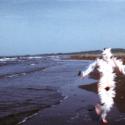
Some of the same stories appear in the video Why I Never Became a Dancer, 1995 (main picture) – how she was raped on New Year’s Eve aged only 13 and then began sleeping around. How, desperate to leave Margate, she entered a dance competition which promised a way out; but a posse of local lads hounded her off the dance floor by chanting “Slag, slag, slag, slag.” Then, twirling round a dance studio to Sylvester’s You Make Me Feel (Mighty Real) and grinning gleefully, she yells “Shane, Eddie, Tony, Doug, Richard, this one’s for you.” And you want to cheer because, not only is she a survivor, but she’s found a way of transforming failure into the material of success.
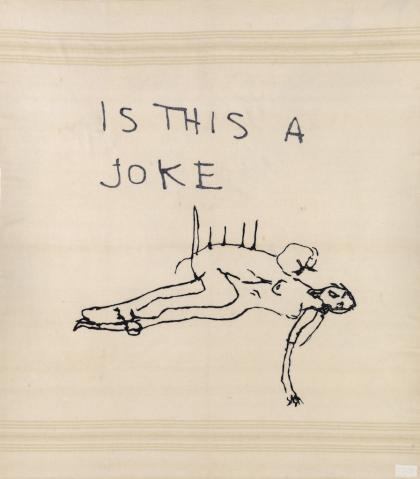
In many ways, it’s the story of Emin’s life and art. She can’t draw for toffee, for instance, yet she persists and there’s something compelling about the jagged lines portraying women in various states of naked despair. Their spiky inarticulacy suggests emotional trauma far more effectively than “good” draughtsmanship ever could. Enlarged and embroidered onto blankets, they acquire a needle sharpness that emphasises the woman’s vulnerability (pictured above right: Is This a Joke 2009).
By contrast, her neon signs imitate fluent handwriting and the more mellifluous these soulful phrases of lost love become, the more they resemble the sentimental kitsch of greetings cards.
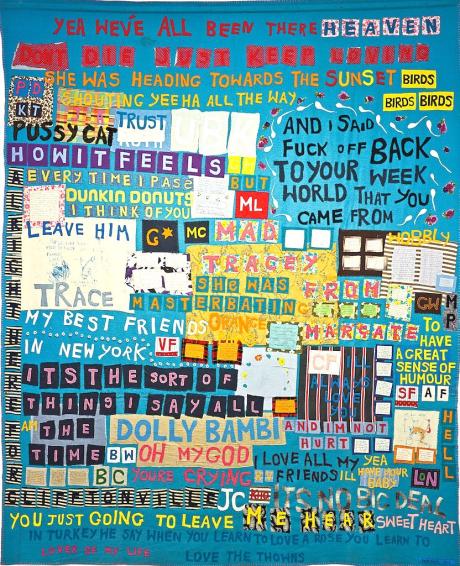
The appliquéd wall hangings, on the other hand, are a delight. Subtitled “The Perfect Place to Grow”, Hotel International, 1993 pays tribute to the hotel run by her mother where she and her twin brother Paul grew up. Mad Tracey from Margate, Everyone’s Been There 1997 (pictured left) is a maze of random remarks such as “Every time I pass Dunkin Donuts I think of you” which provide a snapshot of life in the run-down seaside town.
Why, though, is her sculpture It’s Not the Way I Want to Die, 2005 jammed awkwardly into the same small room? Made from scrap wood, the derelict roller coaster pays tribute to the funfair that once drew crowds to Margate, and it deserves a space of its own. It could have been shown, for instance, with the small bronze figures cast from clay kneaded by hand into squiggles whose contortions suggest the ecstasy of sex or the anguish of rape. Enlarged to giant proportions, the same forms are a disaster, though. With its lumpen incoherence, I Will Not Be Alone 2025 must be one of the dumbest sculptures ever made.
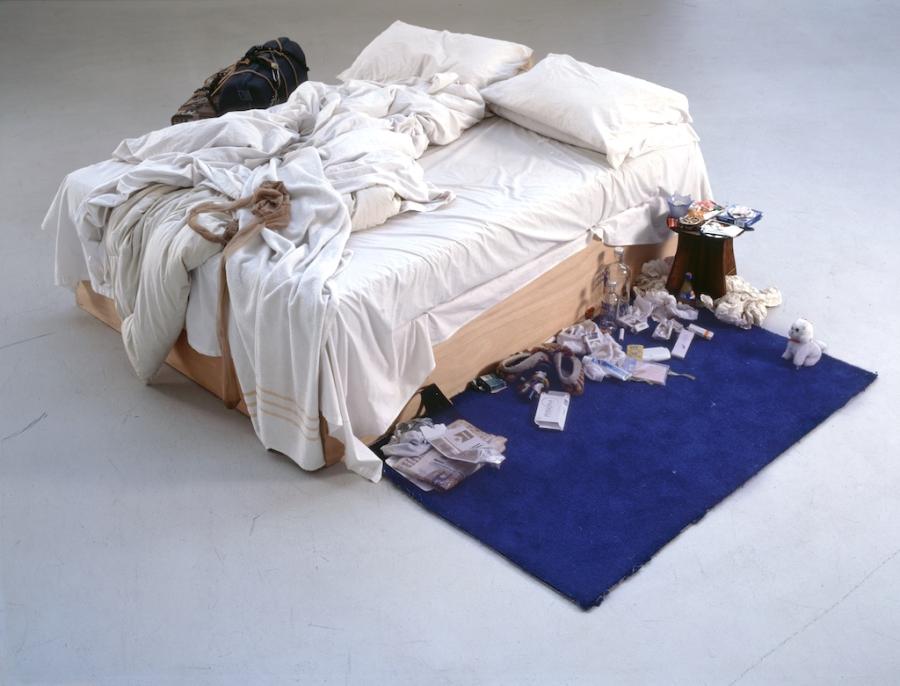
My Bed 1998 (pictured above) is not the focal point of the show, as you might expect. Marooned in the centre of a large room, it merely looks lost. Instead, the fulcrum is How it Feels, 1996 a video in which Emin details every aspect of her botched abortion and its impact on her physical and mental health. She stopped painting when she got pregnant, she tells us, and the relief, pain and guilt of the termination were so extreme that it took her another six years and a three-week residency in a gallery in Stockholm to start again.
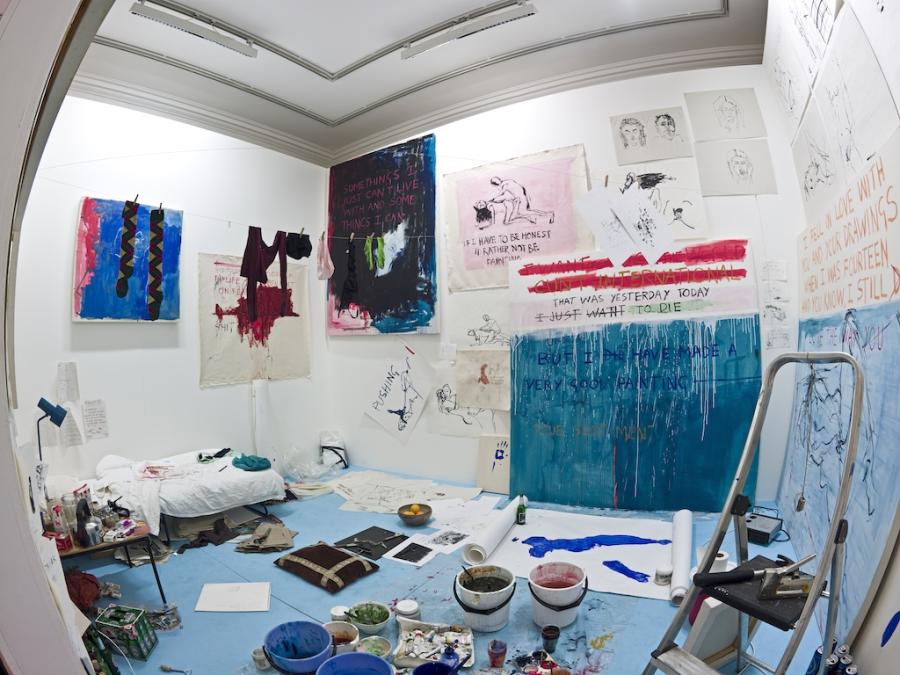
Exorcism of the Last Painting I Ever Made 1996 (pictured below) is an installation recreating the box in which she spent those weeks. Through fish eye lenses set in the walls, visitors could watch the naked artist sleeping, eating, drinking, defecating and struggling with her demons in order to start painting again. And perhaps because she’d set herself such overwhelming task, it worked. She started painting again and hasn’t stopped since.
And paintings dominate the rest of the show. Spindly outline figures, singly or in couples, lie on beds or float in washes of watery paint that dribbles down the canvas like rain, tears or blood. Transparent, weightless and carried away on a tide of love, longing or loss, they threaten to dissolve into incoherence, while titles such as The End of Love and I Never Asked to Fall in Love - You Made Me Feel Like This (pictured below) address the highs and lows of relationships.
“Sometimes,” Emin told me in an interview in 2005, “you love yourself, but sometimes I think if I see my name once more I’ll throw up. The self-pity gets on my nerves.” Her poor-me self-obsession gets on my nerves, too. Then I remind myself that “the personal is political” and it’s important that someone is willing to wash her dirty linen in public and to unapologetically address issues such as rape, abortion and sexism, especially now that women’s rights are under threat the world over.
But its latest manifestation is beyond the pale. In 2020 Emin was diagnosed with bladder cancer. She nearly died and seems to regard her miraculous recovery as a resurrection of sorts – the “second life” in the exhibition title. The art world thrives on myth making – it’s good for business – and Tate Modern is propagating the fantasy.
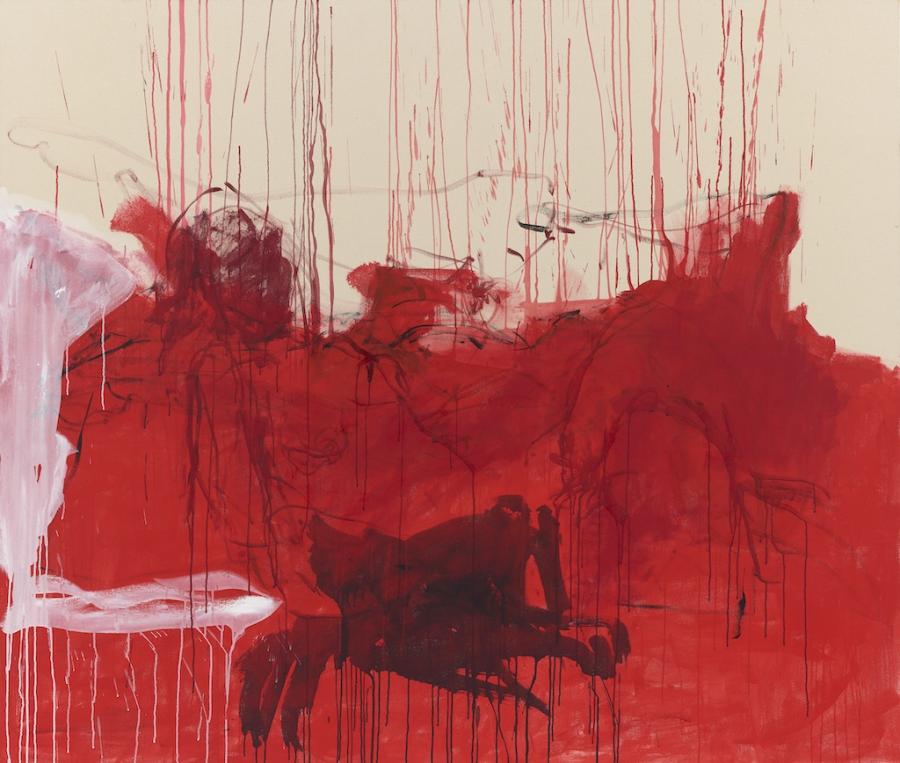
So the last gallery is dedicated to transcendence. It includes the painting I watched myself die and come alive 2023 featuring a figure draped in black gazing at a naked woman lying on a table with bones for legs, while at the centre of the room is a death mask of Emin made in 2002 when she was 39. “Sometimes I think I died, and this is heaven,” she told Maria Balshaw director of Tate. “So my second life is this, now.”
There’s also a crucifixion, a motif Emin has recently begun to explore. Is this her first non-autobiographical subject? I don’t think so. It seems more likely that she has begun to believe in her own mythology – even to the point of identifying with Jesus Christ – and that Tate Modern is inviting us to celebrate her beatification.
The elevation of Tracey Emin from potty-mouthed sinner to latter-day saint – now that really would be a miracle!