

If you stand close to a picture by Georges Seurat, the experience is totally different from being a few feet away. To a certain extent this is true of any painting since, close to, any brush marks and fine details are more apparent; but with Seurat the discrepancy is not only more emphatic, it was factored into his way of working.
He devised what came to be known as pointillism (he called it chromoluminarism). Instead of mixing colours on the palette, he applied each hue separately in tiny dots and dashes, thereby allowing them to mix optically between the canvas and your eye.
The technique makes the colours appear brighter and more luminous and, to further enhance the effect, he also introduced complementary colours (putting dabs of red next to green, for instance, or blue next to orange, and yellow beside purple).
These devices are all employed in Le Bec du Hoc 1885-89 (main picture), a gorgeous painting featuring a dramatic cliff at Grandcamp on the Normandy coast. Seurat shows it towering over the sea like a shark rising out of the water. From a few paces back the experience is like being on a clifftop in a heat haze; everything appears vibrant and slightly out of focus. The sea shimmers and the very air seems alive with dancing particles of light. It’s as dizzyingly euphoric as an acid trip.
Stand too close for the individual marks to optically coalesce, though, and the effect is very different. You become aware of the surface of the canvas as a dense morass of tiny marks vying for space and visibility, like bees swarming over a hive in a frenzy of activity.
This is what the artist would have seen as he worked on the picture and it makes you wonder how he was able to calibrate the size and colour of the marks so they appeared to meld from further back. I like to imagine him using long brushes and dancing back for a more distanced view. A few years after finishing the picture, he added a dark border of blue, red and orange dots as though to lend the image more stability by pinning it down with a frame.
Seurat made the picture during his first trip to Normandy and, from then on, he left Paris every summer to paint views of the coast. When he died in 1891 aged only 31, more than half the 45 or so canvases he’d completed were seascapes.
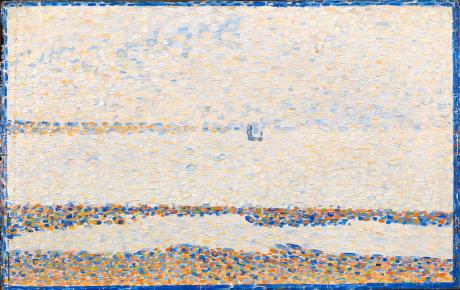
The Courtauld’s Seurat and the Sea is the first exhibition to focus exclusively on these paintings and the accompanying drawings and sketches and it's a delight. On the spot, the artist made rapid oil sketches on little wooden panels slotted into the lid of a travel paint box, light enough to hold in the hand (above right: The Beach at Gravelines 1890, oil on panel, Courtauld Gallery, London). The brush marks are looser, larger and more evenly spread than in the finished pictures. It gives the sketches a wonderful freshness and immediacy and allows you to spot any alterations he made in the canvases painted from them back in his digs or later in his Paris studio.
He also made drawings in conté crayon on rough paper whose grainy texture allowed him to create a tonal equivalent of the coloured dots in the paintings. He’d spent two years perfecting this technique and his drawings are not only magical but have more substance and vitality than the canvases.
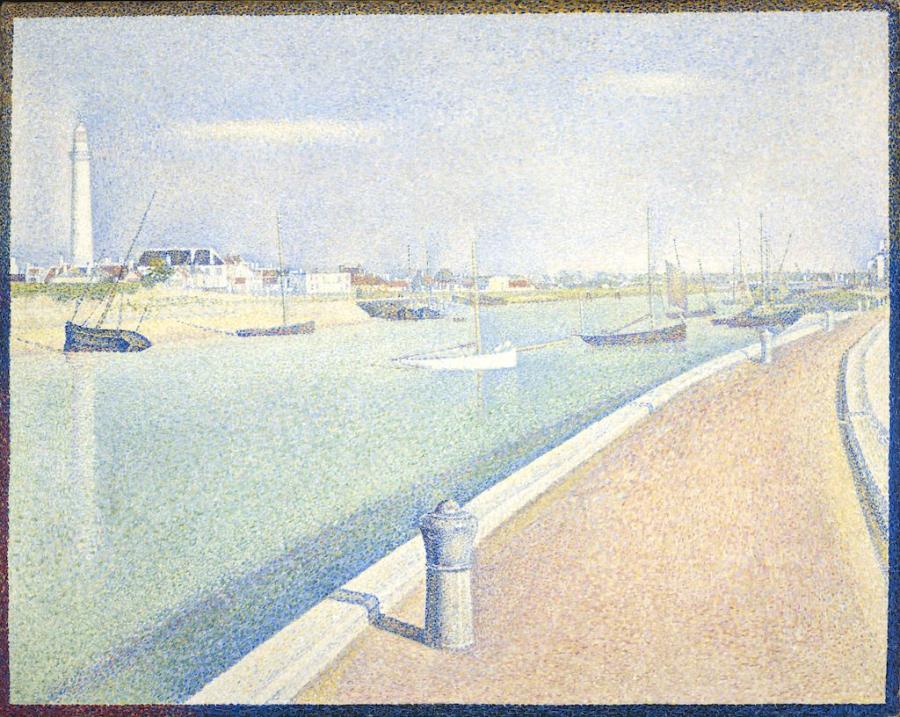
For although, as a technique, pointillism was perfect for capturing the light and atmosphere of the coast (pictured above: The Channel at Gravelines, Petit-Fort Philippe, 1890), it was not good at conveying the weight and solidity of buildings or the energy and dynamism of movement. Consequently Seurat’s seas are as still as a mill pond and, even when flags are flying and sailing ships are scudding by, not a breath of wind disturbs the pearly luminescence of the finished pictures.
To be fair, Seurat was aiming for a sense of harmony and distilled calm, rather than the exhilaration of the wind in your hair. And when he gets the balance right between planning and immediacy as in Le Bec du Hoc or The Shore at Bas-Butin (Honfleur) 1886 – in which pale cliffs overlook a sandy beach beside a tranquil sea – the results are truly sublime.
- Seurat and the Sea is at the Courtauld Gallery until 17 May
- More visual arts reviews on theartsdesk







Add comment