

Turner and Constable, Rivals and Originals, Tate Britain, November 2025
Whoever thought of creating an exhibition comparing the brilliance of JMW Turner with that of John Constable deserves a medal. Even if you are familiar with the work, seeing their paintings hung side by side reveals surprising similarities as well as differences.
Turner relished the visual drama of smoke, fog and inclement weather. When the Houses of Parliament went up in flames in 1834, he seized the opportunity to paint the sky filled with billowing smoke and the river glowing red with fiery reflections (main picture). Above all, though, he loved light. Ostensibly, the subject of Light and Colour, 1843 is Moses revealing the Ten Commandments, but the painting is really an ecstatic celebration of the power of paint to conjure the sublime beauty of light and air.
Turner travelled Europe to record in his notebooks the awesome beauty of mountains and the dizzying power of the elements. Using these images to dramatise scenes from history and mythology, he sought to elevate landscape to the level of history painting and to rival the old masters by creating pictures of universal significance.
Constable’s goal could not have been more different. The son of a well-to-do Suffolk mill owner, his focus was on the people and places he knew and loved. His pictures are of the Dedham Valley where he grew up and of activities related to the family business such as harvesting, boat building and barges negotiating the locks along the River Stour.
Since the weather governed every aspect of rural life, the skies were as important to him as light was to Turner. In sketch after sublime sketch, he records sunsets, rainstorms, rainbows and clouds of every shape, size and colour. Transposed onto his more “finished” paintings, the luminous, scurrying or looming clouds make the sky as dynamic as the activity on the ground.
In many ways, the two artists were polar opposites. Turner looked for meaning in the universal and the sublime, while Constable found it in the everyday world at his doorstep. Yet these titans of British art shared a passionate interest in the heavens and although there’s no mistaking a painting by Constable for one by Turner, you could easily mistake Constable’s Rainstorm over the sea 1824-8 as one of his rival’s sketches. This brilliantly researched exhibition offers a once-in-a-lifetime experience.
- Turner and Constable, Rivals and Originals at Tate Britain until 12 April 2026
Rachel Jones: Gated Canyons, Dulwich Picture Gallery, June 2025
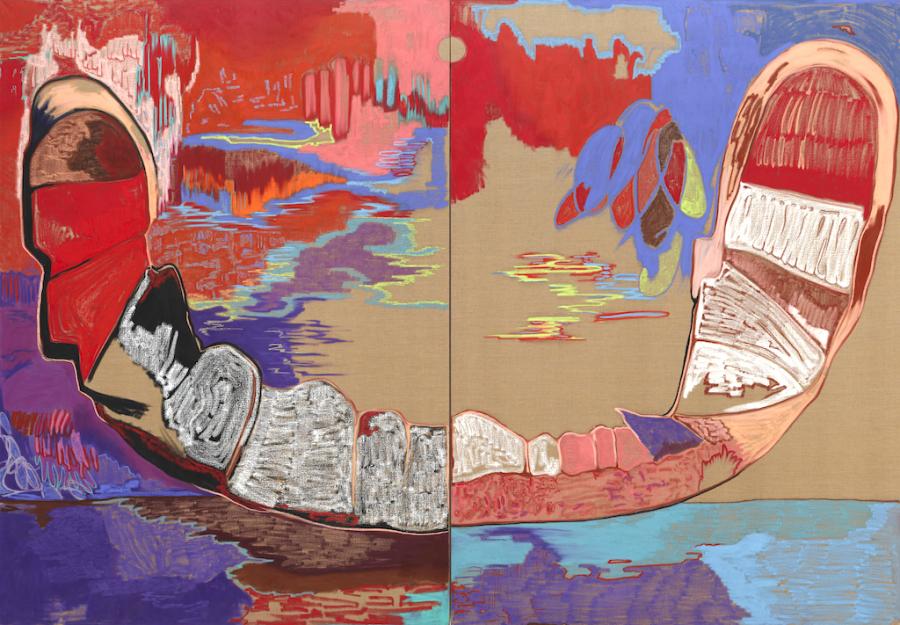
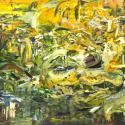
Gated Canyons, 2024 by Rachel Jones. Oil stick and oil pastel on linen Courtesy the artist. Photography by Eva Herzog
The 34-year-old Rachel Jones was the first living artist to show in the main exhibition space at the Dulwich Picture Gallery. In her huge oil pastels, rivulets of bright colour shimmy round one another in what seem like joyous celebrations of pure abstraction. Yet hidden within this glorious maelstrom of marks are brick-like shapes representing teeth; Jones is fascinated by mouths and the dentures that, literally and metaphorically, guard these entry points to our interior being.
Dominating the final room is a picture devoid of teeth. Dangling from a carnival cloud of jazzy yellows, blues and oranges is a huge, phallic tongue. Coloured blushing pink, rich purple and warm red, it is fleshy, raw and pulsating with need.
The presence of such an overtly suggestive image feels like a confession – an acknowledgement of the fact that the mouths and their guardians harbour other layers of meaning. No wonder Jones’ pictures are such an orgy of sensual delight. It seems that they embody the pleasure principle and the many fears that accompany surrender to desire.
Kerry James Marshall: The Histories, Royal Academy, September 2025
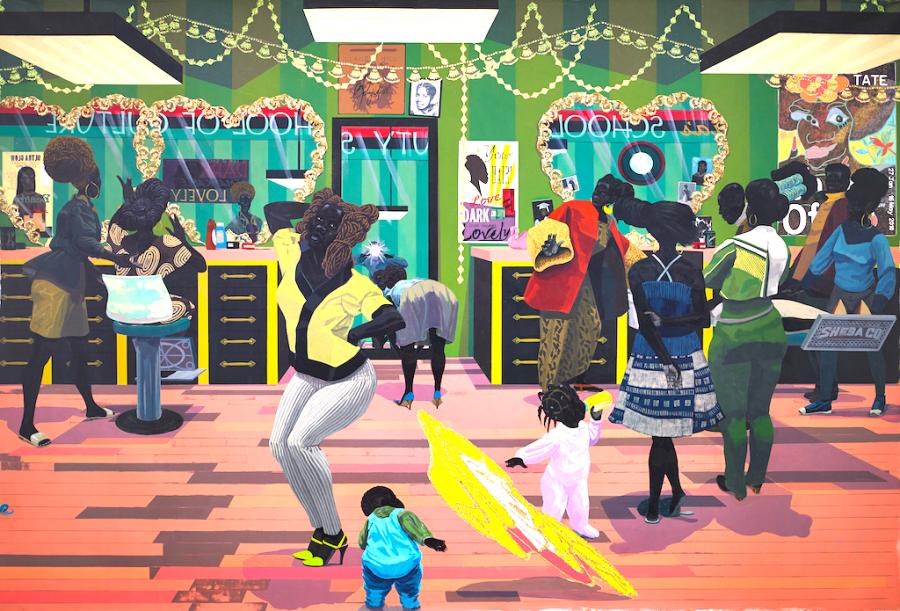
School of Beauty, School of Culture, 2012 by Kerry James Marshall. Acrylic and glitter on unstretched canvas. Collection Birmingham Museum of Art, Alabama. © Kerry James Marshall. Courtesy the artist and Jack Shainman Gallery, New York. Photo: Sean Pathasema
Celebrating Kerry James Marshall’s 70th birthday, The Histories occupied the main galleries of the Royal Academy with such joyous ease and aplomb that it made one forget how rare it is for a black artist to be given centre stage. Gallery after gallery was filled with pictures that unapologetically embed black people within the canon.
My favourite picture is School of Beauty, School of Culture, 2012, a salon where stylish women gather to perfect their make-up and elaborate hairdos. Even in a place dedicated to black beauty, there’s an issue, though. Two toddlers have noticed a strange shape hovering in the foreground. Inspired by the anamorphic skull in Holbein's The Ambassadors 1533, this apparition is of a blonde cutie whose looks supposedly represent an ideal against which these women may well be found wanting.
Before embarking on paintings which unequivocally put black people in the frame, Marshall addressed their absence from the art of the past by making imaginary portraits of overlooked historical figures such as the poet Phillis Wheatley-Peters, the painter Scipio Moorhead and Harriett Tubman who, having escaped slavery herself, set up an “Underground Railway” of safe houses that helped countless others make their getaway.
“I’ve always wanted to be a history painter on a grand scale”, says Marshall. But his paintings have little in common with the tedious celebrations of victories and conquests that come to mind. They may be as ambitious in scope, but they are far more intelligent, far more nuanced and much more fun. That’s how you unapologetically take the citadel (of high art) by storm.
Do Ho Suh: Walk the House, Tate Modern, May 2025
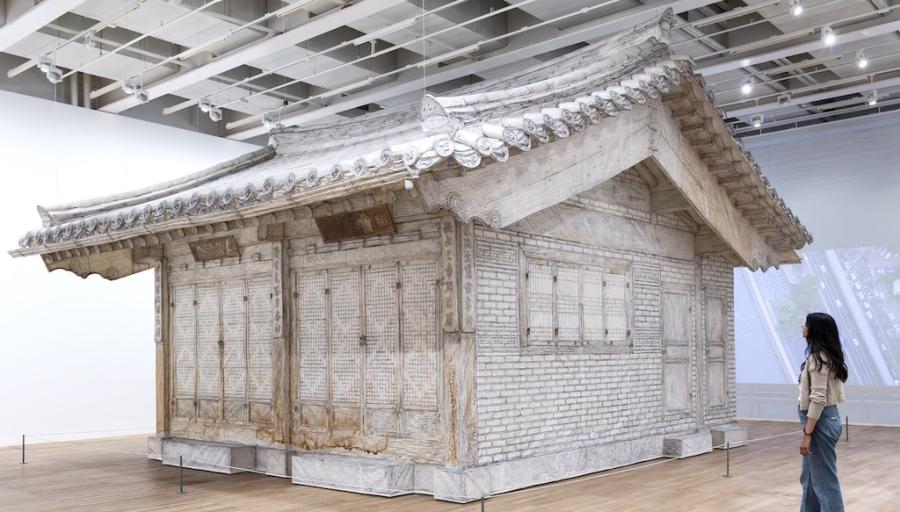
Rubbing/Loving Seoul Home 2013-22 by Do Ho Suh at Tate Modern © Tate Photography (Jai Monaghan)
In 2013, South Korean artist Do Ho Suh covered his childhood home in mulberry paper and made a rubbing of every single nook and cranny of the exterior. He left the paper in situ for nine months until the drawing had weathered to resemble an old sepia photograph. It’s as though he were trying to fix a memory that had begun to dissolve during the 20 odd years since he left home to study in America.
And since leaving Seoul, he has created full-sized replicas of every place he has called home. The white fabric walls of Perfect Home: London, Horsham, New York, Berlin, Providence, Seoul 2024 enclose a space the size of the London flat he now lives in. The walls are lined with replicas of fixtures and fittings – door knobs, handles, sockets, switches, lights, locks, thermostats and so on. Dotted all over the place, they accumulate like the notes of a symphony, celebrating the ongoing rituals of daily life and their continuation no matter where you find yourself.
Do Ho Suh’s aesthetic is so exquisite that, on leaving his glorious exhibition, I found myself noticing the particularities of every surface with unusual clarity and extreme pleasure. Thank you.
Wayne Thiebaud: American Still Life, Courtauld Gallery November 2025
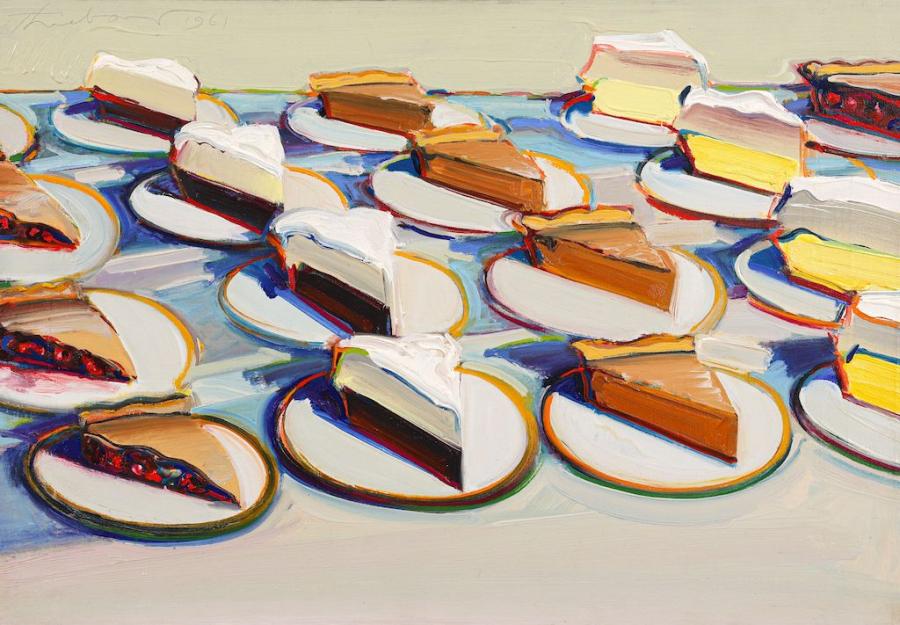
Wayne Thiebaud, Pie Rows, 1961, Oil on canvas, Wayne Thiebaud Foundation. © Wayne Thiebaud VAGA at ARS, NY and DACS, London 2025. Image Wayne Thiebaud Foundation
Four slices of cherry pie are lined up alongside their chocolate, pecan and lemon meringue counterparts. The display goes on and on, for as far as the eye can see. At first glance, Wayne Thiebaud’s pictures of quintessential American treats – cakes, pies, hot dogs, ice creams and gob stoppers – look like euphoric celebrations of abundance. But gazing at this glut of comfort food soon makes you feel downright queasy. More is not always better; nourishment is what’s needed, but fast food is moreish because it has little food value.
The Courtauld exhibition is the first time his pictures have been shown in the UK and, boy, are they delicious – not because the edibles they portray are desirable, but because the paintings are finger licking good. Thiebaud saw himself as part of the grand tradition of still life painting, but he also went to New York, where he met Elaine and Willem de Kooning and was bowled over by their free-hand gestural expression.
He lathers on the paint with such panache that the swipes, slabs and dollops of pigment are as present as the foodstuffs they portray. His slices of pie may look as inert as polystyrene models, but the gaps between the plates are alive with vigorous brush marks.
Downstairs in the Drawings Gallery there’s an exhibition of his drawings and prints, most of which are in black and white. Without the exaggerated palette of the paintings, the mood is totally different; the slices of cake look yummy and the ice creams cones comic yet heroic. Later, Thiebaud hand-coloured some of the etchings in subtle hues that suggest enormous affection for the goodies with which he chose to represent America.
It’s this ambiguity that makes the pictures so memorable. Because you can never get to the bottom of them, the love affair continues – endlessly.
- Wayne Thiebaud: American Still Life at the Courtauld Gallery until 18 January 2026
- More visual arts reviews on theartsdesk


Add comment