


At first glance, the meetings between heart surgeon Steven Murphy (Colin Farrell) and a 16-year-old boy, Martin (Barry Keoghan), lead one to fear the worst for the kid. Their stilted exchanges in public places, during which the man gives the teen expensive gifts, don’t suggest a family connection, or a mentor-student relationship, but a secret intimacy that can only be, in some way, dreadfully wrong.

And so the mini-boom in motor racing movies continues, this time with a look back at the history of Ferrari and the intense on-track battles of the 1950s, a decade in which the Scuderia won four of its 15 Formula One World Drivers Championships.

It's not every day that an actor breaks your heart playing a character who surrenders his. But that's among the numerous achievements of Timothée Chalamet's knockout performance in Call Me By Your Name. Playing a culturally savvy and articulate 17-year-old American who comes of age sexually in sun-dappled northern Italy in 1983, Chalamet's work is a thing of wonder. As is the film, by turns ravishing and wrenching.

Forget the ersatz experience of Sergey Eisenstein's mighty silent films accompanied by slabs of Shostakovich symphonies composed years later. This collaboration between the London Symphony Orchestra and Kino Klassika is as close as we can ever come to hearing the massive score composed by Austrian-born Edmund Meisel for the greatest of the master's 1920s films. It was intended for large-scale screenings of October in Berlin and Moscow, which never took place in the expected format.

It’s a challenge to review this film without resorting to adjectives like “plucky” and “well-meaning”, and its mainstream comfiness made it a strangely cautious choice for the opening night of the recent London Film Festival. Breathe is not only Andy Serkis’s debut as a director, but also a film based on the family experiences of its produce

Who is the real Grace Jones? This is the central question that drives Sophie Fiennes’s documentary, Grace Jones: Bloodlight and Bami. After 115 minutes, you might be less sure of the answer than when you go in. The title is Jamaican for a recording booth’s red light and bread, the substance of life. It’s appropriate for a film which juxtaposes the abstract visual feast of Jones’s live show with her modest upbringing in Jamaica.

Like Steptoe and Son with ideological denouncements, Stalin’s Politburo have known each other too long. They’re not only trapped but terrified, a situation whose dark comedy is brought to a head by Uncle Joe’s sudden, soon fatal stroke in 1953.

Director Dan Sickles has known Dina her entire life. He knows her engaging personality, and he knows her tragic past. It’s the former which he and co-director Antonio Santini feel is worth celebrating in this Sundance award-winning documentary.
Dina is a 48-year-old widow who views the world with childlike optimism. Her charm and openness are immediate – traits which have enamoured her fiancé Scott. Together they make a winning team, each growing from the other’s support, love and unconventional nature. Alongside a rolling cast of friends, family and unsuspecting strangers, we watch the couple reach new milestones in their relationship.
The film is a fascinating look at love – one that is not traditional but unarguably unconditional. The leads are admirably open about the issues they face around sex: Scott uncomfortable with physical contact and Dina paranoid about Scott’s disinterest. It's an honest and subtle insight into how people living with autism navigate relationships..
On face value, the film appears to follow two eccentric people as they plan their marriage. Certainly in the first half-hour, there’s a creeping sense that we’re jumping from one awkward social situation to the next with no clear direction. This is deliberate. We begin like the unsuspecting strangers, only seeing the quirks. Sickles and Santini do not spell out Dina and Scott’s history; we get to know them as people first because it means all the more once we find out what they’ve experienced.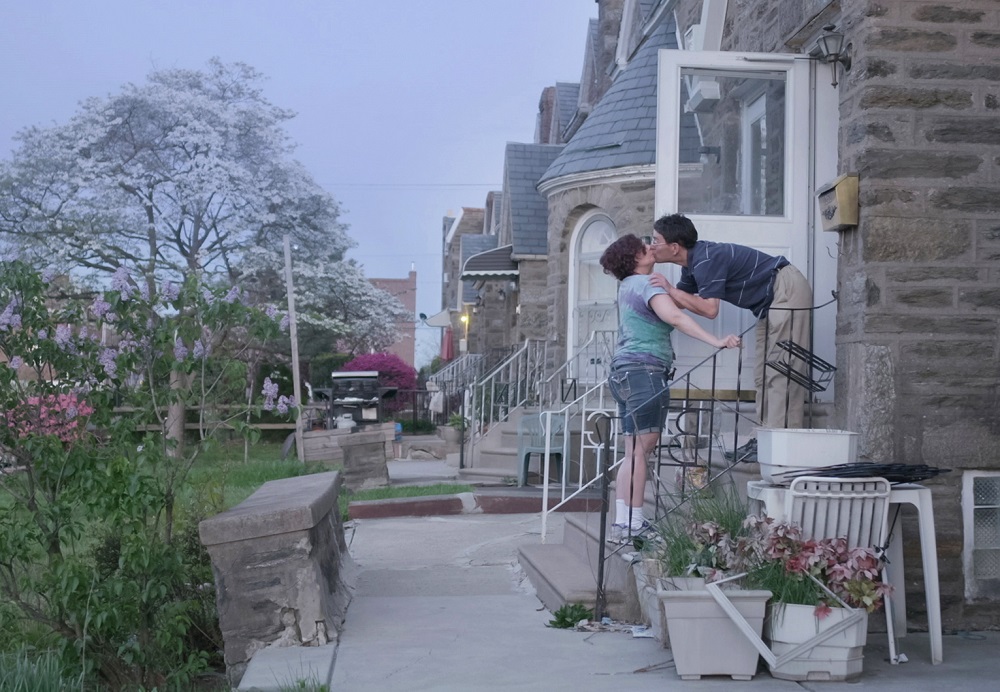 This is highlighted in the film’s final moments, three gut-wrenching minutes made all the more affecting because they follow 90 minutes of relationship-building. The story here is the people Dina and Scott are, not what they’ve been through or what they’ve been diagnosed with. The approach works: somewhere along the way you begin really caring for these characters.
Each scene in Dina appears carefully composed, as if the directors knew that they just had to frame the shot and the material would come. There must be hours of footage left on the cutting-room floor, but the editing seamlessly compiles sequences together. Much of the comedy (and there’s a lot) is drawn from here, including a montage in which Scott shops for tuxedos while Dina browses an S&M shop.
While it’s rewarding to focus on character and not story, it does mean Dina drags in the middle. After watching the couple catch their 10th bus, you can be forgiven for wondering where this is all going. Perhaps it would reward rewatching once Dina’s backstory has been revealed, although this would defeat the point of not tackling it from the beginning. Dina is really about two people very much in love. Dina’s history is overwhelming, but she hasn’t let that define who she is and neither has the film. As a piece of cinema, it’s a surprisingly poignant treat.
Overleaf: watch the trailer to Dina

Screen biographies are tricky things to pull off when the person portrayed has left behind an indelible screen presence. It was hard to love Michelle Williams dragging up for My Week with Marilyn; Grace of Monaco was far from Nicole Kidman’s finest hour.