

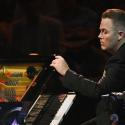
For the final concert in their 80th birthday season, the Philharmonia swept us into the great outdoors. Three works imbued with the forces of nature made up a sort of musical sandwich, with a novel central filling flanked by more familiar, and comfortingly nutritious, outer layers. The surprise flavours in the middle arrived in the form of the UK premiere of the Mother Earth piano concerto performed by its composer: the maverick, prolific Turkish pianist Fazil Say.
Hearty but well-baked fare before and after was supplied by Sibelius’s tone-poem En Saga and Dvořák’s bucolic Eighth Symphony, with its prodigal harvest of dance-driven melody. At the Royal Festival Hall, Santtu-Matias Rouvali conducted with a limber, springy brio that encouraged the many brilliant flowers in his birthday band to bloom when their turn came.
Say’s ecologically-themed concerto proved eccentric, eclectic but never less than entertaining. One of the themes of the afternoon’s pieces turned out to be the distance between programmatic formulations of a musical work and the experience of hearing it. Mother Earth, explains Say, takes its cue from “the environmental challenges our planet faces”. Across its seven parts, sections inspired by “Earth”, “Forest”, “Sea” and “River” summon fires, floods and storms, animals and birds, while bridging passages evoke more abstract or contemplative states. Plentiful mimetic passages saw the resourceful percussion desks conjure up the chirrups, squawks and cries of woodland creatures, the soft rustle of leaves, or the liquid murmur of streams. But this imitative scene-painting contributed less to the overall mood than the more inward journey of Say at his keyboard.
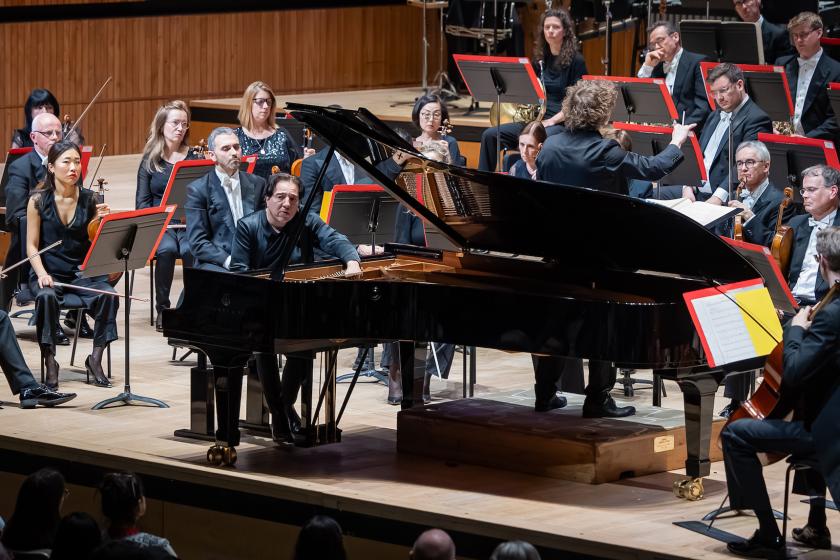
We began with colours of cool blue jazz. Say often reverts to a Brad Mehldau (or even Keith Jarrett) mode of laid-back, rhythmically adventurous lyricism. With those jungle and ocean flavours in the mix, the whole thing sometimes sounded a bit “David Attenborough does Blue Note”. But Say’s many-layered pianism abounds in invention and versatility, whether transforming the plucked piano strings themselves into a kind of oud (Turkish allusions also recurred) or branching out into sparkling, Debussy-like waterfalls and rivulets of sound.
Some of the orchestration effectively found its mark: in the roaring, crackling eruptions of the forest fire, or the mesmeric shimmer and ripple of Say’s musical seashore. Other passages could feel laborious and heavy-footed, with their syncopated ostinato figures sometimes worked too hard. That combination of naturalistic bird or beast calls with thick-textured musical scenography brought to mind the lush Brazilian rainforest rhapsodies of Heitor Villa-Lobos. If the entire piece never sounded quite like a coherent landscape, plenty of its vistas beguiled. And Rouvali’s energetic advocacy ensured that the Philharmonia painted every corner of Say’s earth in rich and exact colours.
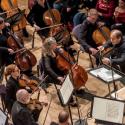
In Sibelius’s En Saga, the Nordic landscapes invoked appear more as emotion than as geography (let alone zoology). The Philharmonia’s strings wove a mysterious carpet of effects (with eerie tremolando), before woodwind voices sang their own haunting songs. Later, the in-form brass (trombones especially majestic) added grandeur, even menace, to the mix. Here, and in the Dvořák, Rouvali’s pulse and drive never slackened. But he made space too for the skin-prickling sense of stillness and mystery Sibelius demands.
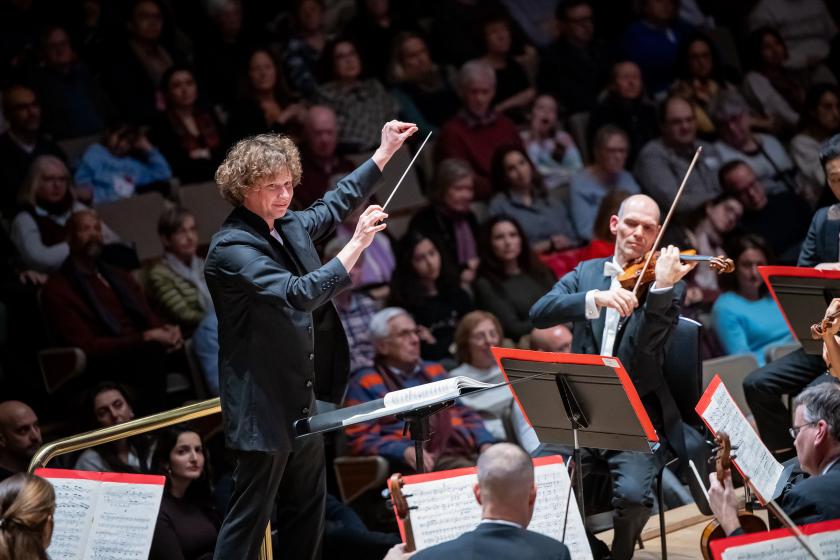
The Eighth Symphony danced and bounded along vernacular elegance; we heard all its folksy, pastoral charm but also the sophisticated, Brahmsian command of contrasting manners and textures. Rouvali ensured that a Bohemian lilt and say underpinned the homely grace of the tunes that adorn the adagio and intermezzo, while the tutti that punctuate this all this rustic charm had a resonant authority. From first to last movement, the Philharmonia cellos wrapped us in warm, velvety nobility of sound. Solo voices sang out strongly: Samuel Coles’s flute, a consistent delight both here and in Sibelius; Scott Dickinson and a sumptuous squad of violas; Timothy Rundle’s refined oboe. Philharmonia leader Zsolt-Tihamér Visontay brought a wining flair to his solo moments while the trumpets (Jason Evans, Robin Totterdell) aced the fanfare that launches the closing set of variations, exuberantly played by all.
The Dvořák furnished a satisfying showcase for the Philharmonia in its celebration season: firm and tight in its ensemble sound, but packed as well with stylish and forceful individual accents. They thoroughly deserved the birthday cake that Rouvali cut at the open-access after-show party.


Add comment