

Kahchun Wong is continuing to put his own stamp on landmark works of the mainstream repertory with the Hallé. This time it was Beethoven’s Third, "Eroica", Symphony.
That’s not to say that his programmes are devoid of novelty for the orchestra’s Manchester audience. He’s made Unsuk Chin the “Featured Composer” for the present season, and her subito con forza, written as a tribute to Beethoven in 2020, represented her in this concert. It’s a piece of which the Hallé gave the UK premiere (in the BBC Proms of 2021, under Sir Mark Elder), but except for those listeners who attended its outing with the BBC Philharmonic here in 2023 (with Anja Bihlmaier) this may well have been a first encounter. Its series of explosive gestures – the quintessence of sforzando, I suppose, with its smattering of mini-near-quotations from Ludwig himself – was delivered with pizazz and precision.
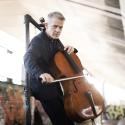
On to more serious stuff, with Jan Vogler (pictured below) the soloist in Shostakovich’s First Cello Concerto, written for Rostropovich and widely considered one of the most taxing pieces among the instrument’s concertos. The first thing to say about his reading is that his own uniquely baritonal, masculine sound, remarkably full of overtones, was superbly suited to the writing. In virtuosic terms, it was heard at its peak in the long cadenza that forms the third movement, but his tone, so often song-like, meditative and lamenting, was heard to greatest effect in its heartfelt passages.
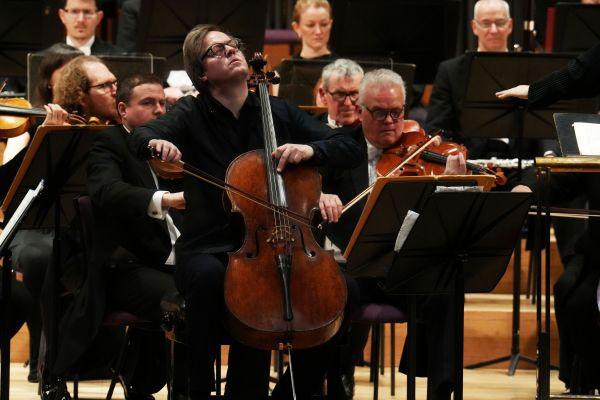
The orchestral strings remained at full strength for this piece (unusual in performances of cello concertos), but that was no handicap for Vogler in the vigorous and energetic opening Allegretto. He had a worthy partner in the form of the Hallé’s principal horn Laurence Rogers – the one brass instrument in the score, whose role includes rapping out both of the movement’s main themes at different points and contrasting its versions with the cello’s. The second movement brought Vogler at his cantabile, expressive, almost vocal-sounding, soulful best (with another reflection from Rogers), and its conclusion, with Vogler in lovely duet with principal clarinet Sergio Castelló López, was haunting. The finale, under Kahchun Wong’s direction, was characterised by shrill and incisive woodwind playing and more brilliance from the soloist, together combining to deliver its message of grim humour and unbeaten determination.
For the Eroica, Wong had most of the orchestra standing (just the cellos and basses permitted to play sitting down), and – no doubt to keep the sightlines clear – both he and those seated players had to have extra platforms erected to raise them up in relation to everyone else. This practice was used by Sir Mark Elder on the odd occasion and is favoured by other conductors for particular occasions: I’ve never been quite convinced that it changes the sound of an orchestra or the ability of professional players to give of their best, but it certainly didn’t harm the impact of Beethoven’s ground-breaking, trail-blazingly gigantic symphony.
The rewarding thing about Kahchun Wong’s interpretations of standard works such as this is that he absorbs the best of all traditions and delivers a thoughtful, yet fresh and thrilling reading of each. He doesn’t rush things (as some Beethoven conductors are wont to do). His opening of the Third was smooth and quite ingratiating (after the two big chords), keeping the surprises for when they should come, in the hammering syncopations. He didn’t repeat the first movement exposition, but brought in a deliberate slow-down near its end to mark the join in the structure (repeated in the recapitulation, too). He doesn’t just bash away at the subsequent shocks, either, but pays attention to gradations in the dynamic marks and saves the most powerful effects for their strategic places. There was vivid contrast (a mark of this essay in Hegelian thesis-antithesis-synthesis in music) right through to the end of the coda.
The Funeral March second movement was really funereal – you could have comfortably walked behind a cortege in time to it – in fact, almost mock-funereal, but I think close to the spirit of echt-Romantik. Its climax was very big, and the details of emphasis and phrasing beautifully clear from the Hallé players led by Robert Ruisi, and the timpani (the old, screw-top sort, of course) used sparingly.
The scherzo was a dance, not a dash, resonant and warm, with the notes at full value, with the horns enjoying their bucolic excursions. And the finale, itself based on Beethoven’s own, real, dance music, was flexible and skilfully paced, slowing nicely even before the switch to Poco Andante, at which it began an episode of nobility and exaltation, on the lines of what was still to come in the ending of the Sixth Symphony – again teetering on the edge of exaggeration, but not quite going over (it helped it to have the first horn part doubled there). The Presto, though still not rushed, was delivered with great swagger and effect.
- To be repeated on 15 February
- More classical reviews on theartsdesk


Add comment