Sometimes a film has you swooning from the very first frame, and Polish director Pawel Pawlikowski's fifth narrative feature is one such film. The story of a nun's self-discovery is captured in delicate monochrome by cinematographers Ryszard Lenczewski (Margaret) and Lukasz Zal, who render the often austere surroundings with great, gob-stopping imagination in a film whose beauty is enough to make you bow down and praise Jesus, whatever your religious proclivities.
Agata Trzebuchowska (mesmerising in her acting debut) is Anna, a novice nun in early 1960s Poland preparing to take her vows. She's a woman without history, a picture of smooth, unblemished purity, living a stark and simple present - the opener shows her carefully restoring a statue of Christ. Anna's life is thrown into turmoil when she's persuaded to visit her only remaining relative, Wanda (Agata Kulesza, pictured below right), her maternal aunt, who, for reasons unknown, neglected to take her in when she was orphaned, allowing her sister's daughter to languish sans identity in the convent.
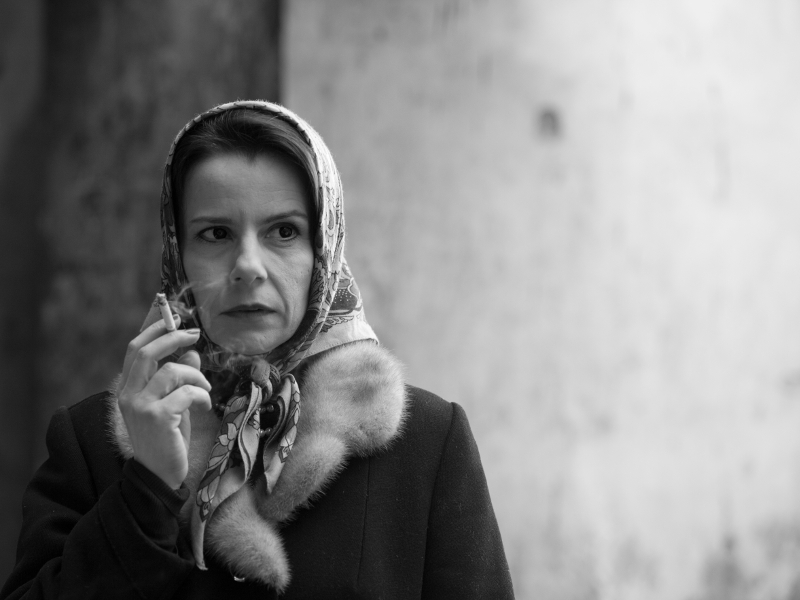 Wanda is a faded, hard-bitten and promiscuous character, coasting on her former glories as a formidable state prosecutor (known as Red Wanda), and forlornly clinging onto her looks. She acts as a rude awakening to Anna's chaste, sheltered existence, refusing to mince her words or conceal her bitterness as she tells her unspoilt niece, "I'm a slut, and you're a little saint."
In sensational yet calmly received news, Wanda informs Anna that she's really a Jew named Ida, whose parents were murdered during the Nazi occupation of Poland. Her identity finally established, the pair take off on an odd-couple adventure to track down the final resting place of Ida's parents. Wanda, it transpires, is dealing with unfinished business, while the enigmatic Anna/Ida gets a chance to try an ordinary life on for size.
There's something perversely showy about employing it modern-day, but shooting in, or converting to, black and white certainly has its advantages. Reducing the cinematic colour-scheme can increase clarity, or imbue a picture with melancholy, severity or dramatic weight, and it's still being very effectively utilised: The White Ribbon, Tabu, Blancanieves and Nebraska to name four striking but very different recent examples.
Here monochrome suits the stripped-back story, the slightly gloomy introspection and the early 1960s era; it emphasises Ida's virtuousness and the corruption of her aunt, whilst also cloaking the latter in retro glamour. A particularly striking effect is that, shorn of their nuance, Ida's eyes appear black; round, shiny and piercing, flickering between incomparably innocent, inhuman and accusatory.
Pawlikowski's previous films include My Summer of Love and Last Resort. His last feature, The Woman in the Fifth, was a slightly hokey thriller, and this spare, sensitive (though perhaps a little slight) tale of redemption redeems him too. Radiant with compositional brilliance and steeped in sorrow, Ida was the winner of Best Film at the 2013 London Film Festival and, as that suggests, has taken its time to reach us. If you can bear the burden of its heartbreak you'll find that it has certainly been worth waiting for.
Overleaf: watch the trailer for Ida