Although Blancanieves seems to come on the back of the world-conquering The Artist, it was actually conceived before the French tribute to silent-era cinema. Rather than being about silent cinema, Blancanieves is a silent Spanish take on Snow White which, through sheer panache, verve and eccentricity, can’t fail to seduce. But like The Artist, it has an unforgettable animal actor. It’s impossible to see a cockerel in the same way ever again.
Blancanieves is also defined by Maribel Verdú’s Encarna, a character who is evil incarnate; Macarena Garcia’s passionate yet sensitive grown-up Carmen; Sofia Oria’s delightful and nuanced Carmenchita; and a visual palette which stunningly pays scrupulous attention to period detail. Director Pablo Berger is obviously on more than nodding terms with Tod Browning’s Freaks, Bergman’s Sawdust and Tinsel, Douglas Sirk and Tim Burton. The Canadian auteur Guy Maddin must be a blood brother. Most of all though, the meticulously crafted Blancanieves is a unalloyed delight.
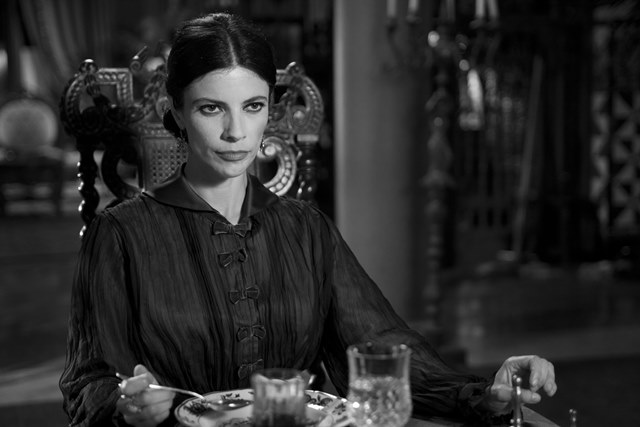 The film is set in the 1920s, when Spain’s Prime Minister was Miguel Primo de Rivera. It climaxes in 1929 at the time a new constitution was adopted which allowed women the vote. De Rivera was gone the next year and the slide into depression and towards Civil War and Franco's dictatorship took hold. The rise of Blancanieves's heroine and her eventual fate parallels the boom to bust path of Spain under de Rivera. Berger's previous film, Torremolinos 73, was set in a Spain which had endured more than 30 years of Franco, two years before the dictator’s death. As a director, he knows how to set context. (Pictured right, Maribel Verdú as Encarna)
Antonio Villalta (Daniel Giménez Cacho) has everything. The pin-up fighter in Seville’s bullring, he transfixes the crowd. Yet when he takes his eye off the bull he pays the price, ending up in a wheelchair. As if that weren’t enough, his pregnant wife Carmen de Triana (Inam Cuesta) is traumatised by events in the arena and dies in childbirth while he's being patched up elsewhere in the same hospital. With no mother and an incapacitated father, his new daughter, Carmenchita (Oria), is brought up by her grandmother. After she dies, the girl is handed over to Encarna (Verdú), the nurse who got her hooks into Villalta at hospital and married him. Carmenchita’s wicked stepmother puts her to work shovelling coal and boiling linen. The filthy basement of her country mansion is the girl's bedroom.
Encarna decides that Carmenchita has to be eliminated. There can be no obstacles to her acquiring all Villalta’s wealth. After years of suffering, Carmen (Garcia) – no longer the Carmenchita of her childhood – is taken in by a travelling troupe of bullfighting dwarves and becomes Blancanieves, the female bullfighter. Salvation has come but Encarna always lurks, ready to cast a shadow over any joy and triumphs.
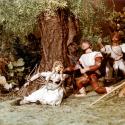
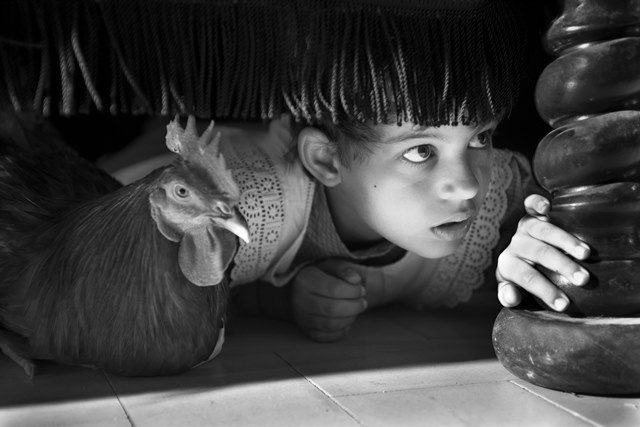 It’s not quite the Snow White we know, but The Brothers Grimm would recognise it. There’s the apple, the coffin and the dwarves. Retribution too. As well as the 1937 Disney animated version, there are countless film and TV adaptations. The first was a 1916 silent-film version. Instead of being weighed down by all this baggage, Blancanieves more than holds its own. (Pictured left, Sofia Oria as Carmenchita takes shelter with Pepe the cockerel)
The way Blancanieves has been made doesn’t limit its appeal. It’s even plausible that it isn’t really a silent film: the music composed for the soundtrack is integral; the sound of bells, fireworks and singing from a record are heard. As a sensory experience, it’s akin to taking in a musical. Alfonso de Vilallonga’s fantastic music reinforces and raises the emotional pressure. It also slows the film’s pulse and is vital to what makes Blancanieves tick. The images and the music are indivisible.
Conceived as a whole, Blancanieves would still succeed if any of the elements in its make up were removed. But when everything is taken together, this lush melodrama becomes very special.
Watch the trailer for Blancanieves