Lovers of a particular novel, when it’s adapted as a movie, often want book and movie to fit together as a hand in a glove. You want it to be like sheet music transfigured into the sound of an orchestra. Too often, though, the resulting film can resemble the sound of the orchestra trying to play in boxing gloves.
Such worries arise for readers of Jim Crace’s rich and eloquent novel Harvest, published in 2013. It iridescently tells of an English rural community assailed by the enclosure movement, in which landlords fenced off common land to make money off sheep (a gambit that picked up steam in Tudor times). The thoughtful narrator, Walter Thirsk, watches as his none-too-thoughtful fellow locals flail against a new lord of the manor intent on grassing over their beloved arable fields and kicking most of them out.
Three impoverished outsiders – themselves kicked out from elsewhere – spark the kind of prejudice that leads people to fail to see the barley for the grass, and the villagers become their own worst enemies. Walter’s crime is to do little to stop all this until the imploding finale, when he mounts a solo revolt to somewhat token effect.
Crace’s work contains common items of a novel – a large number of characters, complex cross-currents and a mainly passive “protagonist” – that a typical movie is likely to struggle with. And so it is with this adaptation helmed by Greek director Athina Rachel Tsangari.
The writer John Fowles once said that the best movie adaptation was a “metaphor” for a novel – that is, with the freedom to re-think the story. (That can even apply to a play: think of Ran, the Kurosawa King Lear overhaul.) In the 131 minutes here, Tsangari sticks to covering every jot and turn of the original plot, yet goes wildly off-book with the setting and production design.
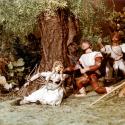
The picture descends into a bit of an editing tangle, with a plangent score of fiddles, pipes and Celtic drummingRather than the wealds and downlands of 16th-century England, we are next to a loch in Argyllshire. It’s not that Scotland was immune to the sheep-hungry enclosure movement, as John McGrath’s play The Cheviot, the Stag and the Black Black Oil reminds us (made into a TV version in 1974, directed by John Mackenzie). But the location used here is basically heathland with only a small triangle of land carved out for a field of corn. The village consists of farm sheds with what look like corrugated-iron roofs.
The costumes similarly range across cultures and centuries, though the villagers have the suitably worn looks seen elsewhere in the pastoral-progressive genre covering class struggle in the countryside – a canon that ranges from Kevin Brownlow’s Winstanley (1975) to Peter Smith’s TV five-parter Bread or Blood (1981) and Bill Douglas’s Comrades (1986). The rough-and-ready camerawork, natural sound and earthy Kodak film stock might recall such predecessors too. (The bedraggled Highland faces even flashed me back to Peter Watkins’s Culloden of 1964.)
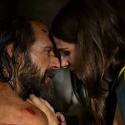
Caleb Landry Jones plays Walter Thirsk in a suitably watchful and wounded manner, and he’s given a voiceover that captures some of the rhythms of Crace’s silken prose, telling us how “ploughing is our sacrament, our solemn oath”. Those with the posh parts veer towards caricature: Harry Melling is a laughably inadequate squire who hands over his land to his cousin, a literally black-hatted English slimeball played by Frank Dillane. Others include a vengeful wise woman (Thalissa Teixeira) and a draughtsman with a bit of a contract out on him (Arinzé Kene). Accents among the cast seem to take us from Lagos to Glasgow, via London and São Paulo.
Director Tsangari made her name with two movies from the Greek indie school of the-odder-the-better, Attenberg from 2010 and Chevalier from 2015 – studies of social disconnection and extended adolescence in the vein of Yorgos Lanthimos (who was once her producer). She sets off promisingly here with floaty, Andrea Arnold-like images of Thirsk immersing himself in the slugs, moss, bark and water of his prelapsarian home, before the story chores of the script kick in and seem to weigh her down.
As the rural aggro and ruling-class abuses cascade, the picture descends into a bit of an editing tangle, with a plangent score of fiddles, pipes and Celtic drumming carrying us across an extended pile-up of second-half violence. But at least Tsangari finds the time to make an eye-catching killing that’s not in the source material: the death of a character between the legs of the weird outsider woman – a death, without going into further details, by drowning.
To be honest, clear motivations and credible backstories of the kind the movies like are not a feature of Jim Crace’s tactile, reflective book, any more than in many top-end novels; chain-link logic is more the domain of drama. When it comes to adaptations, people in the film world often say, “Pick a bad novel and then hugely re-invent it.” It’s just a little unfortunate that the dictum has been doubly forgotten here.