Taiwanese director Chienn Hsiang has given his lead actress Chen Shiang-chyi a role of rare complexity in Exit, and she dominates this bleakly naturalistic slice-of-life film completely. Chen’s character, Ling, is a seamstress approaching middle age, living an isolated, alienated life with rare distractions – hardly dramatic material in itself, you might think, but the film’s accretion of small everyday events, seemingly insignificant in themselves, comes together to capture a slowly compelling sense of character and milieu.
Though Taiwanese cinema in recent years hasn’t received the international attention it was accustomed to a decade or two back, the understated humanism of Exit, though hardly veering towards optimism, fits into that national context. Chienn’s feature debut builds on his extensive experience as a cinematographer working in that industry, with imagery that’s striking in a downbeat way, and rich in detail.
Chen Shiang-chyi hardly needs words to portray her character
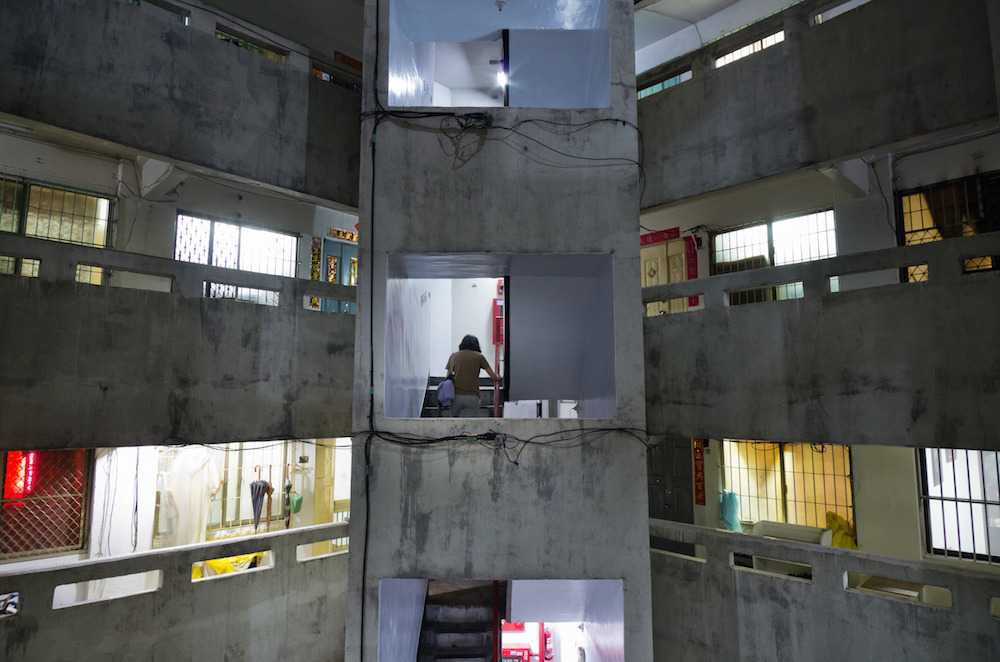
Ling lives a life of quotidian struggle, in which human relationships seem rather absent. Opening scenes show her squabbling with an adolescent daughter before the latter returns to Taipei, while the only evidence of the husband who’s gone to seek work in Shanghai comes with the repeating rota answerphone replies as she tries to locate him. Her work in a small-scale garment factory at least offers the kind of everyday, lighter-hearted interaction with the other women, a degree of connection lacking in the emptiness of her home environment. Chienn captures those details of location rather masterfully, both the domestic interiors with their fraying wallpaper, and the strangely fashioned exteriors (pictured, below right) that create a distinctive sense of atmosphere. The repeatedly jamming door of Ling’s flat, never more striking than in the last scene, acquires an almost symbolic character, making us ponder the film’s title: is there a way out from this life?
Two directions are hinted at. The only diversion at Ling’s workplace comes with an informal dance group; when she’s made redundant and starts sewing at home, such contacts remain, taking her to night classes where the rhythms of tango are in the air. But Ling is there only as an observer, helping to make dresses for dancers, refusing herself to join the action. Exit commendably avoids any hint of easy resolution through such dance magic, or any kind of “tango your way out of the blues” development: if it’s here at all, it’s in Ling’s exaggerated dream-fantasies rather than on any real dance floor. It’s the idea of it more than the reality, a reason at least to brighten herself up (main picture) and imagine there’s a different life out there.
 The film’s other dominant location is the hospital in which Ling’s aged mother-in-law is confined, and where she keeps a long bedside vigil in the hours she has free. Occupying another bed is a man, his eyes bandaged, whose moaning interrupts the ward: he certainly doesn’t speak – Exit is a film of very few words anyway – but something draws Ling to him. Director Chienn leaves this motivation beautifully understated, suggesting both simple kindness and a shared sense of isolation, while hinting too at a growing, more sensual fascination.
Chienn’s aesthetic throughout is a sparing one, but its isolated small gestures speak incrementally through the second half of the film, after a rather languid opening. Chen Shiang-chyi hardly needs words to portray her character, with face and posture somehow conveying everything. She’s taken what might have seemed a slight film to another level entirely.
Overleaf: watch the trailer for Exit