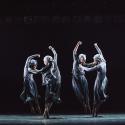
In 2008, a disastrous fire gutted Cloud Gate’s rehearsal studio in Taipei destroying props, costumes and the company archive. Amazingly though, the masks worn by the deities in Nine Songs survived the blaze and Lin Hwai-min, founder of the award-winning company, was so moved by the miracle that he decided to re-stage this sumptuous work.
The phoenix-like revival of the epic, first premiered in 1993, seems especially pertinent since resurrection is a recurring theme. Accordingly, a bed of lotus flowers, symbols of rebirth, fills the orchestra pit and designer Ming Cho Lee has covered the set with huge lotus blossoms enlarged from a painting by Taiwanese artist Lin Yu-San.
All is not a bed of lotuses, though. Nine Songs is based on a cycle of poems by Qu Yuan, doyen of classical Chinese literature, which celebrate life and the seasons but also describe how the vainglorious Gods lead foolish earthlings into debauchery, despair and even death.
A fusion of eastern and western traditions, Lin's choreography is like nothing else
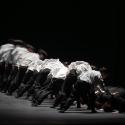
Dressed in a blood-red sheath, a shaman (Huang Pei-hua) dances herself into a frenzy as the circle of white-robed acolytes surrounding her relentlessly beat time with bamboo rods. Later in a stunningly beautiful tableau, the celebrants wave the rods vertically like flickering flames. The Sun God (Yu Chien-hung) appears and, in a lascivious duet with the shaman, asserts his hold over her and the assembled throng.
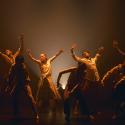
Losing their moral compass, the acolytes tear off their robes, emblems of spiritual purity, and quickly plunge into cruel depravity. In the most extraordinary sequence of moves I have ever seen, the men manhandle their female partners, shoving, grabbing and shaking them as if they were rag dolls, or holding them aloft in ungainly poses resembling leaping frogs. All end up on the floor, a heaving morass of distressed humanity that reminded me of the damned writhing in agony in Hieronymus Bosch’s painting of The Last Judgement (1482).
A fusion of eastern and western traditions, Lin’s choreography is like nothing else. He studied at the Martha Graham and Merce Cunningham studios in New York before returning to his native Taiwan to set up Cloud Gate in 1973, and his dancers are schooled in contemporary dance as well as in Asian disciplines such as martial arts, Chi Kung, calligraphy and meditation. The resulting banquet is laden with extraordinarily diverse references.
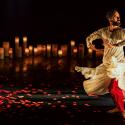
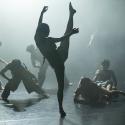
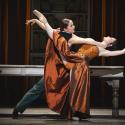
 Dressed in diaphanous white robes, the attendants of the Goddess of the Xiang River (pictured right) are reminiscent of the nubile dancers who skip around the rims of classical Greek pots; while the women bearing candles to commemorate the dead in the closing ritual could have stepped from the walls of some Pharoah’s tomb (main picture, above).
One of the most spectacular sequences is performed by the God of Clouds (Chen Wei-an) who, dressed in a g-string and dramatic mask, looks as if he has sprung from the surface of an ancient Chinese vase. “Dancing in the air” (without touching the ground), Chen demonstrates perfect poise as he strikes demonic poses on the backs of two carriers. Representing autumn, the Mountain Spirit (Tsai Ming-yuan) embodies the anguish of the dying year in an angular solo, his mouth held open in a silent scream.
it is hardly surprising that Lin has won a list of accolades as long as your arm
But there’s humour too – in the form of incongruous references to the present. Gliding round the stage beneath the gesticulating God of Clouds, a man on roller skates trails a large flag. Bike riders weave their way back and forth among celebrants worshipping the Sun God and, at odd intervals, a man in a dark suit appears carrying a suitcase as though he has inadvertently left a Magritte painting and lost his way in the ritualistic mayhem.
The music is equally eclectic, ranging from the ritual songs of Taiwanese tribes, to the clattering drum sticks of the Ju Percussion Group, the ringing harmonies of Tibetan Bells, the deep growl of Mongolian throat music, and the ecstatic refinement of classical Indian flute playing.
Give the astonishing breadth of Lin’s achievement, it is hardly surprising that he has won a list of accolades as long as your arm and has been compared with William Forsythe and George Balanchine. But despite this, for a western audience Nine Songs is not pure pleasure. Frustration is inevitable when you have to content yourself with mere glimpses of the wealth of meaning.
- Nine Songs, Cloud Gate Dance Theatre of Taiwan is at Sadler’s Wells on 22, 23 February and Rice on 26, 27 February
Overleaf: watch Nine Songs