

The finale of the Royal Ballet’s 2025-26 programming is an extraordinary sight. At the curtain call for Salle de danse, a world premiere from Sol León and Paul Lightfoot, there are so many dancers taking a bow that they have to take turns to come forward, in two different rows, each as wide as the stage. That’s before the conductor and creatives join them.
León and Lightfoot’s visit is yet another canny – and generous – piece of scheduling by director Kevin O’Hare, a way to give a sizeable chunk of his company a piece to get their teeth into, with grandstanding turns in the spotlight for many of them, not just the “star” names. The latter had a piece of their own to launch the evening, León’s Shoot the Moon (2006), created after a long stint at NDT and featuring five dancers (and a cameraman, who got to take a bow too, along with three able-bodied wall-pushers).
The cameraman is there to film the dancers, his images appearing as projections above the set. It’s a technique made popular by theatre directors such as Ivo van Hove and Katie Mitchell but not taken up so much by dance, where content tends to be fast-moving and usually takes place in empty spaces where cameras can’t hide. Here the technique is used sparingly and effectively to home in on faces at key moments. There are walls here, too, three on a central axis, hence the pushers, who effectively move the set around. This creates three different “rooms”, two of them connected by a window, all wallpapered with the same fin-de-siècle pattern in different shades.

The music is Philip Glass’s “Tirol” concerto for piano and orchestra, a perfect choice for the repeated sequences the dancers enact, of couples warring and parting and reuniting, one of them inevitably left alone when the other four pair up. Glass’s swirling arpeggios propel the moves on, like a series of waves, rising into overwhelming climaxes, then ebbing, flowing back and forth like the couples' emotions. The first-cast dancers threw themselves into the piece, the two women (Anna Rose O’Sullivan and Lauren Cuthbertson) almost unrecognisable with their slicked down hair and glamorous long shifts. There’s a silent-movie feel to it, underpinned by comic touches and a setting that could have been devised by Edward Gorey.
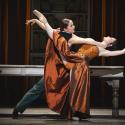
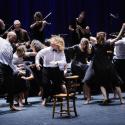
Shoot the Moon establishes the fundamentals of León’s choreographic style. The emphasis is on a histrionic use of the limbs – dramatic extensions, windmilling straight arms, sudden twitches, shivers and shimmies, silent mouthing of unheard words, legs bent with feet at an angle. There are “couples" but few moves that amount to duets or much else from the classical playbook. It’s fun to see a danseur noble like Vadim Muntagirov transformed into a creature moving with almost sharp robotic jerks, and hanging halfway up a wall (pictured above); Matthew Ball tilts even further away from his roots at times into a kind of frenzied melodramatics; and abandoned Lukas Bjorneboe Braendsrod is a portrait of unrestrained misery, bare-chested and at one point howling, audibly but unintelligibly.
These qualities are delivered in spades by Salle de danse, which uses the popular choreographic trope of a dance class at work. But there is no barre, just an open space with a large overhead shape, as wide as the stage, under which dancers come and go. It’s also where the French titles of the piece’s 20 scenes, relating to the steps being rehearsed below, are projected. (There’s also a 21st, for les applaudissements.)
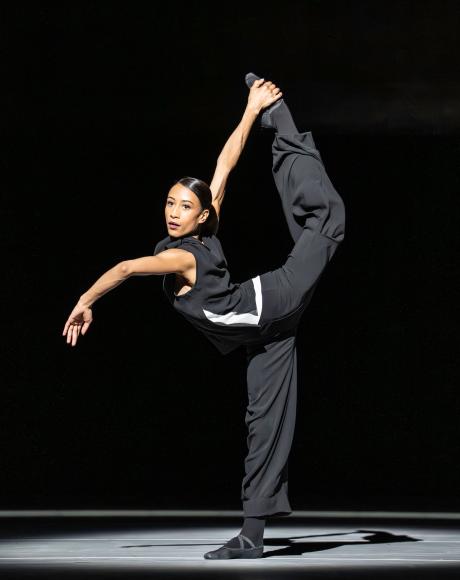
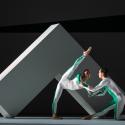
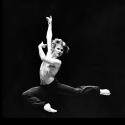
This piece, recycled from a film Lightfoot made during lockdown, is nothing less than a workout for everybody involved. The moves here are more fluid, with arms rippling like a swimmer’s and bodies moving from floor to air with amazing rapidity. Arabesques are often sustained with hands holding the raised foot, as Marianna Tsemenboi (pictured left) demonstrated. Lifts are unconventional and inventive, bodies combine in unexpected ways (hats off to Melissa Hamilton for her 180-degree extension while being held upside down). The action is non-stop, punctuated only by the changing of scenes, as the athleticism intensifies.
Things begin relatively slowly with a seemingly mismatched couple (Marcelino Sambé and Francesca Hayward), he frisky and playful, she more aloof. Their section ends with her standing in a spotlight draped in a vivid scarlet robe, like a glamorous statue. Memories of Matt Ek’s Carmen in a red flamenco dress with a 15ft train were sparked, but this robe, which returns in the last scene, is even more dramatic.
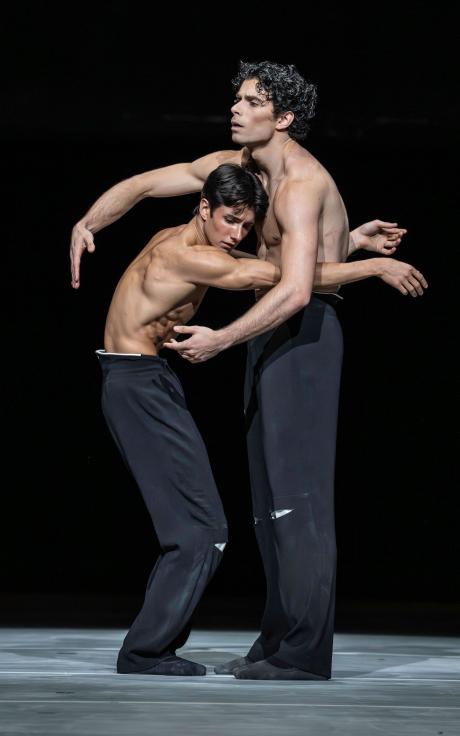
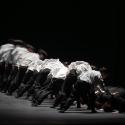
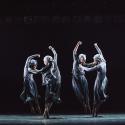
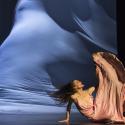
In between, a helter-skelter series of couples, quartets, quintets, sextets come on, stretching to the full company in two scenes that are so engaging, you just want more, where all go through more obvious ballet class sequences, but also walk their fingers up one arm. The mood quietens here and there, as in XIII. Pas de deux romantiques for two men (Caspar Lench and Ravi Cannonier-Watson, pictured below), which slows to an almost elegiac pace, the two barely touching before finally sliding along the ground into a seated embrace. But from there onwards the piece has a high-octane momentum, through the breathtaking scurrying XIX. Mazurka and building to XX: Grand allegro, where you fear for the performers’ limbs.
So many of the company dancers, especially from the recent intake, get to show what they can do in this piece that it’s a shame its accompanying music isn’t more inspiring. Like a film score, it was composed by Ilya Demutsky on existing visuals, the choreography from Lightfoot’s film. There is a welcome variety of tone, and the beats naturally land in perfect synch with the moves, but it feels oddly confected. The orchestration, too, is slightly too traditional for the steps. It’s a larky piece that deserves an equally irreverent score.
But don’t miss this double bill. There are Aud Jebsen Young Dancers onstage here alongside principals like Reece Clarke, Marianela Nunez and Natalia Osipova, and all ranks in between, all on impressively fine form and having the time of their lives.



Add comment